Stapedectomy Surgery
Stapedectomy surgery is a microsurgical ear procedure that replaces a fixed stapes bone with a tiny prosthesis to improve conductive hearing loss, most often caused by otosclerosis.
Quick answer
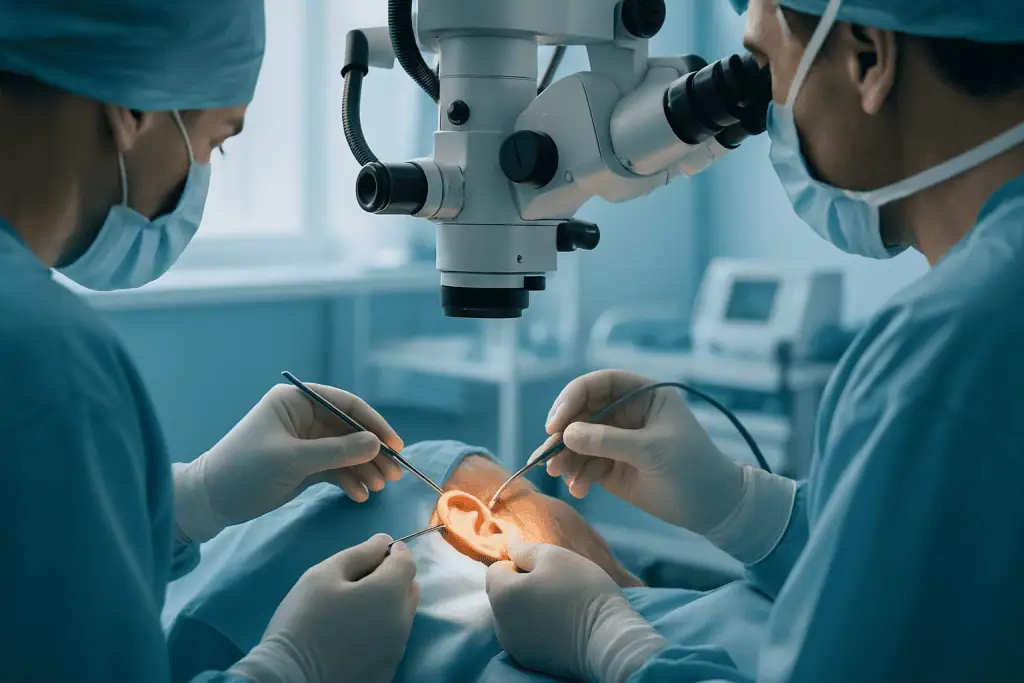
Stapedectomy is a microsurgical ear operation that treats conductive hearing loss caused by a fixed stapes bone, usually due to otosclerosis. Working through the ear canal, the surgeon removes or opens the immobile stapes and places a tiny prosthesis so sound vibrations can reach the inner ear again. The procedure typically takes one to two hours and is usually performed as a day-case or short-stay operation.
What Is Stapedectomy Surgery?
Stapedectomy surgery is a microsurgical operation that replaces a fixed stapes bone with a tiny prosthesis so sound can pass into the inner ear again. It treats conductive hearing loss, most often caused by otosclerosis: a condition in which abnormal bone remodelling stops the stapes from vibrating. The operation is performed through the ear canal, usually leaves no visible external scar, and is typically completed within one to two hours.
The logic of the procedure is mechanical. Your outer ear collects sound, the eardrum vibrates, and three tiny bones, the malleus, incus and stapes, carry that vibration into the fluid-filled inner ear. If the stapes cannot move, the chain is broken. The inner ear may still work well, but the signal never arrives at full strength. Stapedectomy restores movement to that chain. It does not treat problems of the inner ear or the hearing nerve, which is why careful testing before surgery matters far more than the operation’s small physical size might suggest.
You will see several names for the same family of procedures. Stapedectomy, stapes surgery and the common misspelling stapendectomy all refer to operations on this one bone. A closely related technique, stapedotomy, is explained below. Whichever term your surgeon uses in conversation, the goal is identical: to let sound bypass a bone that no longer moves. The operation was developed in the mid-twentieth century and has been refined steadily since, making it one of the longest-established procedures in ear microsurgery.
The stapes bone: the smallest bone in your body
The stapes bone is the smallest bone in the human body. It is shaped like a stirrup, which is why older texts call it the stirrup bone, and it sits deep in the middle ear. Its flat base, the footplate, rests against the oval window, the membrane-covered opening into the inner ear. Every sound you hear crosses this bone on its way to the cochlea. Because the stapes ear bone sits hidden behind an intact eardrum, problems here produce no visible sign at all; your ear can look completely normal to anyone examining it while your hearing steadily worsens.
In otosclerosis, new spongy bone forms around the footplate, most often at the front edge of the oval window. As this abnormal bone matures and hardens, the footplate becomes fixed in place. Sound still reaches the eardrum and travels across the first two hearing bones, but the final, critical transfer into the inner ear fluid becomes inefficient. The result is conductive hearing loss: sound is being blocked mechanically, not lost in the nerve. That distinction is the entire basis for the operation, because a mechanical problem can be given a mechanical solution.
Stapedectomy vs stapedotomy: what is the difference?
Stapedotomy is a refinement of the classic stapedectomy in which the surgeon creates a very small, precise opening in the stapes footplate rather than removing the whole footplate. A piston-shaped prosthesis is passed through that opening and attached to the incus, the neighbouring hearing bone. In a traditional stapedectomy, part or all of the stapes, including the footplate, is removed, the oval window is sealed, and the prosthesis is then positioned across it.
In practice, most modern surgeons use the small-opening technique or a combination of approaches, and many clinics use the two words interchangeably when talking with patients. You do not need to memorise the distinction. What matters is that your surgeon chooses the technique that suits your anatomy on the day, and that the prosthesis re-establishes a moving connection between the incus and the inner ear.
What stapedectomy can and cannot do
Stapedectomy addresses the conductive part of hearing loss: the mechanical blockage. If your inner ear and hearing nerve are healthy, the improvement can be substantial, and many patients find that hearing through their own ear feels more natural than amplified sound through a hearing aid. If the inner ear is also affected, surgery may close the mechanical gap while a sensorineural component remains. Some patients still benefit from a hearing aid afterwards, often at a lower amplification setting than before. An honest consultation sets this expectation before the operation, not after it. Stapedectomy is not the correct treatment for every type of hearing loss, and a good surgeon will say so plainly when it is not.
Who May Need Stapedectomy Surgery?
Stapedectomy is considered for people with a significant conductive hearing loss caused by stapes fixation who still have useful inner ear hearing reserve. The typical patient is an adult who noticed gradual hearing difficulty in one or both ears, often beginning in early to middle adulthood, although the timing varies widely. Otosclerosis can run in families and is more common in some populations. Some women notice worsening during or after pregnancy, which may reflect hormonal influence on the condition.
The pattern of symptoms is often distinctive. Speech becomes hard to follow in background noise. Phones and televisions creep up in volume. People seem to mumble. Conversations that were once effortless leave you tired. Tinnitus, ringing or buzzing in the ear, is common, and some patients describe a sensation of fullness. Significant vertigo is not typical of otosclerosis; when it is present, your physician will look for other causes as well. There is one less obvious clue: some people with otosclerosis hear conversation better in noisy places than expected, because others raise their voices while the background noise is partly blocked by the conductive loss.
How is otosclerosis diagnosed?
Diagnosis rests on hearing tests, not on how the ear looks. In otosclerosis the ear canal and eardrum usually appear normal, which patients often find confusing after months of obvious difficulty. A comprehensive audiological evaluation measures air conduction, sound delivered through the ear canal in the ordinary way, and bone conduction, sound delivered as vibration through the skull directly to the inner ear. It also measures speech discrimination and the overall pattern of loss. The characteristic finding is an air-bone gap: you hear bone-conducted sound better than air-conducted sound, which shows that the inner ear works better than the middle ear can feed it. Tympanometry and acoustic reflex testing add supporting evidence by demonstrating reduced stapes mobility.
When is imaging needed?
High-resolution imaging of the temporal bone is not required for every patient, but it is valuable in selected cases. Your surgeon may request it when the diagnosis is uncertain, when congenital fixation is suspected, when there has been previous ear surgery or trauma, or when another cause of conductive hearing loss needs to be excluded before committing to an operation. Scans can reveal otosclerotic changes around the oval window, ossicular abnormalities, chronic middle ear disease or inner ear conditions that would change the plan entirely. This step matters because several conditions can mimic otosclerosis on a hearing test: fluid behind the eardrum, a break in the ossicular chain, congenital malformations and certain inner ear disorders can all produce a similar air-bone gap yet require completely different treatment.
When surgery is, and is not, the right choice
You may be a candidate for stapedectomy when hearing loss genuinely affects communication and quality of life, test results are consistent with stapes fixation, the eardrum and middle ear are otherwise healthy, and the expected benefit outweighs the risks. Preference matters too. Some people choose hearing aids because they want to avoid an operation, or because they have medical conditions that make surgery or anaesthesia less suitable. Others choose surgery because they want a long-term mechanical solution for the conductive loss, struggle to tolerate hearing aids, or want better unaided hearing for their work and daily life. Neither choice is wrong; they solve the same problem in different ways, and a fair consultation presents both.
Surgery is a poor fit in some situations. If the hearing loss is mild, observation or amplification may be more sensible than an operation on a functioning ear. If the sensorineural component dominates, meaning the inner ear or hearing nerve is significantly affected, stapedectomy has little to offer, and a hearing aid, a bone-conduction hearing device or, in selected severe cases, cochlear implant assessment may be more relevant. In children, conductive hearing loss is far more often caused by middle ear fluid, sometimes managed with procedures such as adenoid surgery, than by otosclerosis. The purpose of consultation is to match the treatment to the exact type and degree of hearing loss, not to apply one solution to every patient.
Does health insurance cover stapedectomy surgery?
Insurers and national health systems generally treat stapedectomy as a medically necessary procedure rather than a cosmetic or elective one, because it addresses documented hearing loss. Actual coverage depends on your specific plan, your deductibles and the setting in which surgery is performed, so confirmation should always come from your insurer before anything is scheduled. The same principle applies in most other countries: national health systems and private insurers usually classify stapes surgery as functional ear surgery, but pre-authorisation rules differ, and anyone considering treatment abroad should clarify reimbursement conditions with their own insurer in advance rather than assuming.
Conditions Treated With Stapes Surgery
The main indication is otosclerosis with fixation of the stapes. The condition may affect one ear or both. When both ears are involved, surgery is planned for one ear at a time, often the poorer-hearing ear, or the ear most appropriate based on testing and your daily needs. The second ear is considered only after the first has healed and the result has proved stable. This staged approach is deliberate: operating on both ears at once would expose both inner ears to surgical risk simultaneously, which no careful surgeon accepts for an operation that is never an emergency.
Less common indications include congenital stapes fixation, where the bone is fixed from birth, and selected cases of ossicular fixation caused by other middle ear conditions. Chronic ear disease is generally treated differently, infection and cholesteatoma may call for procedures such as mastoid surgery rather than stapes surgery, which requires a dry, healthy middle ear to succeed.
Revision stapes surgery is possible for some patients who had a stapedectomy or stapedotomy in the past and later developed recurrent conductive hearing loss. Scar tissue, a displaced prosthesis or erosion of the incus may be responsible. Revision cases are more complex than first-time operations and demand especially careful evaluation, because the anatomy has already been altered and the margin for error is smaller. The operated stapes itself does not become fixed again, it has been replaced, but the condition can progress elsewhere in the temporal bone, and the reconstruction around the prosthesis can change over years, which is why long-term hearing follow-up is sensible even after a good result.
How Stapedectomy Surgery Is Performed
Preoperative evaluation and planning
Preparation begins with a detailed history: your symptoms, hearing timeline, previous ear infections or operations, family history, balance symptoms, medications and general health. Recent audiological testing confirms the pattern of loss and estimates the realistic potential for improvement. The surgeon examines both ears under magnification and discusses whether your anatomy and hearing profile suit stapes surgery, and, just as importantly, what the alternatives would offer you.
Anaesthesia planning follows. Stapedectomy can be performed under local anaesthesia with sedation or under general anaesthesia, depending on your medical condition, your anxiety level, the surgeon’s preference and the operative plan. Local anaesthesia carries one particular advantage: some surgeons can check your hearing response during the operation itself. Your anaesthesiologist reviews your health and current medicines beforehand; any adjustment to medication, including blood thinners and supplements, is a decision for your treating doctors and is made before the day of surgery.
If you are travelling for the operation, preparation also covers timing and documentation. Recent hearing tests, imaging studies, medication lists and any previous ear operation reports are reviewed before arrival, so the surgical decision does not have to be built from scratch on the day. It is wise to plan enough time in one place for evaluation, surgery, early healing and the first follow-up examination, because air travel after ear surgery is timed by the treating physician rather than by the airline schedule.
How long does stapedectomy surgery take?
Stapedectomy commonly takes about one to two hours in the operating theatre. The exact time depends on your anatomy, whether it is a first-time or revision procedure, the technique chosen and any unexpected findings once the middle ear is open. It is usually organised as an outpatient or short-stay operation: most patients return home or to their accommodation the same day or after a brief observation period, once the early effects of anaesthesia and any dizziness have settled.
The operation, step by step
- Access. The team confirms the operative ear, and the ear canal is cleaned and prepared in a sterile manner. The surgeon works entirely through the ear canal under high magnification, so there is normally no external incision and no visible scar afterwards.
- Exposure. A small flap of eardrum and ear canal skin is gently lifted to open a window into the middle ear.
- Confirmation. The surgeon inspects the three hearing bones and checks that the stapes is truly fixed while the malleus and incus move freely. This step is essential: the operative findings must match the preoperative diagnosis before anything is removed.
- Removing or opening the stapes. Using fine micro-instruments, and in many cases a laser or microdrill, the surgeon removes the fixed portion of the stapes or creates a precise small opening in the footplate, depending on the technique chosen for your anatomy.
- Placing the prosthesis. A tiny prosthesis, often a piston made of titanium, fluoroplastic or a shape-memory alloy such as nitinol, is positioned to connect the incus to the oval window region, so that vibration bypasses the fixed bone and reaches the inner ear fluid.
- Closure. The eardrum flap is returned to its original position, and soft packing may be placed in the ear canal to support healing while the flap settles.
Technology used in stapes surgery
Stapes surgery depends on precision rather than scale. Operating microscopes, and in selected cases endoscopic visualisation, give the surgeon a clear view of structures measured in millimetres. Fine micro-instruments allow controlled movement in a very small space. Lasers and microdrills open the footplate with minimal mechanical trauma, which helps protect the delicate inner ear directly beneath it. Prostheses come in a range of designs and lengths, and the final choice is often measured and confirmed during the operation itself rather than beforehand.
Audiological equipment matters just as much before and after surgery as the instruments do during it: documented hearing levels are what justify the decision to operate and what verify, months later, what the operation actually achieved. High-resolution imaging, when indicated, defines the anatomy in advance and flags conditions that would change the approach. The value of any of this technology is not that it is advanced for its own sake; it is that it lets the team plan accurately, disturb as little tissue as possible and measure the result honestly.
The first hours after surgery
Expect the ear to feel blocked. Packing and fluid in the middle ear mute hearing at first, so the immediate result tells you very little about the final one. Mild dizziness, nausea, ear fullness or an altered sense of taste can occur and are usually temporary: the taste change relates to a small nerve, the chorda tympani, that crosses the middle ear and can be irritated during surgery. You are monitored while the anaesthesia wears off, and before you leave, your surgeon explains how the healing period should feel and which symptoms would need prompt medical review.
Why Acting Early Matters
Otosclerosis is rarely an emergency, and you should have time to make this decision without pressure. But delaying evaluation has costs of its own. Untreated hearing loss increases listening effort and fatigue. Meetings, group conversations and noisy restaurants become work rather than pleasure, and some people quietly begin to avoid them altogether. The social and professional weight of hearing loss accumulates gradually, which is exactly why it is so easy to underestimate until it has already reshaped daily habits.
Early assessment also protects you from the wrong diagnosis. Not all conductive hearing loss is otosclerosis. Middle ear fluid, chronic ear disease, eardrum perforation, ossicular discontinuity and congenital abnormalities can produce similar hearing test results yet require entirely different treatment. Establishing the actual cause early prevents wasted time, unnecessary procedures and misplaced expectations.
Finally, otosclerosis can progress. The conductive component may deepen, and in some patients the inner ear becomes involved, producing a mixed hearing loss. Surgery works best when there is a clear mechanical problem and good cochlear reserve. Waiting until the picture has become more complicated can narrow your options or reduce the improvement that can reasonably be expected from any single treatment.
Potential Benefits of Stapedectomy Surgery
For well-selected patients, stapedectomy offers practical, everyday benefits by restoring the mechanical transmission of sound. The table below summarises what those benefits mean in daily life, and notes honestly where results vary from person to person.
| Benefit | What It Means for You |
|---|---|
| Improved conductive hearing | Sound may travel more efficiently from the eardrum to the inner ear, making speech and everyday sounds easier to hear. |
| Reduced dependence on hearing aids | Some patients use hearing aids less often after surgery, although others still benefit from amplification depending on their inner ear hearing. |
| Better speech awareness | Improved hearing levels can make one-to-one conversations, phone calls and meetings less demanding. |
| Possible tinnitus improvement | Some patients notice that ringing or buzzing becomes less intrusive when hearing improves, though the tinnitus response varies. |
| No visible external incision in most cases | The procedure is usually performed through the ear canal, which supports discreet healing and avoids an external scar. |
Recovery After Stapedectomy
Recovery varies by patient, but the timeline below describes what many people can expect after an uncomplicated operation.
| Time Period | What Patients Can Expect |
|---|---|
| Day 1 | Ear fullness, mild discomfort, dizziness or nausea may occur. Patients usually rest and follow pressure precautions closely. |
| First Week | Most light daily activities can gradually resume, but heavy lifting, straining, water exposure to the ear and pressure changes are avoided. |
| First Month | Hearing often begins to improve as packing and swelling resolve. A follow-up examination confirms healing and guides activity restrictions. |
| Longer Term | Hearing levels become more stable over several weeks to months. A postoperative hearing test documents the result and helps plan ongoing care. |
The precautions after stapes surgery exist for one reason: pressure. The freshly reconstructed connection between the incus and the inner ear needs weeks of undisturbed healing, and sudden pressure changes travel straight to it. Until your surgeon lifts the restrictions, the standard advice is to:
- avoid forceful nose blowing;
- sneeze with your mouth open, which releases pressure away from the ears;
- avoid heavy lifting, straining and strenuous exertion;
- keep water out of the operated ear until it has been examined and cleared;
- delay air travel until the treating physician confirms it is appropriate;
- avoid very loud environments while the ear is still settling.
Hearing may fluctuate during the first days and weeks as packing dissolves or is removed and swelling subsides. When sound first comes through, it can seem oddly loud, echoing or tinny for a while; the brain needs time to recalibrate to a level of input it has not received for years. Many patients notice improvement within several weeks, while final stabilisation takes longer. Return to desk-based work is often possible within the first week or two, whereas physically demanding jobs, diving and flying are timed individually by the surgeon.
Follow-up includes examination of the ear and repeat hearing tests once healing allows a meaningful measurement. If you already wear a hearing aid in the other ear, or still need one in the operated ear because of an inner ear component, refitting is arranged after the result has stabilised. If you had surgery away from home, the follow-up plan can usually be continued by an ear, nose and throat physician or audiologist in your own country once the surgical team has documented the early outcome and written a clear handover summary.
Factors That Influence Outcomes
Stapedectomy is a well-established operation with a long record of improving conductive hearing loss in carefully selected patients. Many patients experience a substantial narrowing of the air-bone gap, meaning the mechanical portion of their hearing improves. But outcomes genuinely vary, and no surgeon can promise a specific hearing level in advance. Understanding what drives the variation helps you weigh the decision realistically.
Accuracy of diagnosis. Surgery helps most when the hearing loss is truly caused by stapes fixation and the inner ear retains good potential. Speech discrimination scores, bone conduction levels and the pattern of loss all feed into an honest estimate of benefit before anyone operates. This is why the audiological work-up is not a formality; it is the foundation of the whole decision.
Anatomy. The width of the ear canal, the condition of the eardrum, the position of the facial nerve, the stability of the incus, the thickness of the stapes footplate and any additional middle ear abnormality can all change the complexity of the operation. Some of these factors are visible only once the middle ear is open, which is why your surgeon discusses the possible intraoperative decisions with you in advance rather than improvising silently on the day.
Extent of the disease. When otosclerosis is limited mainly to the stapes, the expected improvement is greater. When the inner ear is significantly involved, the conductive component may improve while a sensorineural loss remains. Surgery can still be worthwhile for selected patients in that situation, but expectations must be set accordingly and stated before consent, not after.
Previous surgery. Revision stapedectomy is technically more demanding than a first operation. Scar tissue, prosthesis displacement, incus erosion or changes around the oval window may be present, and both the predictability and the risk profile differ from primary surgery.
Surgeon experience. The structures involved are among the smallest a surgeon ever handles, and the margin for error is minimal. Familiarity with otologic anatomy, middle ear microsurgery, prosthesis selection and the calm management of unexpected findings all shape results in an operation where fractions of a millimetre matter.
Your part in recovery. Following the instructions about pressure, activity and water exposure protects the healing ear from avoidable stress. General health matters too: conditions affecting wound healing, bleeding, balance or anaesthesia safety are reviewed before surgery, and every question about medicines belongs with your treating doctors.
What are the risks of stapedectomy?
Complications are uncommon, but they are real and you should hear them stated plainly. They include persistent or worsened hearing loss; sensorineural hearing loss, including, rarely, severe loss in the operated ear; dizziness or vertigo, usually temporary; new or altered tinnitus; taste disturbance from irritation of the chorda tympani nerve; eardrum perforation; infection; displacement of the prosthesis, which may require revision surgery; and, very rarely, facial nerve weakness. Because the operation is elective and the alternative of a hearing aid always exists, a balanced consultation weighs these possibilities against the likely benefit for your specific test results, and leaves the final decision with you.
How Acibadem Organises Stapes Surgery
Stapedectomy at Acibadem is carried out within ear, nose and throat departments whose surgeons work across the full range of ear and head-and-neck operations, from chronic ear procedures to surgery such as parotidectomy. The evaluation is deliberately multidisciplinary. Ear, nose and throat physicians, often with a particular focus on otology and ear microsurgery, lead the assessment; audiology teams perform the detailed hearing measurements the decision depends on; radiology supports the diagnosis with high-resolution imaging when it is indicated; and anaesthesiology reviews safety and comfort before the operation. Complex situations, such as revision stapes surgery, mixed hearing loss or an uncertain diagnosis, are discussed between specialties before a recommendation is made.
The pathway is personalised rather than automatic. Some patients are best served by surgery. Others achieve excellent results with hearing aids, or need further evaluation for a different hearing disorder altogether. The recommendation weighs your hearing tests, anatomy, medical history, lifestyle, professional needs and expectations, and it is not unusual for the honest advice to be no operation at all. For a condition that is never an emergency, choosing the correct treatment at the correct time matters more than choosing quickly.
The hospitals use modern diagnostic hearing testing, high-resolution ear imaging where required, operating microscopes, endoscopic visualisation where appropriate, and the fine microsurgical instruments and techniques that help protect the inner ear during stapes procedures. The specific equipment varies by hospital and by case, but the working principle is constant: accurate diagnosis, careful planning and controlled surgical execution, with documented hearing tests before and after.
For patients who travel for treatment, Acibadem’s international patient services handle the practical layer of care: appointment coordination, review and translation of medical records, interpretation during consultations, and communication between the patient and the clinical teams before, during and after the visit. Pre-arrival review of recent hearing tests, imaging and previous operation reports is particularly useful for stapes surgery, because those documents shape the surgical plan. After surgery, follow-up is arranged to check healing, guide the timing of travel and daily activity, and prepare the information a local physician or audiologist will need for ongoing hearing care at home.
A structured evaluation of this kind does not mean every patient is advised to have surgery. It means the diagnosis is verified rather than assumed, the alternatives are explained rather than dismissed, and the decision, whichever way it goes, rests on measured hearing data and your own priorities. For a procedure as delicate as stapedectomy, performed on the smallest bone in the body, that level of care in the decision is worth as much as the operation itself.
Preparation
- Before surgery, an ENT specialist evaluates hearing tests, ear examination findings, and imaging if needed. Patients should share all medications, allergies, and previous ear surgery history. Blood thinners or certain supplements may need to be stopped as advised, and fasting is required before anesthesia.
Aftercare
- Patients should keep the ear dry, avoid nose blowing, heavy lifting, flying, and sudden pressure changes until cleared by the doctor. Mild dizziness, taste changes, or ear fullness can occur temporarily. Follow-up visits and hearing checks are important to monitor healing and prosthesis function.
Frequently Asked Questions
What affects the cost of stapedectomy surgery?
Cost depends on the surgeon’s otology experience, hospital setting, diagnostic hearing tests, prosthesis type, anaesthesia, whether revision surgery is needed and what follow-up care is included. A personalised quote can be prepared after specialist review.
How can I get a personalised quote from Acibadem?
You can request a free consultation by sharing your hearing test results, ENT reports and any previous ear surgery history. The medical team can then advise whether further tests are needed and prepare a case-based estimate.
Does a package usually include all tests and follow-up?
Package content varies by patient and provider. It may include consultation, audiology tests, surgery, anaesthesia, hospital services and planned follow-up, but you should confirm inclusions before travel.
Why might revision stapes surgery cost more than primary surgery?
Revision surgery can require more complex planning, longer specialist assessment and different operative resources because of scar tissue, prosthesis position or changes from a previous procedure.
Is travelling for stapedectomy safe for international patients?
Travel planning should be discussed with the treating specialist because timing depends on the ear examination, surgery plan and recovery needs. International patient teams can help coordinate appointments, language support and follow-up arrangements.
Medically reviewed by the Acıbadem International Medical Board September 13, 2026
See our medical review board →
Update history
- PublishedJune 8, 2026
- Medical review approvedSeptember 13, 2026
- Last content updateSeptember 12, 2026
Trusted care for international patients
From the Acibadem Blog

Flying and Pressure Changes After Stapedectomy Surgery: What International Patients Ask
Most surgeons ask patients to avoid flying after stapedectomy for a period of weeks, not days, because cabin pressure changes stress the healing eardrum…

Otosclerosis and Stapedectomy Surgery: How Does a Fixed Stapes Bone Cause Hearing Loss?
Otosclerosis is abnormal bone remodeling in the middle ear that gradually freezes the stapes, the smallest bone in the body, so it can no…