

Female Pattern Hair Loss: Causes, Testing, and Treatment

Female pattern hair loss usually causes gradual thinning on the top and crown of the scalp while the front hairline is often preserved. Diagnosis is mainly clinical, but blood tests may be recommended to check for thyroid disease, iron deficiency, hormonal imbalance, or other contributors.
Key Takeaways
- Female pattern hair loss usually causes gradual thinning on the top and crown of the scalp while the front hairline is often preserved.
- Diagnosis is mainly clinical, but blood tests may be recommended to check for thyroid disease, iron deficiency, hormonal imbalance, or other contributors.
- Topical minoxidil is a well-established treatment; oral medications, procedures, and supportive therapies may be considered depending on the individual case.
- Treatment takes time: visible improvement commonly requires several months of consistent use and ongoing maintenance.
- Sudden shedding, scalp pain, patchy hair loss, or signs of excess androgens should be assessed by a dermatologist or qualified doctor.
Female pattern hair loss is a common, gradual form of hair thinning in women that often shows as a widening part or reduced hair density on the crown. With careful evaluation and consistent treatment, many women can slow progression, improve scalp coverage, and manage contributing factors.
Overview
Female pattern hair loss, also called androgenetic alopecia in women, is a long-term condition in which hair follicles gradually produce thinner, shorter hairs. It is not the same as temporary shedding after illness, childbirth, major stress, or nutritional change, although these issues can occur at the same time and make thinning more noticeable.
The typical pattern is a widening part line and reduced volume over the top of the scalp or crown. Many women keep their frontal hairline, which can make the condition less obvious at first. Because the change is gradual, a person may notice more scalp visibility in photos, less hair in a ponytail, or the need to style hair differently before recognizing a medical pattern.
Female pattern hair loss is common and can affect emotional well-being, self-confidence, and daily routines. It is also manageable. Early assessment helps confirm the diagnosis, identify treatable contributors, and choose therapies that fit the person’s health status, reproductive plans, and preferences.
Symptoms and How It Appears
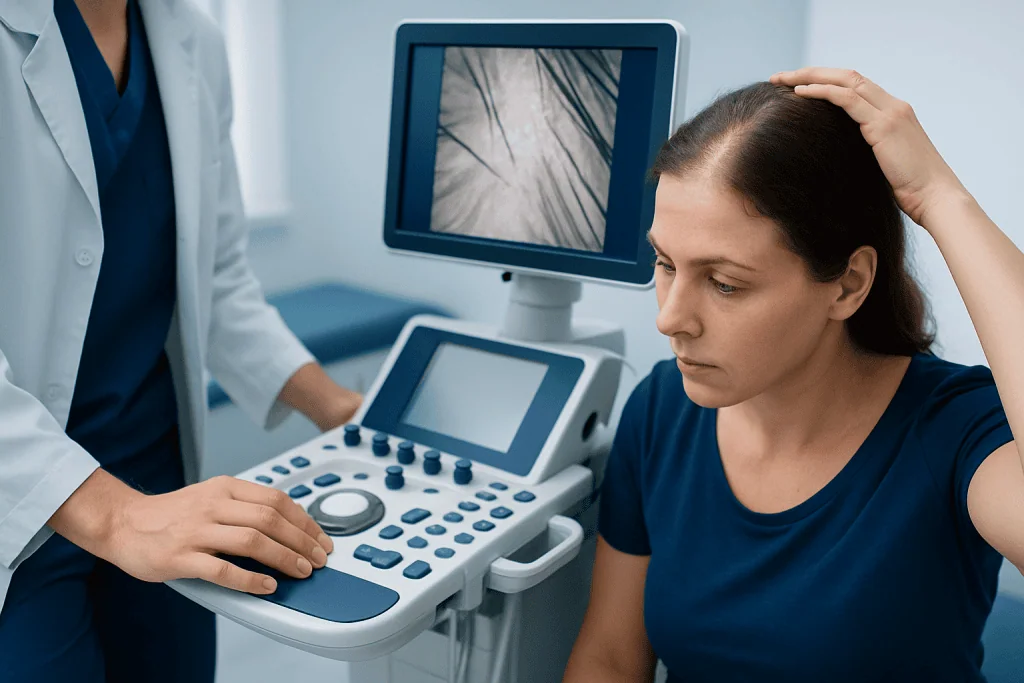
The main symptom is progressive thinning rather than complete bald patches. Hair may look less dense over the central scalp, the part may become wider, and the crown may appear more visible under bright light. Some women describe that hair styling takes longer because there is less volume or coverage.
Shedding may be mild, moderate, or variable. In female pattern hair loss, the underlying issue is follicle miniaturization: individual hairs become finer over time. A person can have normal daily shedding but still lose density because the replacement hairs are smaller and shorter.
Doctors often describe the pattern using visual scales, such as the Ludwig or Sinclair scale, to follow progression over time. Features that may suggest another condition include round patches, broken hairs, scaling, redness, burning, pain, pustules, or scarring. These findings need careful examination because they may require different treatment.
Causes and Risk Factors

Female pattern hair loss is influenced by genetics, age, and the sensitivity of hair follicles to androgens, which are hormones present in all women. Unlike some male hair loss patterns, many women with female pattern hair loss have normal blood androgen levels. The follicles may simply be more responsive to hormonal signals, leading to gradual miniaturization.
Risk increases with family history and can become more noticeable after menopause, although it may begin earlier. Hormonal conditions such as polycystic ovary syndrome may contribute in some women, especially when hair thinning is accompanied by acne, irregular periods, or increased facial or body hair.
Other factors can worsen or mimic female pattern hair loss. These include thyroid disease, iron deficiency, low protein intake, restrictive dieting, significant weight changes, vitamin or mineral deficiencies, certain medications, postpartum shedding, chronic illness, inflammatory scalp disorders, and traction from tight hairstyles. Identifying these contributors is important because correcting them can improve shedding and support treatment results.
- Family history of similar hair thinning
- Menopause or hormonal changes
- Signs of excess androgens, such as acne or irregular periods
- Low iron stores, thyroid imbalance, or nutritional deficiency
- Hairstyles that pull tightly on the scalp over time
Diagnosis and Hair Loss Testing
A dermatologist usually begins with a medical history and scalp examination. The doctor may ask when thinning started, whether shedding is sudden or gradual, what medications or supplements are used, whether menstrual cycles are regular, and whether there has been childbirth, illness, surgery, stress, dieting, or weight loss in recent months.
Examination may include a hair pull test, part-width assessment, and dermoscopy or trichoscopy, which uses magnification to view hair shaft thickness, follicle openings, and scalp signs. In female pattern hair loss, doctors often see variation in hair shaft diameter, with many fine miniaturized hairs among thicker hairs.
Blood tests are not needed for every person, but they are often useful when shedding is increased, the diagnosis is uncertain, or symptoms suggest an underlying issue. Common tests may include a complete blood count, ferritin or iron studies, thyroid-stimulating hormone, vitamin D or other nutritional markers when appropriate, and androgen tests if there are signs of hormonal excess. A scalp biopsy is uncommon but may be recommended when scarring alopecia, inflammatory disease, or another diagnosis is suspected.
Treatment Options
Treatment aims to slow further miniaturization, reduce shedding when possible, and improve hair density over time. The most established first-line treatment for many women is topical minoxidil, available as a solution or foam. It can help prolong the growth phase of hair follicles, but it must be used consistently and usually takes several months to show visible benefit. Some people notice temporary increased shedding early in treatment as follicles shift into a new growth cycle.
For selected patients, doctors may discuss prescription options such as low-dose oral minoxidil or anti-androgen medications. These treatments are not suitable for everyone and require medical supervision, especially for people with heart or blood pressure conditions, kidney issues, pregnancy plans, or the possibility of becoming pregnant. Some hormonal medications are avoided during pregnancy because of potential risks to a developing baby.
Procedural and device-based treatments may be considered as part of a broader plan. Platelet-rich plasma therapy, low-level laser therapy, and hair transplantation can help selected patients, but results vary and depend on the pattern, donor hair quality, and whether the hair loss is stable. Treating iron deficiency, thyroid disease, scalp inflammation, or nutritional problems is also important when present, as these factors can limit response to hair-specific therapies.
Realistic expectations help treatment feel more manageable. Most therapies require ongoing maintenance; stopping treatment may allow hair thinning to gradually return to its previous course. Follow-up photos taken under similar lighting can be useful because early improvement is often subtle.
Prevention and Self-Care
Not all female pattern hair loss can be prevented, particularly when genetics play a strong role. However, supportive habits can protect existing hair, reduce breakage, and help the scalp stay healthy. Gentle hair care is especially helpful when the hair shaft is fine or density is reduced.
Women are often advised to avoid tight hairstyles that pull on the hairline or crown, such as very tight buns, braids, ponytails, or extensions. Heat styling, bleaching, and harsh chemical treatments can increase breakage, making thinning look worse even when follicles are stable. Using a mild shampoo, conditioner, wide-tooth comb, and lower heat settings can reduce damage.
Nutrition also matters. Hair follicles need adequate protein, iron, zinc, essential fatty acids, and overall energy intake. Supplements should be used thoughtfully, because more is not always better and some supplements can interact with medications or affect lab tests. A doctor or dietitian can help identify whether testing or targeted replacement is appropriate.
- Use gentle detangling and avoid pulling on wet hair.
- Protect the scalp from sun exposure where hair is thin.
- Choose loose hairstyles and limit heavy extensions.
- Seek advice before starting multiple supplements.
- Track changes with photos rather than daily hair counts.
When to See a Doctor
A medical evaluation is recommended when hair thinning is progressive, distressing, or unclear. Early care is useful because treatments are generally more effective at preserving existing follicles than restoring long-standing severe thinning. A dermatologist can distinguish female pattern hair loss from telogen effluvium, alopecia areata, traction alopecia, scarring alopecia, scalp infections, and inflammatory conditions.
Prompt assessment is especially important if hair loss is sudden, patchy, painful, itchy, associated with redness or scaling, or accompanied by symptoms such as fatigue, unintended weight change, irregular periods, acne, or increased facial hair. These clues may point to an underlying medical condition that needs specific treatment.
Patients who travel for care may benefit from coordinated dermatology, endocrinology, gynecology, nutrition, and hair restoration expertise when needed. Acibadem International’s multidisciplinary specialists and JCI-accredited hospitals diagnose and treat hair and scalp conditions for international patients, with care plans tailored to the individual’s diagnosis and health history.
Frequently asked questions
Is female pattern hair loss permanent?
Female pattern hair loss is usually a chronic condition, meaning it tends to progress gradually without treatment. However, treatment can often slow progression and improve visible density. The earlier it is recognized, the more existing hair can usually be preserved.
How is female pattern hair loss different from shedding?
Temporary shedding, called telogen effluvium, often starts after illness, childbirth, stress, weight loss, or medication changes and may improve when the trigger resolves. Female pattern hair loss is more gradual and involves miniaturization of follicles, causing hairs to become finer over time. Some women have both conditions at once, which is why evaluation can be helpful.
What blood tests are commonly done for women with hair loss?
Testing depends on the history and examination. Doctors may check a complete blood count, iron stores such as ferritin, thyroid function, vitamin D or other nutritional markers, and hormone tests if there are signs of excess androgens. Not every patient needs every test.
Does minoxidil work for women?
Topical minoxidil is one of the best-established treatments for female pattern hair loss. It may reduce shedding and improve hair density when used consistently, but results take time and maintenance is usually needed. A doctor can advise which formulation is appropriate and how to manage irritation or early shedding.
Can diet or supplements reverse female pattern hair loss?
A balanced diet supports healthy hair growth, and correcting a true deficiency can improve shedding. However, supplements do not usually reverse genetic female pattern hair loss on their own. Testing is useful before taking high-dose supplements, because unnecessary supplementation may be ineffective or harmful.
When should hair transplant be considered?
Hair transplantation may be an option for selected women with stable hair loss and adequate donor hair. It is usually considered after a clear diagnosis and after medical treatments have been discussed or tried. A specialist assessment is important because diffuse thinning can limit transplant suitability.
References
- American Academy of Dermatology Association
- British Association of Dermatologists
- DermNet New Zealand
- European Dermatology Forum
- National Institute for Health and Care Excellence
This article is for general information only and is not a substitute for professional medical advice. Please consult a qualified doctor about your individual situation.
Hair transplant in Turkey — costs, graft counts & a free assessment
JCI-accredited · board-certified surgeons · reply within 24h
Add us as a Preferred Source to see more of our trusted health content across Google Search, AI Overviews and Discover.
Check your numbers in seconds
BMI, calories, due date, blood pressure and 30+ more clinical calculators — free, instant, doctor-reviewed ranges.

Related Treatments
Related Conditions
More from the Health Library



Related Specialists

Prof. Dr. Sedef Şahin
Dermatology
Prof. Dr. Şükrü Yazar
Aesthetic Plastic & Reconstructive Surgery
Prof. Dr. Emel Öztürk Durmaz
Dermatology
Prof. Dr. Özlem Dicle
Dermatology