ILASIK
ILASIK is a blade-free laser vision correction procedure used to reduce dependence on glasses or contact lenses for eligible patients with refractive errors.
Quick answer
ILASIK is a blade-free form of LASIK eye surgery. A femtosecond laser creates a thin corneal flap without a blade, then an excimer laser reshapes the cornea underneath to correct nearsightedness, farsightedness or astigmatism. Treatment is planned from detailed measurements of each eye, takes minutes per eye under anaesthetic drops, and many patients notice clearer vision within a day or two.
What Is ILASIK?
ILASIK is a blade-free form of laser vision correction. It treats refractive errors, nearsightedness, farsightedness and astigmatism, by reshaping the cornea, the clear front surface of the eye, so that light focuses more accurately on the retina. It is intended for adults whose prescription has been stable for a meaningful period, whose eyes are otherwise healthy, and who want to depend less on glasses or contact lenses in daily life.
Most people begin their research locally, comparing the practices closest to home, and the same pattern repeats everywhere in the world. Wherever your research started, the questions that actually matter are identical: is your eye suitable, how is the procedure done, what does recovery involve, what can go wrong, and what determines the price.
You will also run into confusing terminology. Some people type lysic surgery when they mean LASIK; others see brand names like iLASIK, all-laser LASIK or bladeless LASIK and assume these are different operations. They are not. They all describe the same family of corneal laser procedures, distinguished mainly by how the corneal flap is created and how the treatment is planned. This page explains ILASIK specifically, because the technical differences do matter, for precision, for candidacy and for cost.
Two things ILASIK does not do are worth stating early. It does not place an implant in the eye, and it does not treat the lens or retina: it works only on the cornea. And it does not stop the eye from ageing. People in their 40s and beyond may still need reading glasses because of presbyopia, the normal age-related loss of near focusing ability. A good clinic tells you this before surgery, not after.
How does ILASIK work?
ILASIK works by changing the curvature of the cornea in two laser stages: a femtosecond laser creates a thin flap in the corneal surface, and an excimer laser then removes microscopic amounts of tissue from the layer underneath, according to a treatment plan built from your eye’s measurements. When the flap is laid back into place, the new corneal shape bends light differently, so images focus on the retina rather than in front of or behind it.
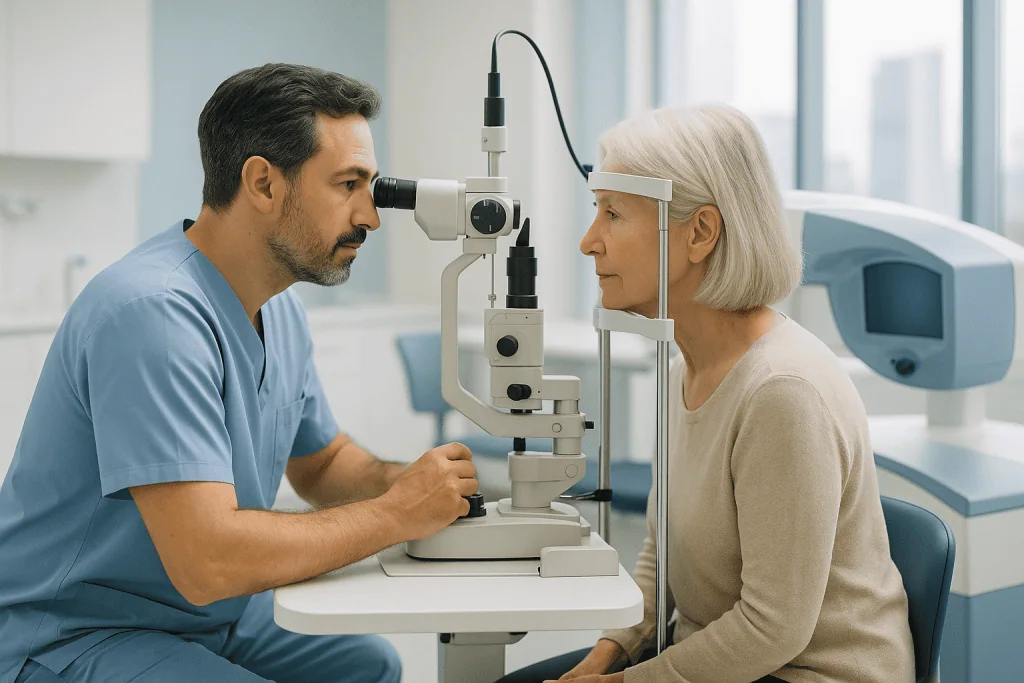
The planning stage is what separates a careful treatment from a generic one. Before any laser is used, your eye is measured in detail: corneal mapping (topography and tomography), corneal thickness, wavefront analysis of the eye’s fine optical imperfections, and pupil size. These measurements capture more than the prescription written on a standard eye test. They describe the individual optical character of your eye: the features that influence night vision, glare, halos and contrast sensitivity. Customised planning aims to correct the prescription without degrading these subtler qualities of vision.
What is the difference between ILASIK and standard LASIK?
The difference lies in how the corneal flap is made and how thoroughly the treatment is personalised. In conventional LASIK, a mechanical instrument called a microkeratome, essentially a very fine oscillating blade, creates the flap. In ILASIK, a femtosecond laser creates the flap instead, delivering rapid pulses at a precise, pre-programmed depth within the cornea. No blade touches the eye.
Laser flap creation allows the surgeon to control the flap’s depth, diameter and edge profile with a level of consistency a mechanical device cannot match. ILASIK protocols also typically pair this with wavefront-guided or otherwise customised excimer treatment, so the reshaping stage reflects your eye’s measured optics rather than the prescription alone. The excimer reshaping itself, the part that actually corrects your vision, is common to both approaches.
Who Is a Suitable Candidate for ILASIK?
Typical candidates are adults with a stable glasses or contact lens prescription, healthy corneas of adequate thickness, and a healthy tear film. Most are people who can see well with correction but have grown tired of it: lenses that dry out during long screen days, glasses that get in the way of sport or travel, or simply the wish to wake up and see clearly without reaching for anything.
Candidacy is decided by an evaluation that goes well beyond a routine glasses check. Your ophthalmology team reviews your medical and eye history, current medications, contact lens use, previous eye infections or injuries, and any symptoms such as dryness, glare or fluctuating vision. You will usually be asked to stop wearing contact lenses for a period before measurements, because lenses temporarily mould the corneal surface and can distort the readings the treatment plan depends on, soft and rigid lenses need different lens-free periods.
Diagnostic testing then measures your refractive error, corneal thickness, corneal curvature and overall corneal shape. Topography and tomography scans look for irregularities, including early signs of corneal weakness or keratoconus, which change the risk calculation entirely. The tear film is assessed, because untreated dry eye affects both measurement accuracy and comfort after surgery. Pupil measurements, a retinal examination and eye pressure checks may round out the assessment. On the strength of all of this, the team decides whether ILASIK is appropriate, or whether a surface laser treatment, a phakic intraocular lens, or simply continuing with glasses or contacts would serve you better.
That last point deserves emphasis. Because ILASIK is elective, a responsible recommendation sometimes means advising against it, or delaying until the eye surface and measurements are more reliable. A clinic that treats every enquiry as a candidate is not doing the selection work that keeps this procedure safe. This holds true wherever you are: the screening standard should not change with geography.
What disqualifies you for LASIK?
The main disqualifying factors are an unstable prescription, corneas that are too thin or irregularly shaped, keratoconus or suspected corneal weakness, untreated severe dry eye, active eye inflammation or infection, and certain uncontrolled systemic diseases that affect healing. Some of these are absolute: a cornea showing signs of keratoconus should not have tissue removed from it. Others are temporary: dry eye can often be treated first, an unstable prescription can be monitored until it settles, and pregnancy or breastfeeding, which can temporarily shift vision, usually means postponement rather than refusal.
Age-related lens changes matter too. If early cataract is developing, reshaping the cornea makes little sense, because the lens will need attention anyway and lens-based surgery can correct the refractive error at the same time. This is one reason the pre-operative examination looks at the whole eye, not just the cornea.
Is it worth getting LASIK after 40?
It can be, provided you understand what laser correction will and will not do at that age. ILASIK corrects the distance prescription; it does not stop presbyopia, the stiffening of the eye’s natural lens that makes near focus harder from the mid-40s onward. A 45-year-old with corrected distance vision will still, in time, need reading support, exactly as a 45-year-old with naturally good distance vision does.
For some patients over 40, a monovision or blended vision strategy is discussed: one eye is adjusted more for distance, the other more for near tasks. This suits some people well and others not at all: it affects depth perception, and tolerance varies. It should usually be trialled with contact lenses before surgery so you experience the compromise before committing to it. The right answer depends on your occupation, your visual priorities and, frankly, your temperament; there is no universal recommendation for this age group.
Conditions ILASIK Treats
ILASIK is used to treat the three common refractive errors in patients who meet the safety and anatomical criteria: myopia, hyperopia and astigmatism. In myopia, nearsightedness, the eye focuses images in front of the retina rather than on it, so distant objects blur. In hyperopia, farsightedness, light tends to focus behind the retina, causing near blur, eye fatigue and sometimes distance blur as well. In astigmatism, uneven corneal curvature focuses light at more than one point, producing distortion, ghosting or shadowed vision at multiple distances. Many patients have astigmatism combined with one of the other two, and the treatment plan corrects both together.
The indication, though, is rarely the prescription alone. It is the mismatch between correction and lifestyle. Frequent travellers, athletes, people in physically demanding or visually demanding jobs, and long-hours screen workers whose contact lenses have become intolerable through dryness or allergy: these are the situations that typically bring people to a consultation. Some patients simply want fewer moving parts in their morning routine, while accepting that reading glasses may still arrive later in life.
Equally important is what ILASIK does not treat. It is not a treatment for cataracts, glaucoma, retinal disease or neurological causes of vision loss, and it does not slow natural eye ageing. If the examination finds one of these conditions, that condition takes priority, and a different treatment pathway may be more appropriate. This is precisely why the full eye examination comes before any decision about laser correction: the laser answers one question, and the examination has to make sure it is the right question.
How ILASIK Is Performed, Step by Step
The procedure really begins days or weeks earlier, with the pre-operative assessment described above. If dry eye, blepharitis or allergy is found, treating it first improves measurement reliability and post-operative comfort. You will receive practical instructions covering the lens-free period before measurements, eye drops, medication review with your treating doctor, and timing. On the day itself you are usually asked to avoid eye makeup, creams and perfumes near the eyes, and you should not plan to drive afterwards, because vision is blurred in the first hours.
On the day of surgery, the sequence is straightforward:
- Numbing and positioning. Anaesthetic drops numb the surface of the eye. You remain awake throughout. A small instrument holds the eyelids open, so blinking is not something you need to manage yourself.
- Flap creation. The femtosecond laser delivers rapid pulses at a precise depth within the cornea, forming a thin flap without a blade. You may feel pressure at this stage; the surgical team talks you through it.
- Flap lift. The surgeon gently lifts the flap to expose the corneal tissue beneath.
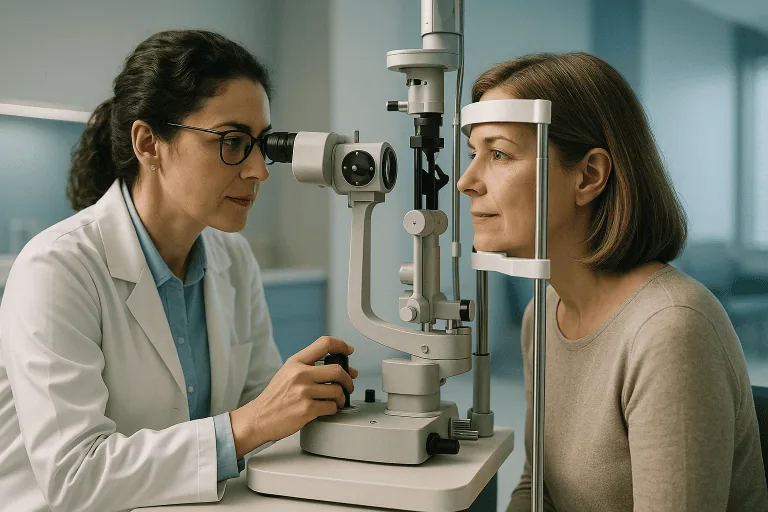
- Reshaping. The excimer laser removes microscopic amounts of tissue according to your customised treatment plan while you look toward a target light. An eye-tracking system follows small eye movements and keeps the laser aligned.
- Repositioning. The flap is laid back into place, where it adheres naturally. No stitches are needed.
The laser portion of treatment is brief: the whole visit takes far longer than the lasers do, because of preparation and the checks afterwards. Both eyes are commonly treated on the same day when appropriate. Afterwards you rest briefly, the eye is examined, and you leave with prescribed drops, protective measures such as shields for sleeping, and a follow-up schedule.
What technology does ILASIK use?
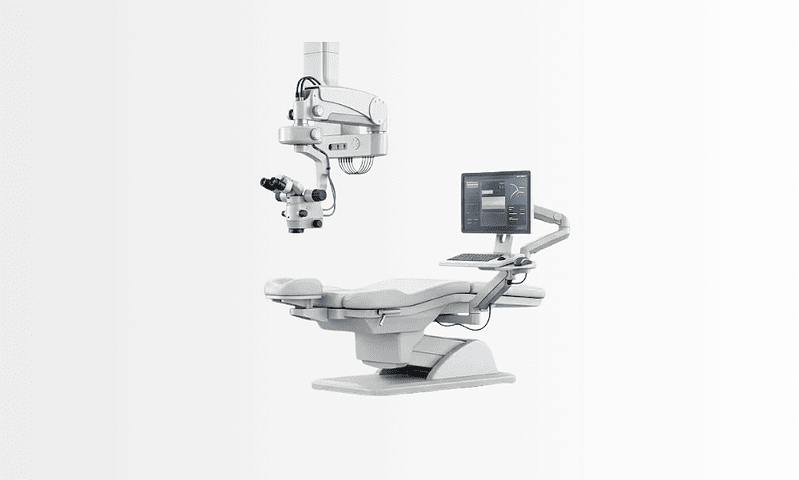
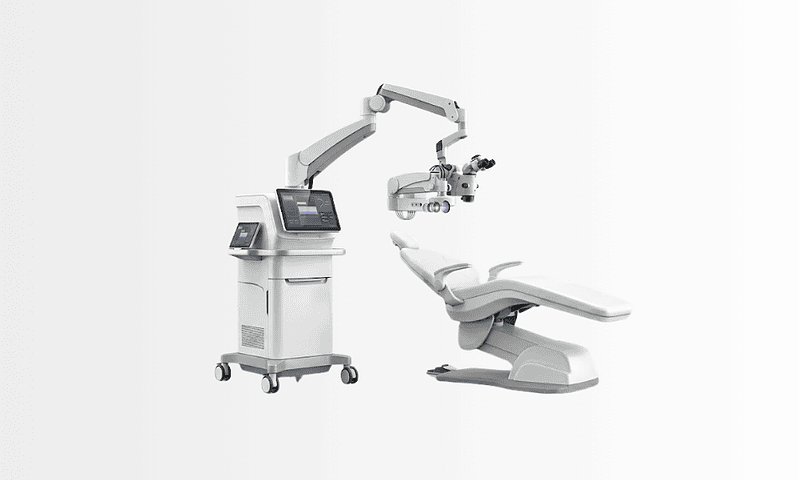
ILASIK combines several systems, each with a distinct job. Corneal imaging maps the shape and internal structure of the cornea. Wavefront analysis measures the eye’s fine optical imperfections beyond the standard prescription. The femtosecond laser creates the flap at a controlled depth and diameter; the excimer laser performs the actual reshaping; and eye-tracking keeps delivery aligned with the eye in real time. The honest framing is this: the technology supports precision, but it does not replace judgement. The most important decisions, whether to operate at all, and on what plan, are made by the surgeon reading the diagnostics, not by the machines.
Recovery After ILASIK
How long does it take to recover from ILASIK?
Basic daily function typically returns within days, while vision settles fully over weeks to months. Many patients notice a clear improvement within the first day or two, though early vision commonly fluctuates. Mild burning, watering, light sensitivity and a gritty sensation are normal in the first hours. Most people return to desk work and non-strenuous activities quickly, depending on comfort and their surgeon’s advice.
| Time period | What to expect |
|---|---|
| Day 1 | Blurred or hazy vision, watering, light sensitivity and a gritty sensation are common. A follow-up examination is usually scheduled to check early healing. |
| First week | Vision usually becomes clearer, with fluctuations. Prescribed drops are used as directed. No eye rubbing, swimming or dusty environments. |
| First month | Most routine activities resume. Dryness, glare or halos tend to ease gradually. Follow-up visits assess visual stability and the eye surface. |
| Longer term | Vision typically stabilises over weeks to months. Some patients keep glasses for specific tasks such as night driving, and age-related near vision changes still develop over time. |
The aftercare rules are the same everywhere, whether you have the procedure close to home or at a hospital abroad. Avoid rubbing the eyes, especially early on, because the flap is still settling. Postpone swimming, contact sports, heavy eye makeup and dusty environments for the period your surgeon defines. Use the prescribed drops exactly as directed: they reduce inflammation, lower infection risk and keep the healing surface comfortable. Attend every follow-up visit, even when vision already feels good; the examinations confirm what feeling cannot. Your surgeon will explain which symptoms would need a review outside the scheduled visits.
If your plans involve air travel soon after treatment, cabin air is worth factoring in: it is dry, and a freshly treated eye is prone to dryness anyway. Our guide to flying after eye surgery compares LASIK with retinal laser and cataract procedures and explains what to plan for on the flight home.
Benefits of ILASIK
For suitable candidates, ILASIK offers practical advantages. Keep expectations individual, though: the benefits below describe what the procedure is designed to deliver, and your own assessment determines how far they apply to your eyes.
| Benefit | What it means for you |
|---|---|
| Reduced dependence on glasses or contact lenses | Many patients manage daily activities with less need for corrective eyewear, especially for distance vision. |
| Blade-free flap creation | The corneal flap is created with a femtosecond laser at a controlled depth and shape, without a mechanical blade. |
| Personalised treatment planning | Detailed measurements tailor the correction to your prescription, corneal anatomy and the fine optical character of your eye. |
| Rapid functional recovery for many patients | Vision often improves quickly, and routine non-strenuous activities usually resume after early follow-up, with medical guidance. |
| No implanted lens or corneal stitches | The procedure reshapes the cornea without placing a device inside the eye, and the flap adheres naturally. |
Risks, Limitations and What Shapes a Good Result
The single biggest factor in ILASIK outcomes is patient selection. Someone with stable vision, healthy eyes, adequate corneal thickness and a regular corneal shape is a fundamentally better candidate than someone with a shifting prescription, significant dry eye or early corneal weakness. Screening is not a formality; it is the safety mechanism.
Prescription level matters as well. Mild to moderate refractive errors tend to behave more predictably than very high corrections, though eligibility always rests on the whole anatomical picture, not the prescription alone. Corneal thickness sets a hard limit on how much tissue can be safely reshaped, and topography has to confirm the cornea’s pattern is regular before any tissue is removed.
The ocular surface deserves its own mention. Dry eye distorts pre-operative measurements and undermines post-operative comfort, so it may need treating before surgery, lubrication, eyelid care or anti-inflammatory therapy, depending on the cause. Screen habits, climate, air travel and years of contact lens wear all feed into it. For patients travelling for treatment, this is doubly relevant: flights and a change of environment can temporarily worsen dryness at exactly the point the eye is healing.
Healing itself varies from person to person. Temporary glare, halos, dryness and visual fluctuation are common early on and usually improve with time and treatment, but in some patients they persist. Undercorrection or overcorrection can occur; an enhancement procedure may be considered, but only once vision has stabilised and only if the cornea remains suitable. Rare complications include infection, inflammation, flap-related problems and corneal ectasia, a progressive weakening and bulging of the cornea. These are uncommon in carefully screened patients, which is another way of saying the screening is where most of the risk is managed.
Your own behaviour during recovery is part of the equation. Correct drop use, kept follow-up appointments, no eye rubbing and respected activity restrictions all protect the healing flap. And a good result is broader than reading a particular line on a chart: it includes comfort, quality of vision at night, stable focusing, satisfaction in daily activities and expectations that matched reality from the start. Some patients still choose glasses for night driving, long screen sessions or fine detail work, and consider the surgery a success anyway.
What happens 10 years after LASIK?
For most well-selected patients, the corneal reshaping itself is lasting: the tissue removed does not grow back, so the correction made to the cornea endures. What changes over a decade is the rest of the eye. Presbyopia progresses through the 40s and 50s, so near vision typically needs support regardless of any earlier laser treatment. The natural lens continues to age and may eventually develop cataract, which is treated in its own right and is not caused by LASIK. In some patients the prescription drifts slightly over the years, particularly if it was not fully stable at the time of surgery, one more reason stability is a firm pre-condition. Routine eye examinations remain worthwhile after laser correction, exactly as they are for everyone else.
ILASIK Cost: What Determines the Price
How much does ILASIK surgery cost?
There is no single honest number, because ILASIK cost is built from several components that vary between clinics and countries. If you have been comparing clinic price listings at home against clinics elsewhere, you will already have noticed how widely quotes range, and the range is explained by what each quote actually contains. The main drivers are:
- Technology. Femtosecond flap creation and wavefront-customised planning involve more equipment and more diagnostic work than conventional LASIK, which is generally reflected in the price.
- Diagnostics. A thorough candidacy work-up, topography, tomography, wavefront analysis, tear film assessment, takes time and equipment. Some quotes include it; others bill it separately.
- Surgeon and institution. Experience, and whether the procedure is performed in a full hospital setting with access to other specialties, both influence pricing.
- What the quote covers. Follow-up visits, prescribed drops and any later enhancement procedure may be included or excluded. Two quotes with different headline figures can describe very different packages.
- Both eyes or one. Some clinics quote per eye; most patients treat both. Always confirm which basis a quote uses.
When you compare offers, compare the contents, not just the totals. Our guide Why Did My Eye Surgery Quote Cost So Much? breaks down what sits inside an eye surgery quotation. And if you are considering treatment away from home, remember that the procedure price is only part of the picture: accommodation across the follow-up period, travel timing and the cost of returning for checks all belong in the same calculation as the quote itself.
Will insurance cover LASIK eye surgery?
Usually not, because ILASIK and LASIK are classed as elective procedures, glasses and contact lenses already correct the underlying refractive error, so most health insurers treat laser correction as a lifestyle choice rather than a medical necessity. Some insurers or employer benefit schemes offer partial discounts or allow the use of health savings arrangements, and policies differ between countries and plans, so the terms of your own policy are the only reliable answer. Budget on the assumption that you will pay yourself, and treat any coverage as a bonus.
Why the Timing of Your Evaluation Matters
ILASIK is elective, so there is no emergency clock running: this is not a cataract, an infection or a retinal detachment. But an early evaluation still has real value. It gives your ophthalmologist time to find and address the issues that affect eligibility: dry eye that needs treating, a corneal irregularity that needs monitoring, a prescription that has not yet settled. Several of these can be resolved or clarified before a final decision, rather than discovered on the day they block one.
Waiting has its own costs. Long-term contact lens wear can contribute to dryness, allergy-related inflammation and corneal surface changes that themselves need treatment before laser correction can be considered, meaning the lenses you are trying to escape can gradually complicate the escape route. If your prescription is still changing, waiting is the right call; but monitored waiting, with periodic measurements, tells you when stability has actually arrived instead of leaving it to guesswork.
Age changes the calculation at both ends. Younger adults need demonstrated stability before anything is done. Patients approaching their 40s should understand presbyopia before surgery, not after. Older patients may have early lens changes that make a corneal procedure the wrong tool altogether. An early assessment matches the treatment to the current stage of your eye, rather than to convenience.
Equally: do not rush. Proceeding without a thorough evaluation is how avoidable problems happen, undercorrection, overcorrection, persistent glare or halos, prolonged dryness, visual fluctuation and, rarely, corneal instability. The diagnostic pathway exists to identify the patients who should have a different procedure, or should wait. Skipping it to save a week is a poor trade.
How Acibadem Approaches ILASIK
Acibadem’s ophthalmology teams treat candidacy assessment as the core of the ILASIK pathway, not a preliminary. The evaluation asks two separate questions: whether laser correction is possible for your eyes, and whether it is the appropriate choice, and when the findings point toward a different option, that becomes part of the discussion rather than a footnote. Corneal imaging, thickness measurement, refraction analysis, ocular surface evaluation and customised planning tools give the ophthalmologist a detailed picture of each eye’s optics and structure; the emphasis is on matching the technology to medical judgement rather than treating every patient the same way.
Patients with more complex eye histories benefit from working within a hospital system. Some need evaluation for cataract, retinal disease, glaucoma, corneal disease or diabetes-related eye changes before a decision about laser correction can responsibly be made, and some have systemic conditions that influence healing. Access to specialist consultation across departments: the same structure that supports fields from general surgery to more specialised disciplines, allows those questions to be answered within one clinical pathway.
Planning is also personal. A frequent traveller, a long-hours screen worker, a pilot, an athlete and a photographer each carry different visual demands into the consultation, and the ophthalmologist weighs those demands alongside the objective measurements. A proper pre-operative discussion covers expected benefits, limitations, alternatives, recovery planning, and the plain possibility that glasses may still be useful for certain tasks afterwards. That candour is not pessimism; it is what informed consent is supposed to look like.
Questions Worth Settling Before You Decide
ILASIK can be an effective option for eligible patients who want to depend less on glasses or contact lenses. Whether it is the right option for you comes down to a short list of questions that only a comprehensive evaluation can answer:
- Has your prescription been stable long enough to treat?
- Is your cornea thick enough, and regular enough, for tissue to be safely removed?
- Is your eye surface healthy, or does dry eye need treating first?
- Do your expectations match what the procedure can honestly deliver at your age, including the likelihood of reading glasses later?
- Is ILASIK the best-fitting procedure, or would a surface laser treatment or a lens-based option serve your eyes better?
- Does the quote you are comparing include diagnostics, follow-up and any enhancement, or only the laser itself?
These questions apply identically wherever you started your research: a local comparison, a regional clinic’s website, or an international hospital’s page like this one. The clinics worth taking seriously are the ones that answer all six before asking you to decide anything, and that are willing to tell you no when your eyes say no. Vision is not something to negotiate with; the evaluation exists so that the decision, whichever way it goes, is made on evidence rather than enthusiasm.
Preparation
- A detailed eye examination is performed to assess corneal thickness, refraction, eye pressure, and overall suitability. Contact lenses may need to be stopped before testing and surgery as advised by the ophthalmologist. Patients should avoid eye makeup, perfume, or lotions on the day of the procedure.
Aftercare
- Mild dryness, light sensitivity, or blurred vision can occur in the first days and is usually managed with prescribed eye drops. Patients should avoid rubbing the eyes, swimming, and dusty environments during early healing. Follow-up visits are important to monitor recovery and visual stability.
Frequently Asked Questions
What affects the cost of ILASIK?
The final cost depends on your eye measurements, refractive error, corneal thickness, dry eye status, diagnostic tests, laser technology, surgeon assessment, hospital setting and what is included in the care package.
How can I get a personalised ILASIK quote?
A personalised quote requires an ophthalmology review and diagnostic testing to confirm whether ILASIK is suitable. You can request a free consultation to share your medical details and receive guidance on the expected care pathway.
Is ILASIK always cheaper abroad?
Not always. The overall cost depends on the treatment plan, included services, travel, accommodation, follow-up arrangements and whether any additional care is needed. Comparing written package details is more useful than comparing headline prices.
What should an ILASIK package include?
A clear package should explain which examinations, surgeon consultations, laser procedure, medications, follow-up checks, translator support and patient coordination services are included, as well as what is billed separately.
Can everyone with glasses or contact lenses have ILASIK?
No. Suitability depends on prescription stability, corneal thickness, corneal shape, tear film quality, eye health and general medical factors. A specialist decides whether ILASIK or another option is safer and more appropriate.
Medically reviewed by the Acıbadem International Medical Board September 13, 2026
See our medical review board →
Update history
- PublishedJune 8, 2026
- Medical review approvedSeptember 13, 2026
- Last content updateSeptember 12, 2026
Planning tools for this treatment
Indicative figures for orientation only: your written plan and quote follow a free medical review.
Trusted care for international patients
Laser eye surgery costsledger-based guide ranges, or browse the full Turkey Medical Price Index.
From the Acibadem Blog
ILASIK Step by Step: The Femtosecond Flap, the Excimer Laser and the Minutes in Between
ILASIK is an all-laser, wavefront-guided form of LASIK. The typical procedure steps are: detailed corneal and wavefront mapping, numbing drops and an eyelid holder,…
ILASIK vs Standard LASIK: Is a Blade-Free Flap Actually Different for Patients?
iLASIK is a trademarked name for LASIK performed with a femtosecond laser to cut the corneal flap, instead of a mechanical blade, combined with…