Reverse Tummy Tuck
Reverse tummy tuck removes excess skin from the upper abdomen and tightens the area beneath the breasts. It is designed for selected patients with upper abdominal laxity.
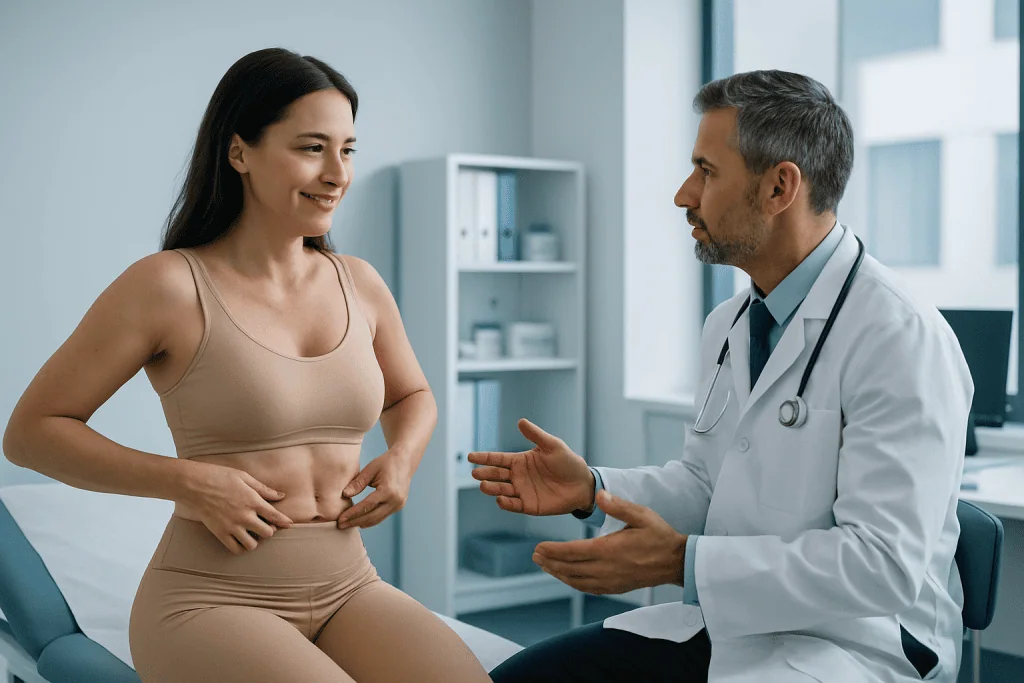
Quick answer
A reverse tummy tuck (reverse abdominoplasty) removes excess skin from the upper abdomen by lifting it upward through an incision placed along the natural fold beneath the breasts: the opposite direction to a standard tummy tuck. It suits patients whose skin laxity sits above the navel, is performed under general anaesthesia, and typically takes a few hours, with gradual recovery over several weeks.
Reverse Tummy Tuck: When the Loose Skin Sits Above the Navel
A reverse tummy tuck is a body contouring operation that removes excess skin from the upper abdomen, the area between the navel and the breasts, by lifting the tissue upward through an incision placed along the natural crease beneath the breasts. It is intended for people whose loose skin sits above the navel rather than below it, which is the opposite of the pattern a conventional tummy tuck treats. For a carefully selected patient, it can smooth a fold or crease beneath the breasts that no amount of exercise will change.
This pattern is easy to miss. Most people researching tummy tuck before and after results are looking at the lower abdomen, because that is where laxity usually collects after pregnancy or weight loss. But in some patients the lower abdomen is relatively firm while the skin above the navel folds, ripples or gathers under the breasts. You may notice it when you sit, when a fitted top or bra presses against the fold, or when swimwear emphasises a soft horizontal line across the upper abdomen. Your weight is stable, you exercise regularly, and the fold remains.
The frustration is understandable. Skin that has lost elasticity does not retract on its own, and the upper abdomen is a difficult area to treat with anything short of surgery. A reverse tummy tuck exists precisely for this situation: it moves the excess skin upward towards the breast fold, where the resulting scar can, in suitable anatomy, sit within or close to the natural inframammary crease, where a bra or bikini band normally rests.
This page explains what the operation involves, who it suits and who it does not, how it compares to a standard abdominoplasty, what recovery genuinely looks like, and how to read tummy tuck before and after material with a critical eye. It also sets out the limits plainly. A reverse tummy tuck is a focused procedure with narrow indications. It is not a substitute for a standard tummy tuck (abdominoplasty), and it is not the right operation for most people with abdominal laxity. Whether it is right for you depends on your anatomy, your skin quality, your surgical history and your goals, all of which need an in-person assessment before any decision is made.
What Is a Reverse Tummy Tuck?
A reverse tummy tuck, also called reverse abdominoplasty, is a surgical procedure that removes excess skin from the upper abdomen and tightens the tissue beneath the breasts. The word “reverse” describes the direction of pull. In a standard abdominoplasty, loose skin is drawn downward and removed through a long incision low on the abdomen, near the bikini line. In a reverse tummy tuck, the upper abdominal skin is lifted upward, and the excess is removed through incisions placed along the lower breast folds, sometimes joined across the midline of the chest depending on how much skin needs to be removed.
The question “what is a reverse tummy tuck” usually comes up when someone discovers that the operation they assumed they needed, a conventional tummy tuck, will not correct the fold they actually have. Traditional techniques pull tissue downward, which effectively flattens the lower abdomen but has a limited effect on skin sitting high under the breasts. The reverse approach was developed for exactly that residual zone: skin laxity between the lower chest and the navel, whether it appeared after pregnancy, after weight loss, with age, or after earlier abdominal surgery that improved the lower abdomen but left the upper part loose.
Two things the operation is not. First, it is not a weight-loss procedure. It does not replace diet, exercise or medical weight management, and it is not intended to treat significant generalised obesity. Second, it is not liposuction. Liposuction removes localised fat deposits; reverse abdominoplasty removes excess skin and tightens soft tissue. In selected cases the two are combined to refine the contour, but only when the surgeon judges it safe for the tissues and their blood supply, over-treating the same area can compromise healing.
The procedure can be performed on its own or, in carefully selected patients, together with breast surgery such as a breast lift, breast reduction, breast augmentation or a revision of breast reconstruction. Combining procedures makes planning more demanding, because incision placement, tissue circulation and scar position must all be considered as one system. That trade-off, convenience against complexity, is a genuine decision point, not a formality, and it deserves a full discussion with the surgeon before anything is scheduled.
What is a modified reverse tummy tuck?
A modified reverse tummy tuck is any adapted version of the standard technique, treating one side only, shortening the incision, limiting how far the tissue is lifted, or performing the skin removal through the same incision as a planned breast procedure. One well-described variation does not discard the excess upper abdominal tissue at all: instead, it is turned upward and used to add volume to the breasts during a lift, a technique sometimes described as autoaugmentation. Whether any modification suits you depends on how much excess skin you have, where it sits, the position and definition of your breast fold, and what, if anything, is being done to the breasts at the same time. The label matters less than the plan; ask any surgeon proposing a “modified” technique to draw exactly where the incisions will run and what tissue will move where.
How is a reverse tummy tuck different from a standard tummy tuck?
The two operations treat different areas, pull in opposite directions and leave scars in different places. A standard abdominoplasty removes skin below the navel, frequently repairs separated abdominal muscles (diastasis recti) and usually repositions the navel; its scar runs low across the abdomen. A reverse tummy tuck treats skin above the navel, does not normally involve muscle repair, leaves the navel untouched and places its scar under the breasts. Variations of the conventional operation exist as well: the Brazilian tummy tuck, for example, emphasises a lower scar line and waist definition, but all of them work downward. Only the reverse approach works upward. That is why candidate selection matters so much: if your laxity is below the navel, or spread across the whole abdominal wall, the reverse technique will not solve your problem, and a surgeon who examines you properly will say so.
Who Is a Candidate for a Reverse Tummy Tuck?
Patients who end up considering this operation usually describe the same thing: looseness, folding or drooping of the skin in the upper abdomen. The area may look soft, wrinkled or gathered beneath the breasts. Some notice that the upper abdomen bulges or creases when they sit; others see a horizontal fold that never changes regardless of fitness. Clothing tends to make it more obvious, fitted tops, dresses, bras and swimwear all press on or outline the fold.
The common backgrounds are consistent. Upper abdominal laxity after pregnancy, when stretched skin has partially retracted but left residual looseness high on the abdomen. Redundant skin after meaningful weight loss, where the new body contour no longer matches the skin envelope. Age-related relaxation of skin that was once elastic. And, a group surgeons see regularly, residual upper abdominal looseness after a previous traditional tummy tuck that flattened the lower abdomen but could not fully correct the tissue above the navel. A few patients simply have a natural body shape in which the upper abdominal skin is more mobile than the lower.
Candidacy is established by physical examination, not by photographs alone. A qualified plastic surgeon assesses skin quality and elasticity, the amount and exact location of excess tissue, the position and definition of the breast fold, abdominal muscle tone, fat distribution, previous scars, and the visual relationship between the breasts and the upper abdomen. Standardised photographs are taken for planning and documentation. The medical history is reviewed in detail: previous operations, pregnancies, weight changes over time, smoking and nicotine use, current medications, allergies, and any condition that could affect healing or anaesthesia.
What disqualifies you for a tummy tuck?
The most common reasons a surgeon will advise against a tummy tuck, reverse or conventional, are an unstable weight, plans for pregnancy, active nicotine use, uncontrolled medical conditions, and expectations the operation cannot meet. In more detail:
- Ongoing weight change. If you are still losing or gaining weight, the result will shift under you. Surgeons generally want weight stable and maintainable before contouring.
- Planned pregnancy in the near term. Pregnancy stretches the treated tissues and can undo the correction. Most surgeons advise completing or pausing family plans first.
- Smoking and nicotine use. Nicotine constricts blood vessels and impairs wound healing. Patients are typically expected to stop nicotine well before surgery and stay off it during recovery.
- Uncontrolled medical conditions. Poorly managed diabetes, clotting disorders, significant anaemia or unmanaged thyroid disease raise surgical risk until they are brought under control.
- Fat rather than skin. If the fullness is mainly fat with good skin tone, liposuction or non-surgical measures may be more appropriate than skin excision.
- The wrong anatomy for the scar. If the breast fold cannot conceal the incision acceptably, the visible scar may cost more than the contour gain is worth.
- Unrealistic expectations. The operation improves contour; it does not deliver flawless skin, stop ageing or prevent future change.
None of these is necessarily permanent. Weight can stabilise, nicotine can be stopped, medical conditions can be optimised. “Not now” is a common and honest answer; it is different from “never”.
Good candidates, by contrast, are in stable general health, at or near a stable weight, free of nicotine or willing to stop, and clear-eyed about the trade: a permanent scar under the breasts, one that matures and usually fades over months but never disappears, in exchange for a smoother upper abdomen.
Conditions and Indications a Reverse Tummy Tuck Addresses
The core indication is a well-defined area of excess skin between the lower chest and the navel, particularly when the skin hangs or folds towards the breast crease. After pregnancy, abdominal skin that stretched and then only partially retracted can leave exactly this pattern: the lower abdomen recovers reasonably, the upper abdomen does not.
Upper abdominal laxity after weight loss is the second frequent indication. People who have lost a meaningful amount of weight are often left with redundant skin that no longer matches their frame. Lower abdominal excess is more common and more familiar, but some patients carry a prominent upper component, either as the main concern or as the part that remains after other contouring procedures have dealt with the rest.
Revision body contouring is the third. A patient who previously had a standard abdominoplasty may have a flat lower abdomen but persistent looseness above the navel, because downward-pulling techniques cannot always reach that zone in every anatomy. A reverse approach can sometimes correct the residual area without reopening the long lower incision, though revision surgery of any kind demands careful evaluation of existing scar tissue and the blood supply it has altered. Operating on previously operated tissue is a different risk calculation from a first procedure, and the surgeon should explain that difference explicitly.
The fourth indication is coordination with breast surgery. Because the reverse tummy tuck incision lies at or near the inframammary fold, it can be planned in relation to a breast lift, reduction, augmentation or reconstruction revision. For patients with changes in both the breast and the upper abdominal region, a single coordinated plan can produce a more coherent result than two separate operations planned in isolation. The caveat repeats: combined surgery means longer operating time and a more demanding recovery, and it should only proceed after a full safety assessment.
Equally important is what a reverse tummy tuck does not treat. It is not the preferred operation for significant lower abdominal overhang, extensive stretch marks below the navel, major muscle separation, large hernias or generalised abdominal obesity. If a hernia, diastasis recti or another structural problem is suspected, that needs assessment, sometimes with imaging, before any cosmetic planning makes sense. A reverse tummy tuck fixes one specific problem well. Asked to fix a different problem, it fails.
Tummy Tuck Before and After: How to Judge Results Honestly
Reading tummy tuck before and after material critically is one of the most useful things you can do before committing to any body contouring surgery. Photographs are the most persuasive content a clinic can publish, and persuasive is not the same as informative. Before and after tummy tuck galleries are curated: clinics choose which patients to show, at which point in healing, in which lighting. That is not deception in itself, but it means the burden of critical reading falls on you. There is a second point specific to this page: because the reverse technique is uncommon, almost every gallery you will find shows conventional lower-abdominal results. Those images tell you little about what a reverse procedure would do for a fold under the breasts.
What do tummy tuck before and after pictures actually show?
Tummy tuck before and after pictures show one patient’s outcome, at one moment in healing, under conditions the clinic controlled, lighting, pose, camera distance, garments and timing were all chosen. What they cannot show is your skin elasticity, your scar biology, your healing pattern or your starting anatomy. They are evidence of what a surgeon has achieved for someone else, not a preview of your result. Our guide on what realistic before-and-after results mean explains in more depth why the gap between a gallery and an individual outcome exists and how to reason about it.
How should you read abdominoplasty before and after pictures?
Abdominoplasty before and after pictures are most useful when you read them like a clinician rather than a shopper. A short checklist:
- Matched conditions. The before and after images should use the same lighting, pose, camera angle and distance. Different conditions can manufacture apparent improvement.
- Stated timing. An image taken at six weeks, while swelling still masks the contour, tells a different story from one taken a year later when the tissues have settled. The timing should be declared.
- The scar in view. An honest abdominoplasty before and after comparison shows the scar rather than cropping or angling it away. The scar is part of the result.
- A body like yours. Look for patients with similar age, skin quality, weight history and laxity pattern. A result on very elastic skin predicts little about lax, sun-damaged skin.
- A series, not a highlight. Several cases across different body types are more informative than one exceptional result.
Responsible providers produce this material through standardised clinical photography with consistent protocols, the same positions, backgrounds and settings every time, which is also what makes the images medically useful for planning. If you want to understand how that documentation works, and why it protects patients as much as it informs them, see our guide to medical photography before and after treatment.
How a Reverse Tummy Tuck Is Performed
The process begins with consultation and planning. The surgeon listens to what bothers you, then examines the abdomen, breasts and torso as one connected aesthetic unit: the upper abdomen and the breast fold influence each other visually, and a plan that treats them separately can produce an odd transition. The central questions at this stage: can the excess skin be lifted safely upward, and can the incision sit along the natural crease beneath the breasts in your particular anatomy? For patients travelling from abroad, preliminary information, medical history and photographs are often reviewed before arrival to establish whether an in-person consultation is worthwhile, though no final decision is made without examination.
Preparation covers general health and surgical risk. Depending on your age, history and the planned extent of surgery, you may be asked to complete blood tests, imaging or further medical evaluations. The team reviews every medication and supplement you take, particularly anything affecting bleeding or wound healing, including blood thinners, anti-inflammatory medicines, hormone therapy and herbal products, and any adjustments are decided and directed by the treating doctors, never improvised by the patient. Patients who smoke or use nicotine in any form are advised to stop well before surgery and to stay off nicotine through recovery, because nicotine restricts circulation exactly where healing needs it.
On the day of surgery, the surgeon marks the planned incision and the area of skin to be removed while you are standing. This is a critical step, not a ritual: skin folds and tissue positions change completely when you lie down, so markings made on the operating table would be wrong. The incision is designed along the inframammary fold beneath one or both breasts, sometimes extending across the midline depending on how much skin must go. If breast surgery is happening at the same time, the markings for both procedures are coordinated so that scars and tissue movement are planned together.
The operation itself is usually performed under general anaesthesia and follows a consistent sequence:
- Anaesthesia and positioning. The team follows established protocols for anaesthesia, monitoring, positioning and infection prevention throughout.
- Incision. The surgeon opens along the marked lines beneath the breasts.
- Elevation. The upper abdominal skin and soft tissue are carefully lifted so the excess can be advanced upward.
- Excision. The redundant skin is removed conservatively and precisely. Taking too much creates tension, widens scars and can drag the breast fold out of position, restraint here is a feature, not a limitation.
- Deep support. Where the anatomy calls for it, deeper soft tissues are tightened to improve support and contour.
- Selective refinement. Liposuction may be added in nearby areas if fat distribution contributes to the problem, but only where it will not compromise the blood supply of the lifted tissue.
- Closure. The incisions are closed in layers to support healing and take tension off the skin edges, which is one of the main determinants of how the scar matures.
Duration depends on scope. A standalone reverse tummy tuck typically takes a few hours; combined surgery takes longer. Some patients return to their accommodation the same day after appropriate observation; others stay overnight, depending on the extent of surgery, anaesthesia considerations and individual medical needs. Drains are not always required, but are used in some cases to reduce fluid accumulation. Dressings cover the incisions, and a supportive garment or surgical bra is often recommended depending on incision position and whether breast surgery was performed.
A note on technology, because clinics often oversell it. High-resolution clinical photography, careful preoperative measurement and, where abdominal wall concerns exist, imaging all support the planning. In the operating room, modern systems support anaesthesia monitoring, temperature control and sterile technique. The honest value of these tools is consistency and safety margin. They do not replace surgical judgment, and no piece of equipment makes a poorly selected operation succeed.
Recovery After a Reverse Tummy Tuck
Recovery varies with the extent of surgery, whether procedures were combined, and your general health, but the broad shape is predictable. Swelling, bruising, tightness and altered skin sensation are expected early and improve gradually. Gentle walking starts soon after surgery to support circulation; stretching, lifting, strenuous exercise and any movement that pulls on the upper abdominal incisions are avoided until the surgeon clears them.
| Time Period | What to Expect |
|---|---|
| Day 1 | Monitoring after anaesthesia, first gentle walking, and instructions covering dressings, medications, positioning and activity limits. |
| First week | Swelling, bruising, tightness and mild to moderate discomfort are normal. Movement stays careful; no lifting, stretching or strenuous activity. |
| First month | Light daily routines resume gradually on the surgeon’s guidance. Swelling starts to settle, though the area may still feel firm or sensitive. |
| Six to twelve weeks | Activity increases in stages. Exercise and upper-body movement return only when healing is adequate and the surgeon confirms it is safe. |
| Longer term | Scars continue to mature for many months, typically softening and fading from an initial pink, firm or raised state. The final contour emerges as swelling resolves and tissues settle. |
On a scale of 1 to 10, how painful is a tummy tuck?
There is no honest single number, pain perception varies too widely between individuals for a universal score to mean much. What can be said: most patients describe the sensation after abdominoplasty as tightness and pulling rather than sharp pain, most intense in the first several days and managed with prescribed medication. It is also worth knowing that the muscle repair performed in many conventional tummy tucks is generally the most uncomfortable element of that operation, and the reverse technique does not normally include muscle repair. That does not make the recovery trivial, an incision under the breasts pulls with every reach and stretch, but the character of the discomfort differs from a full abdominoplasty with muscle work. How your medication is planned and adjusted is a matter for the treating team, who tailor it to your surgery and your individual needs.
Patients travelling for surgery should build the recovery timetable into the trip, not around it. Long flights too soon after surgery increase discomfort and raise circulation-related considerations; the care team advises on a safe travel window, mobility during the flight and any preventive measures for your individual risk. Before departure, the surgical team evaluates early healing and removes or manages any drains and dressings. It is also worth knowing which findings should be reviewed before you travel at all: our guide to warning signs to report before flying home after surgery covers this in detail.
What Are the Benefits of a Reverse Tummy Tuck?
For the right candidate, and only for the right candidate, the operation offers focused improvement in an area that neither exercise nor non-surgical treatment can meaningfully change. The gains, stated without inflation:
| Benefit | What It Means for You |
|---|---|
| Targets upper abdominal skin laxity | Addresses loose skin beneath the breasts and above the navel: the zone that lower-abdominal procedures often cannot fully correct. |
| Improves the chest-to-abdomen contour | Creates a smoother transition from the lower breast fold into the upper abdomen, which tends to make fitted clothing sit more comfortably. |
| Places the scar in a planned natural crease | In suitable anatomy, the incision can sit along the inframammary fold, where it is less conspicuous in everyday dress and swimwear. |
| Can be coordinated with breast surgery | Where appropriate, the procedure can be planned together with a breast lift, reduction, augmentation or revision to address the upper torso as a unit. |
| Useful in revision contouring | Can address residual upper abdominal laxity after a previous abdominoplasty, depending on scar pattern and tissue health. |
| A tailored alternative | Fills the gap for patients who need more than skin care, exercise or isolated fat reduction, but do not need a full traditional tummy tuck. |
Why Timing Matters
Upper abdominal skin laxity is not a medical emergency, and in most patients waiting creates no immediate danger. Timing still matters, in both directions. The best window for body contouring is usually when weight is stable, pregnancy plans are complete or paused, and life allows enough uninterrupted time for recovery. Postponing evaluation indefinitely mostly prolongs the practical nuisances, clothing that fits badly, recurring skin irritation beneath the fold, or lingering dissatisfaction after a previous procedure.
For some patients the fold is more than cosmetic. Skin folds trap moisture and can cause chafing, rashes or irritation, particularly in warm climates or during exercise. Skin care helps, but a persistent fold tends to keep producing symptoms; a medical evaluation can establish whether surgery is appropriate or whether dermatological treatment should come first.
Timing also affects planning when several procedures are on the table. Someone considering breast surgery who also has upper abdominal laxity benefits from having both assessed together early, because the breast fold and the upper abdomen share the same real estate. If the procedures are done separately without a joint plan, scar placement and tissue tension can end up less favourable for any future work.
Acting too soon carries its own cost. Patients still losing weight, planning pregnancy in the near term, actively using nicotine or managing uncontrolled medical conditions are usually advised to wait. The point of a careful consultation is to separate useful timing from manufactured urgency: operate when you are medically optimised and the result will be stable, not before, and not on a marketing calendar.
How Long Do Tummy Tucks Last?
The skin removed during a tummy tuck, reverse or conventional, does not grow back, so the structural change is lasting. What the operation cannot do is freeze the result in time. Skin keeps ageing and gradually loses elasticity; significant weight gain stretches the treated tissues again; major weight loss can create new laxity; and pregnancy after surgery can alter the result substantially. Patients who maintain a stable weight generally keep the improvement for many years. This ongoing evolution is also why honest before-and-after series taken years apart look different from those taken at three months: the early images show a result at its most swollen and least settled, the later ones show what living in the result actually looks like. When you evaluate longevity claims, ask when the “after” photograph was taken: the answer is often more revealing than the image.
What Influences the Final Result
The quality of a reverse tummy tuck outcome rests on four pillars: patient selection, surgical planning, tissue characteristics and recovery behaviour. The single most important factor is whether your anatomy genuinely matches the operation. Reverse abdominoplasty works best when the upper abdomen is the main concern and the lower abdomen needs no major tightening. If laxity is widespread, or the abdominal muscles need repair, another approach will give a more balanced result, and choosing the fashionable operation over the correct one is how disappointing outcomes happen.
Skin quality shapes what is achievable. Elasticity, thickness, stretch marks, sun damage and previous scarring all influence how the skin redrapes and how the scar matures. Patients with significantly damaged skin can still benefit, but expectations must be calibrated: the operation improves contour, it does not restore skin texture.
Scar placement is a genuine design problem. The incision must follow the natural breast fold as closely as possible while still permitting safe removal of the excess skin. A well-defined inframammary crease makes concealment easier; a less distinct fold, small breasts, breast ptosis or previous breast surgery makes the planning harder and the trade-offs sharper. Scar quality itself is influenced by genetics, skin type, wound tension, infection, smoking and how faithfully aftercare instructions are followed, some of which you control, some of which you do not.
Weight stability and general health round out the picture. Significant weight gain after surgery stretches the tissues again; major loss creates new laxity; pregnancy changes everything, so timing deserves an open conversation. Conditions such as diabetes, anaemia, immune disorders, clotting disorders or poorly controlled thyroid disease raise risk unless properly managed, and the team reviews all medicines affecting bleeding or healing before surgery. Nicotine remains the most preventable threat to a good result. On the surgeon’s side, the requirements are experience and restraint: understanding abdominal contour, breast fold anatomy, scar behaviour and tissue circulation, because over-tightening distorts and strains the wound, while under-correction leaves the fold you came to remove.
What do people wish they knew before getting a tummy tuck?
Recurring themes from patients who have been through abdominoplasty of any type, offered here so they are not surprises:
- The scar is real and permanent. It matures and usually fades over many months, but it never vanishes. Deciding you can accept it is part of deciding to have surgery.
- Swelling outlasts the headlines. The contour you see in the first weeks is not the final result; tissues settle over many months.
- Early tightness changes how you move. Reaching, stretching and standing fully upright can feel restricted at first, with a reverse technique, reaching overhead in particular.
- You will need help at home. Lifting restrictions are real, and daily life needs planning for the first weeks, especially with young children.
- The result is a partnership. Weight stability, nicotine avoidance and adherence to aftercare do as much for the long-term outcome as the surgery itself.
- Recovery is boring before it is rewarding. The patients most satisfied at a year are usually the ones who respected the restrictions in the first six weeks.
How Much Does a Reverse Tummy Tuck Cost?
There is no single meaningful price for a reverse tummy tuck, and any figure quoted before a surgeon has examined you should be treated as an estimate at best. The cost of the procedure is driven by a set of individual variables:
- The extent of surgeryhow much skin must be removed, whether one or both sides of the fold are treated, and whether the incision crosses the midline.
- Combined proceduresadding a breast lift, reduction, augmentation or liposuction changes operating time, anaesthesia requirements and materials.
- Anaesthesia and facility timegeneral anaesthesia, operating room duration and whether an overnight stay is needed.
- Revision complexitysurgery on previously operated tissue takes longer and demands more planning.
- Preoperative work-up and aftercaretests, imaging where indicated, garments, follow-up visits and wound care.
- Where the surgery takes placesurgeon experience, facility standards and local cost structures all move the number.
A meaningful quotation follows an individual assessment and itemises what it covers: the operation, anaesthesia, hospital stay, garments, follow-up. When comparing quotes, compare the scope line by line rather than the headline figure, and be wary of prices attached to an operation nobody has yet confirmed you need. The cheapest quote for the wrong procedure is not a saving.
Reverse Tummy Tuck at Acibadem
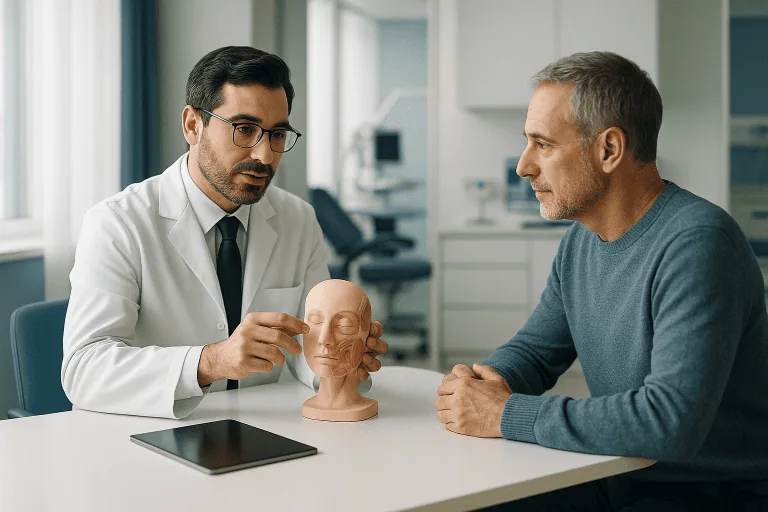
At Acibadem, evaluation for a reverse tummy tuck starts from a deliberately unexciting premise: the procedure is not suitable for everyone, and the consultation exists to find out whether it is suitable for you. The surgeon examines the abdomen, breast fold, torso proportions, previous scars and overall health before recommending anything. If your concern would be better served by a traditional tummy tuck, liposuction, a breast procedure, revision surgery or no surgery at all, that is what you will hear. The aim is to match the operation to the anatomy, not to recommend the most extensive procedure available.
Multidisciplinary input is available where a history calls for it. Reverse tummy tuck is usually an elective plastic surgery procedure, but patients who have had bariatric surgery, cancer treatment, breast reconstruction, hernia repair or complex previous operations benefit from coordination between plastic surgeons, anaesthesiologists and other relevant specialists, and more complex cases can be discussed jointly so the surgical plan fits the wider health picture. Preoperative assessment, laboratory testing, imaging where abdominal wall concerns exist, anaesthesia evaluation tailored to individual risk, feeds into that plan, and structured nursing observation and wound assessment after surgery help identify concerns early.
For international patients, the practical layer matters as much as the clinical one: coordinating appointments and medical records, understanding how long a stay should be, and knowing what happens at each stage from arrival through discharge. Acibadem’s international patient services support that coordination, and follow-up planning includes documentation and recommendations for continued care with clinicians in your home country after you return. A fuller picture of how a treatment journey is organised, from records review to follow-up, is in our guide to what happens before, during and after treatment.
Deciding Whether to Proceed
A reverse tummy tuck is a valuable option for a narrow group: patients with genuine skin excess in the upper abdomen, an anatomy that lets the scar sit acceptably in the breast fold, stable weight, good general health and expectations aligned with what skin excision can and cannot do. Its success depends less on the technique itself than on choosing the right candidate, planning the incision with care and respecting how the upper torso naturally moves.
The most informative next step for anyone weighing the operation is a detailed evaluation with an experienced plastic surgeon, and a second opinion where the recommendation surprises you. A good consultation should answer, specifically for your body: whether reverse abdominoplasty fits your pattern of laxity or another procedure would serve you better; exactly where the scar will run and how visible it is likely to be; whether combining breast surgery is sensible or adds risk without benefit; what the recovery timeline means for your work, family and travel; and what would need to change, weight, nicotine, medical optimisation, before surgery becomes advisable. If a consultation cannot answer those questions plainly, the problem is the consultation, not the questions. The operation itself, done for the right person at the right time, does one focused thing well: it removes the fold that nothing else would.
Preparation
- A plastic surgeon evaluates skin laxity, previous scars, overall health, and expectations to confirm suitability. Preoperative blood tests and anesthesia assessment are usually required. Patients may need to stop smoking and avoid blood-thinning medicines before surgery.
Aftercare
- Patients wear supportive garments and follow incision-care instructions to reduce swelling and protect healing tissues. Light walking is encouraged early, while heavy lifting and strenuous exercise are avoided for several weeks. Follow-up visits monitor wound healing and scar maturation.
Frequently Asked Questions
What affects the cost of a reverse tummy tuck?
The main factors are the amount of upper abdominal skin to be removed, whether another procedure is combined, surgeon experience, hospital setting, anaesthesia, recovery needs, medical tests and follow-up care. Travel, accommodation and language support can also affect the total budget for international patients.
How can I get a personalised quote?
A personalised quote usually requires photographs, medical history, previous surgery details and a specialist assessment. Acibadem International can arrange a free consultation to review suitability and provide a tailored treatment plan and cost estimate.
Is a reverse tummy tuck cheaper than a standard tummy tuck?
Not necessarily. Cost depends on the surgical plan rather than the name of the procedure. A reverse tummy tuck can be technically specific because of scar placement near the breast fold and the need to assess upper abdominal skin, breast anatomy and prior scars.
What is typically included in an international patient package?
Inclusions vary by provider, but a package may include specialist consultation, hospital services, surgery, anaesthesia, nursing care, translator support, transfers and follow-up. Patients should always confirm what is included and what is billed separately.
Can reverse tummy tuck be combined with other procedures?
It may be combined with liposuction, breast surgery or other body contouring procedures in selected patients. A specialist decides whether combining procedures is safe and appropriate based on examination, health status and recovery planning.
Is reverse tummy tuck covered by insurance?
Because it is commonly performed for cosmetic contouring, insurance coverage may be limited or unavailable. Coverage depends on the insurer, medical indication and policy terms, so patients should confirm directly with their provider before treatment.
Medically reviewed by the Acıbadem International Medical Board September 1, 2026
See our medical review board →
Update history
- PublishedJune 8, 2026
- Medical review approvedSeptember 1, 2026
- Last content updateSeptember 1, 2026
References1
- Tummy tuck (abdominoplasty) nhs.uk
Planning tools for this treatment
Indicative figures for orientation only: your written plan and quote follow a free medical review.
Trusted care for international patients
Tummy tuck costsledger-based guide ranges, or browse the full Turkey Medical Price Index.
From the Acibadem Blog

Do You Need a Reverse Tummy Tuck? Upper Abdominal Laxity and Who Actually Qualifies
A reverse tummy tuck is usually considered only for people whose loose skin sits mainly above the navel, in the upper abdomen, while the…

Reverse Tummy Tuck Recovery: Supportive Garments, Incision Care and Returning to Lifting
Reverse tummy tuck recovery usually runs about six weeks, with most people back to desk work within roughly four to six weeks and back…
Doctors Performing This Treatment


Aesthetic Plastic & Reconstructive Surgery
Prof. Mehmet Veli Karaaltın, MD

Aesthetic Plastic & Reconstructive Surgery
Assoc. Prof. Erdem Güven, MD

Aesthetic Plastic & Reconstructive Surgery
Assoc. Prof. Ahmet Küçükçelebi, MD
Aesthetic Plastic & Reconstructive Surgery
Assoc. Prof. Mehmet Altıparmak, MD

Aesthetic Plastic & Reconstructive Surgery