Earwax Build Up Treatment
Earwax build-up can block the ear canal, causing fullness, reduced hearing, ringing or discomfort. ENT specialists assess the ear and remove wax safely when home care is not enough.
Quick answer
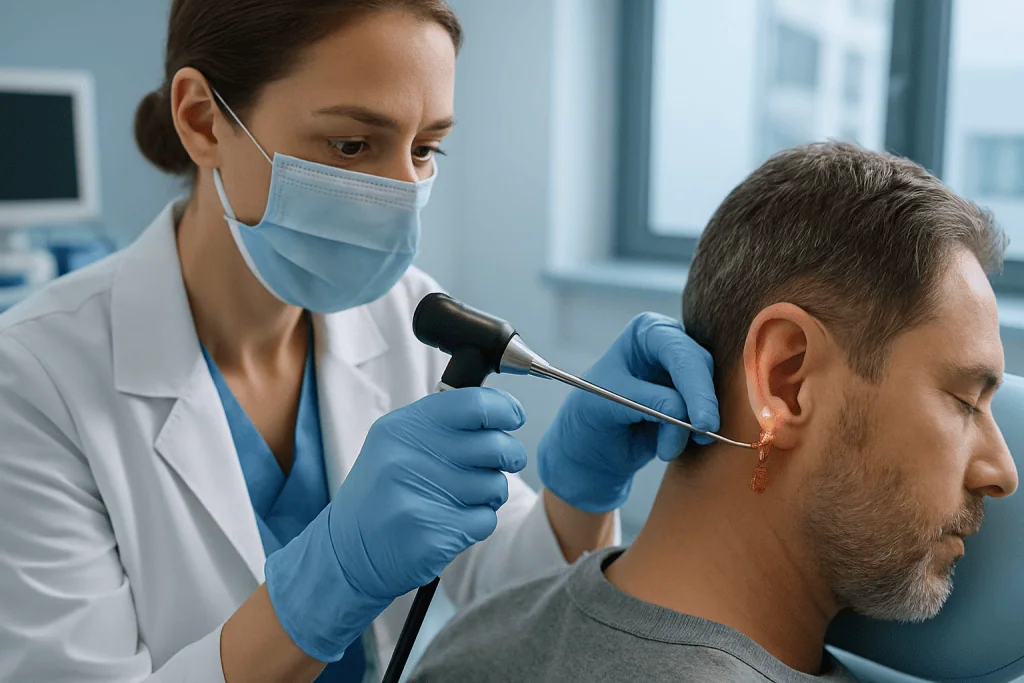
Ear wax removal is the clearing of excess cerumen from the ear canal when it blocks hearing or causes discomfort. An ENT specialist examines the ear, then removes the wax using microsuction, fine instruments or controlled irrigation, sometimes after softening drops. It is usually a brief outpatient procedure, and the method is chosen to suit each ear's anatomy and medical history.
Ear Wax Removal: When Earwax Build Up Affects Daily Life
Ear wax removal is the careful, professional clearing of excess cerumen, the wax your ear canal produces naturally, when it accumulates enough to block hearing, cause discomfort or stop a doctor from seeing the eardrum. It is usually a brief outpatient procedure performed by an ear, nose and throat (ENT) specialist using microsuction, fine instruments or, in selected patients, controlled irrigation. It is intended for anyone whose blocked ear does not settle with careful home care.
Earwax build up is common, but it can be surprisingly disruptive. A blocked ear may create a feeling of fullness, muffled hearing, ringing, itching, mild dizziness or discomfort that makes conversations, phone calls, travel and sleep harder than they should be. For some people, the symptoms come on gradually over weeks. For others, hearing seems to change suddenly, after a shower, a swim, a flight, or the use of cotton swabs that push wax deeper into the ear canal, where it swells and completes the blockage.
Many people try to manage the problem at home with drops or over-the-counter products, and sometimes that is enough. But when wax becomes impacted, hardened, painful or repeatedly returns, medical assessment matters. The ear canal and eardrum are delicate structures. Attempts at ear wax removal with cotton swabs, hairpins, ear candles or other objects can scratch the canal skin, push wax further inward, trigger infection or injure the eardrum. What began as a minor nuisance can become an ear that is sore, infected and harder to treat.
Even a seemingly small ear problem raises practical questions. Is it simply wax, or is there another reason for the hearing change? Is it safe to fly? Will removal hurt? Can it be dealt with in one visit? At Acibadem, earwax build-up is evaluated by ENT specialists who can distinguish uncomplicated wax blockage from other ear conditions and clear it using the technique that suits that particular ear, rather than a one-size-fits-all approach.
The stakes are modest but real. Hearing and ear comfort affect communication, balance, work, travel and confidence. In most cases, professional ear wax removal is a straightforward outpatient procedure. The key is matching the right method to the right ear, especially when there is pain, prior ear surgery, an eardrum perforation, recurrent infections, diabetes, hearing aid use or a history of dizziness.
Understanding Cerumen Impaction: What the Treatment Addresses
Cerumen is the medical name for earwax, and cerumen impaction is what doctors call wax that has accumulated enough to cause symptoms or block the view of the eardrum. Treatment means the medical evaluation and removal of that excess wax. Earwax is not a sign of poor hygiene. In normal amounts it protects the ear: it traps dust and debris, helps moisturise the skin of the canal, discourages some bacteria and fungi, and supports the ear’s built-in cleaning system. Ordinarily, jaw movement and the slow outward migration of canal skin carry wax towards the entrance of the ear, where it dries and falls away without anyone noticing.
Wax becomes a medical issue when this conveyor system fails, when wax accumulates faster than it clears, hardens in place, presses on sensitive canal skin, blocks sound or hides the eardrum from examination. Treatment is designed to clear the blockage while protecting the canal and eardrum. Depending on symptoms, ear anatomy, medical history and the consistency of the wax, an ENT specialist may use softening drops, microsuction, gentle manual removal with fine instruments, irrigation in carefully selected patients, or a combination of these.
Professional removal differs from home cleaning in one decisive way: it happens after direct examination of the ear. The specialist can confirm whether symptoms are truly caused by wax, or whether something else is going on: an outer ear infection, middle ear fluid, an eardrum perforation, sudden hearing loss, eczema of the canal skin, a foreign body, or a problem related to a hearing device. That distinction matters most when hearing loss is sudden, one-sided, painful, or accompanied by dizziness or discharge. The goal is never simply to “clean the ear”. It is to restore a clear canal safely and to understand why the blockage happened, so it is less likely to happen again.
What causes ear wax build up?
Ear wax build up is usually caused by something interfering with the ear’s natural self-cleaning, rather than by producing “too much” wax alone. The most common culprits are objects placed in the ear: cotton swabs, earbuds, earplugs, hearing aids and in-ear headphones all press wax inward and block its outward migration. Anatomy plays a role too, narrow, curved or unusually hairy ear canals clear wax less efficiently. Some people naturally produce drier, harder wax that moves poorly. Skin conditions such as eczema or dermatitis add flakes and debris to the mix. Age is a factor as well, because canal skin migrates more slowly and wax tends to become drier over time.
Why does earwax build up?
Earwax builds up when production outpaces clearance. The glands in the outer part of the canal keep producing wax throughout life; the clearance side of the equation is what usually breaks down. Anything that compacts wax, slows skin migration or narrows the canal tips the balance towards accumulation. Repeated water exposure can make existing wax swell. Previous impactions leave some people prone to recurrence, because a canal that has trapped wax once often has the anatomy or habits that trapped it in the first place. That is why prevention advice after removal focuses on habits, particularly abandoning cotton swabs, rather than on the wax itself.
How long does it take for earwax to build up?
There is no fixed timeline: it varies from months to years depending on the person. Someone with narrow canals, hearing aids worn daily and naturally dry wax may develop a symptomatic blockage within a few months of a professional clean. Someone else may never experience impaction at all. What clinicians can say honestly is that people who have needed removal once are more likely to need it again, and that the interval tends to be fairly consistent for each individual. Patients with recurrent impaction often settle into a rhythm of periodic checks, timed to their own pattern rather than a universal schedule.
Who May Need Professional Ear Wax Removal
Professional treatment becomes appropriate when earwax causes symptoms, prevents proper examination of the ear, interferes with hearing aids, or fails to improve with careful home care. Wax blockage can affect anyone, but it is more common in people with narrow or curved ear canals, dry or hard wax, frequent earbud or earplug use, hearing aids, skin conditions affecting the canal, or a long-standing habit of using cotton swabs. Children, older adults and people with limited dexterity or mobility are also over-represented, because their wax is less likely to be noticed early.
How do you know if you have earwax build up?
You cannot confirm earwax build up yourself, only an ear examination can, but a recognisable cluster of symptoms points towards it. Typical signs include a blocked or plugged sensation, reduced hearing in one or both ears, ringing (tinnitus), earache, itching, a cough triggered by stimulation of the canal, mild imbalance, or discomfort when using headphones or hearing aids. A classic clue is hearing that worsens abruptly after water enters the ear: existing wax swells and turns a partial blockage into a complete one. Hearing aid users may notice recurrent feedback or a drop in device performance because wax is obstructing the microphone, the mould or the canal itself. None of these signs is exclusive to wax, which is precisely why examination matters.
Diagnosis begins with a focused history. The ENT specialist asks when symptoms started, whether one or both ears are affected, whether there is pain or discharge, whether you have had ear surgery or a known eardrum perforation, and whether you have conditions such as diabetes, immune suppression, eczema or frequent ear infections. These details are not formalities: they determine which removal methods are safe for your ear and which should be avoided.
The ear is then examined with an otoscope, an operating microscope or an endoscopic camera. These tools let the physician see the wax, the shape of the canal, the condition of the skin and whether the eardrum is visible. If hearing symptoms persist after the wax is removed, hearing tests may follow, to establish whether there is another cause of hearing loss. This is particularly important for patients with sudden hearing changes, ongoing tinnitus, hearing loss that differs between the two ears, or dizziness.
Timely assessment is especially relevant when an ear problem needs clarifying before flights, hearing aid adjustments or other treatment. It also matters for children, older adults, hearing aid users and anyone whose history, pain, discharge, previous surgery, makes home removal a poor idea.
Conditions and Indications Addressed by Treatment
Treatment addresses cerumen impaction, but its value often extends beyond the wax itself. A blocked canal can hide underlying problems. Once the wax is cleared, the ENT specialist can assess the eardrum, diagnose infection or inflammation, and determine whether further care is needed. In this sense, removal is frequently both a treatment and a diagnostic step.
Common indications include symptomatic wax blockage, recurrent impaction, difficulty fitting or using hearing aids, inability to see the eardrum during examination, suspected outer ear infection with debris in the canal, and discomfort caused by trapped wax. In children, wax may need clearing so the ear can be properly assessed during episodes of ear pain, fever, suspected middle ear infection or hearing concern. In adults, removal is often necessary before hearing tests, ear procedures or certain ENT assessments, simply because an accurate result requires a clear canal.
Certain findings, ear drainage, bleeding, severe pain, sudden hearing loss, spinning vertigo, a known eardrum perforation, previous ear surgery, ventilation tubes, or an object lodged in the ear, usually indicate something other than simple wax. These ears need a different diagnostic and treatment approach, and drops or flushing at home can make matters worse. Similarly, people with diabetes, immune system conditions or a history of radiation to the head and neck are managed more cautiously, because ear canal infections in these groups can become serious.
It is worth being clear about limits. Removing wax does not treat every cause of hearing loss or tinnitus. If wax is contributing, clearing the canal can improve sound transmission and relieve blockage-related symptoms. If symptoms persist afterwards, the cleared canal at least allows further testing to be done accurately, which is its own kind of progress.
How to Unclog Ears: What Helps at Home and What Harms
Anyone searching for how to unclog ears will find a mixture of sensible advice and genuinely harmful folklore, so it is worth separating the two. Sensible home care for suspected wax includes leaving the ear alone, letting warm water run over (not into) the ear during a shower, and, where a doctor has confirmed the eardrum is intact, softening drops used as directed. Harmful approaches include cotton swabs, hairpins, keys, twisted tissue, and ear candles. The canal skin is thin, the eardrum is close, and the most common outcome of poking is wax pushed deeper and packed harder. Guides on how to unclog ear blockages that recommend inserting anything rigid into the canal are advising exactly the behaviour that causes most impactions ENT specialists see.
How do you remove deep ear wax at home?
You should not attempt to remove deep ear wax at home, and this is a genuine safety point rather than professional gatekeeping. Wax sitting deep in the canal is close to the eardrum, cannot be seen without instruments, and cannot be reached without risking injury. Softening drops may loosen deep wax enough for it to migrate out or be removed easily at a clinic, but any physical extraction at depth, with swabs, tools or suction gadgets sold online, carries a real risk of abrasion, infection and eardrum damage. Deep or impacted wax is precisely the situation professional removal exists for: the clinician can see what they are doing, and stop the moment the ear objects.
What pulls ear wax out?
Nothing safely “pulls” ear wax out, and products claiming to do so deserve scepticism. Ear candles are the most notorious example: they do not create meaningful suction, the residue they produce is candle wax rather than cerumen, and they can cause burns and canal injury. Evidence-based care does not recommend them. What actually works is softening (drops loosen wax so the ear’s own migration can carry it out), suction under direct vision (microsuction performed by a clinician who can see the wax), and gentle instrumentation or irrigation in appropriate ears. The common thread is that safe methods either work with the ear’s own clearance system or are performed with full visibility, never blind pulling.
Does hydrogen peroxide help clogged ears?
Hydrogen peroxide can help soften earwax, and it is the active ingredient in several over-the-counter softening drops, but it is not suitable for every ear. The fizzing action helps break up wax so it can migrate or be removed more easily. The important caveats: peroxide-based drops are generally avoided when there is a known or suspected eardrum perforation, ear discharge, significant pain, ventilation tubes or previous ear surgery, and overuse can irritate the canal skin. Whether drops are appropriate for a particular ear, and which kind, is a judgement the examining doctor makes, because it depends on what the eardrum looks like, which cannot be known from the outside.
Are there cures for ear wax build up?
People often search for cures for ear wax build up, but the honest answer is that wax is not a disease to be cured: it is a normal secretion that sometimes needs removing. There is no product or procedure that permanently stops the ear producing wax, nor should there be, since wax is protective. What exists instead is effective management: professional removal when a blockage forms, treatment of any skin condition that contributes, sensible hearing aid maintenance, abandoning cotton swabs, and, for people who block repeatedly, planned periodic checks. Framed that way, recurrent wax becomes a minor maintenance issue rather than an unsolved illness.
How Professional Earwax Removal Is Performed
Professional earwax removal follows a consistent sequence, even though the technique chosen varies from ear to ear. A typical appointment looks like this:
- History-taking: symptoms, previous ear problems, surgery, hearing aids, relevant medical conditions.
- Examination of the canal and, where visible, the eardrum under magnification.
- Selection of the removal method, microsuction, manual instruments, irrigation, or softening first and removal at a second visit.
- Removal, with the ear re-examined as wax is cleared.
- Final inspection of the canal and eardrum, aftercare advice and, if needed, planning of hearing tests or follow-up.
Preparation and initial assessment
The process begins with consultation and examination. The ENT specialist reviews your symptoms, prior ear problems, medications, allergies, hearing aid use and any past ear surgery. This information determines whether the wax can safely be softened, suctioned, irrigated or removed manually, and, just as importantly, which of those options should be ruled out for your particular ear.
If the wax is very hard, the physician may recommend wax-softening drops for a short period before removal, to loosen the plug and make the procedure more comfortable. Drops are generally avoided when a perforation is known or suspected, when there is discharge or significant pain, or when a patient has previously been told to keep liquids out of the ear, which is exactly why the decision belongs to the examining doctor rather than the pharmacy shelf. Where clinically appropriate, assessment and removal can be completed in the same visit.
Before removal, the specialist explains what to expect. You remain seated or reclined, with the ear positioned for a clear view. The procedure generally requires no anaesthesia, although sensitive ears may need a slower pace. Children and highly anxious patients may need extra reassurance, paediatric ENT assessment or a modified technique, and a good clinician will pause or stage the removal rather than push through discomfort.
Microscopic or endoscopic visualisation
Clear visualisation is the foundation of safe removal. ENT specialists use an otoscope, an operating microscope or a fine endoscopic camera to examine the canal. Magnification and strong illumination reveal the wax, the canal skin and the eardrum in detail, especially valuable when the canal is narrow, the wax sits close to the eardrum, the patient has had ear surgery, or the skin is inflamed.
Visualisation does not remove wax by itself; it guides the choice and execution of the safest technique. Seeing precisely means less unnecessary contact with the canal, and it is how the physician identifies conditions that rule out certain methods: a perforated eardrum or an active infection, for instance, generally rules out irrigation.
Microsuction
Microsuction removes wax through a small sterile suction tip while the physician watches the canal under magnification. Many ENT specialists prefer it for impacted wax, narrow canals, and any ear where water should be kept out. You may hear the suction and feel mild pulling or pressure; the procedure is usually well tolerated, though the noise surprises some patients.
Microsuction works well when wax is soft, flaky or has been partially loosened with drops. It is also often the method of choice for patients with a history of eardrum perforation or ear surgery, though every case is judged individually. If the wax is very hard and stuck to the canal skin, the specialist may recommend softening first or removal in stages, to avoid abrading the skin for the sake of finishing in one sitting.
Manual removal with fine instruments
Manual removal uses specialised instruments, small loops, hooks or curettes, to lift or extract wax under direct vision. It suits wax sitting near the outer canal, solid plugs that can be mobilised in one piece, and situations where suction alone is not ideal. Because the canal skin is thin and sensitive, the physician’s view and control matter more than the instrument itself.
In practice, techniques are often combined: a fine instrument loosens the plug, then suction clears the remaining debris. This mix-and-match approach is standard in ENT work because wax consistency, canal shape and patient comfort vary so much from ear to ear, and sometimes between a patient’s own two ears.
Irrigation in selected patients
Irrigation flushes wax from the canal using body-temperature water or solution. It can be effective, but it is emphatically not for everyone. Irrigation is generally avoided when there is a known or suspected eardrum perforation, certain previous ear operations, ventilation tubes, active infection, significant pain, or a history of trouble with water in the ear.
When irrigation is appropriate, temperature and pressure are carefully controlled to minimise discomfort, dizziness and canal irritation, water that is too cold or too warm can provoke a brief spinning sensation by stimulating the balance organ. The ear is examined before and after to confirm the wax is gone and the canal and eardrum are intact. In a specialist setting, irrigation is one tool among several, chosen deliberately rather than applied by default.
How to get rid of earwax build up when it keeps coming back?
Recurrent blockage is managed with a plan rather than a single fix: professional removal when needed, plus targeted prevention between visits. Depending on the cause, that plan might include treating canal eczema, reviewing how hearing aids or earplugs fit and how often they are cleaned, retiring cotton swabs permanently, and scheduling periodic ear checks matched to how quickly your wax accumulates. For most people, the combination reduces how often removal is needed, even though nothing switches wax production off entirely.
Typical duration and aftercare
Removal is normally completed within a single outpatient visit. The extraction itself may take only minutes, but the full appointment includes history, examination, counselling and sometimes hearing assessment or treatment for canal irritation. Complex cases, very hard wax, sensitive canals, infection, young children, post-surgical ears, may need more time or a staged plan across two visits.
Afterwards, hearing often feels noticeably clearer if wax was the main blockage. Some people have temporary sensitivity, mild soreness or an odd sensation of cool air in the newly open canal. If the skin was inflamed or scratched, the physician may prescribe drops or advise keeping the ear dry for a short period. The single most useful piece of aftercare is negative: do not put cotton swabs or anything else into the ear, because that habit is the most common reason wax impacts again.
If hearing loss, tinnitus, dizziness or fullness continues once the wax is out, further evaluation follows, audiology testing, middle ear assessment or, in selected cases, imaging. Persistent symptoms should never be filed under “just wax”, especially when they are one-sided or came on suddenly.
Why Acting Early Matters
Earwax build-up is rarely dangerous when handled properly, but delay makes everything slightly worse. Wax left in the canal becomes drier, harder and more tightly impacted; the more firmly it adheres to the skin, the more sensitive removal becomes. Early assessment usually means simpler treatment and less irritation.
Delay also obscures diagnosis. While the canal is blocked, the physician cannot see the eardrum or identify infection, fluid, perforation or other causes of hearing loss, some of which are time-sensitive. Sudden sensorineural hearing loss, for example, is not caused by wax and is treated in ENT practice as a condition where timing matters. A patient who assumes every hearing change is wax may unknowingly postpone care that should not wait, which is one of the strongest arguments for examination over assumption.
Repeated home attempts create their own problems. Cotton swabs push wax deeper and compact it. Ear candles can cause burns, deposit candle wax and injure the ear; they have no place in evidence-based care. Scraping the canal with household objects invites bleeding, infection and eardrum trauma. In people with diabetes or immune conditions, even small skin breaks in the canal deserve attention, because infections there can escalate.
For hearing aid users, untreated wax degrades device performance, causes feedback and quietly erodes communication. For travellers, a blocked ear becomes more uncomfortable with altitude changes and after swimming. Early ENT assessment clarifies the cause and offers a safer, faster route to relief than a second box of drops bought on hope.
Benefits of Professional Treatment
When earwax is genuinely the cause of symptoms, professional removal delivers benefits beyond an open canal.
| Benefit | What It Means for You |
|---|---|
| Clearer ear canal | Wax that blocks sound, interferes with hearing aids or hides the eardrum is removed under direct vision. |
| Safer removal | The technique is chosen for your anatomy, symptoms and history, including whether irrigation or instruments are appropriate at all. |
| Better diagnostic accuracy | With the wax gone, the doctor can properly assess the eardrum and identify infection, inflammation, fluid or other causes of symptoms. |
| Symptom relief when wax is the cause | Less fullness, clearer sound, reduced discomfort and easier hearing aid use once the blockage is out. |
| Prevention guidance | Practical advice on safe ear care, recurrence risk, hearing aid cleaning and when a follow-up check makes sense. |
Recovery Timeline After Ear Wax Removal
Recovery is usually uneventful, though the experience varies with the amount of wax, the method used and the condition of the canal skin.
| Time Period | What Patients Can Expect |
|---|---|
| Day 1 | Hearing may feel clearer immediately if wax was the main blockage. Mild sensitivity, brief dizziness or an unfamiliar sensation in the open canal can occur and usually settles quickly. |
| First week | Most patients return to normal activities straight away. If the canal was irritated, the physician may advise keeping the ear dry or using prescribed drops. |
| First month | The canal typically returns to its usual comfort. Patients with recurrent wax, hearing aids or narrow canals may benefit from follow-up planning. |
| Longer term | Prevention centres on keeping cotton swabs out of the ear, managing skin conditions, maintaining hearing aids properly and arranging periodic checks if wax repeatedly builds up. |
Factors That Influence a Good Result
The outcome depends on more than the volume of wax. It starts with accurate diagnosis: if wax truly explains the hearing loss or fullness, removal is likely to relieve it; if another condition is also present, clearing the wax is only the first step in care, not the last.
Wax consistency matters. Soft wax comes out easily; very hard, dry wax may need softening first. Canal shape matters too, narrow, curved, hairy or post-surgical canals make removal more technically demanding. Inflammation or infection increases sensitivity and may need treating before or after the wax is addressed.
Patient history steers safety. Someone with a previous perforation, ventilation tubes, mastoid surgery, chronic infections or a surgically reconstructed ear needs a different technique from someone with an untouched ear: irrigation may be off the table, and removal under magnification preferred. Patients whose dizziness is triggered by ear procedures need slower, more deliberate care.
Hearing aids and other in-ear devices influence recurrence. Devices can stimulate wax production and block its natural outward migration. Regular maintenance, a proper fit and periodic ENT or audiology checks reduce repeated blockage. Earbuds, noise-protection plugs and heavy headphone use have a similar effect in some people, which is worth knowing if your work or habits involve them daily.
Skin health plays its part. Eczema, psoriasis, dermatitis and chronic dryness produce flaking and debris that mimic or mix with wax; treating the underlying skin condition reduces itching and recurrent blockage. Over-cleaning backfires, stripping the canal of its natural wax irritates the skin, worsens dryness and can set up a cycle of itching, scratching and more debris.
Finally, technique matters. Safe removal requires good visualisation, appropriate instruments, attention to comfort and the judgement to stop when the canal becomes too sensitive and finish another day. The best method is individualised, never automatic, which is the practical case for ENT evaluation whenever symptoms are persistent, recurrent, painful or tangled up with other ear problems.
How Acibadem Approaches Earwax Build-Up Care
Confidence in even a simple ENT treatment rests on the diagnostic process behind it. Ear fullness or hearing loss may be wax, or infection, an eardrum problem, pressure changes, an inner ear disorder, or age- and noise-related hearing change. At Acibadem, earwax build-up is assessed within a full ENT framework that looks past the blockage to the complete clinical picture, so that what gets treated is the actual problem.
ENT specialists work with structured diagnostic pathways: direct visualisation of the canal and eardrum, audiology support where needed, and referral to related specialties if symptoms point to something broader. For patients with persistent tinnitus, dizziness, recurrent infections or complex hearing concerns, multidisciplinary evaluation can be arranged when clinically appropriate.
The technology is chosen for precision and safety rather than spectacle: magnified examination, microscopic or endoscopic visualisation, controlled suction systems, fine ENT instruments and audiological testing. Together these let physicians remove wax while protecting delicate structures and spotting conditions that need further care. The specific approach follows the patient’s anatomy, history and symptoms, not a fixed protocol.
Experience counts most in ears that are not routine. Previous surgery, chronic infection, perforated eardrums, hearing aids, narrow canals and marked sensitivity all demand careful technique and judgement. In those ears the question is not merely how to remove wax, but how to avoid unnecessary irritation, which method is safest, and when a symptom warrants investigation beyond the wax.
Ear care sometimes overlaps with recovery from other treatment, and the practical questions overlap too. The guides to caring for stitches, staples and sutures after treatment and building a safe daily routine during hotel recovery cover the everyday side of that period in more detail.
Treatment planning is personalised. Some patients need one outpatient removal and nothing more. Others need softening preparation, audiology testing, management of canal dermatitis, a review of hearing aid habits, or follow-up for recurrent impaction. The plan takes shape around symptoms, examination findings and long-term ear health, thorough where it needs to be, brief where it can be.
Living With Ears That Make Too Much Wax
Earwax build-up is one of the more fixable problems in medicine, provided it is approached with a little respect for the anatomy involved. Professional evaluation confirms whether wax is genuinely the cause, clears the blockage with the method that suits your ear, and picks up anything else that needs attention. For most people that is the whole story: one visit, clearer hearing, sensible habits afterwards.
For those whose ears block repeatedly, the realistic goal is management rather than elimination, periodic removal timed to your own pattern, attention to skin conditions and device habits, and a firm retirement of the cotton swab. And for anyone whose symptoms outlast the wax, the cleared canal is not a dead end but a starting point: it is what makes accurate hearing tests and further assessment possible, so that whatever is actually behind the symptom can be found and addressed properly.
Preparation
- Do not insert cotton buds, ear candles or sharp objects into the ear before the appointment. Tell your doctor if you have ear pain, discharge, a perforated eardrum, ear surgery history or hearing aids. The ENT specialist may examine the ear canal with an otoscope before removal.
Aftercare
- Mild temporary sensitivity or a feeling of moisture may occur after removal. Keep the ear dry if advised and avoid inserting objects into the ear canal. Contact your doctor if you develop pain, discharge, dizziness, bleeding or persistent hearing loss.
Frequently Asked Questions
What affects the cost of earwax removal?
The final cost depends on the ENT consultation, whether one or both ears are treated, the removal method, the complexity of the blockage, and whether hearing tests or infection treatment are needed.
How can I get a personalised quote in Turkey?
You can request a free consultation by sharing your symptoms, previous ear history, any known eardrum problems and recent test results if available. The medical team can then advise on the likely assessment and provide a personalised quote.
Is earwax removal usually included in a package?
Some providers offer package-style outpatient services that may include ENT examination, wax removal and basic aftercare advice. Always confirm what is included, such as follow-up, hearing checks or medication if required.
Why might the quote change after examination?
The quote may change if the wax is deeply impacted, both ears need treatment, there is infection, the eardrum cannot be clearly seen, or additional hearing assessment is recommended.
Is it cheaper to use home ear drops instead of seeing an ENT specialist?
Home softening care may be suitable for mild cases, but it is not appropriate for everyone. If there is pain, discharge, previous ear surgery, suspected eardrum perforation or persistent hearing loss, specialist assessment is safer than self-treatment.
Medically reviewed by the Acıbadem International Medical Board August 31, 2026
See our medical review board →
Update history
- PublishedJune 8, 2026
- Medical review approvedAugust 31, 2026
- Last content updateSeptember 8, 2026
References2
- Earwax build-up nhs.uk
- Earwax Buildup & Blockage my.clevelandclinic.org
Trusted care for international patients
From the Acibadem Blog

When Is Earwax Build Up a Job for an ENT Specialist Rather Than Ear Drops?
Most earwax build up clears on its own or with a few days of softening ear drops, so an ENT is not the first…
Microsuction or Irrigation for Earwax Build Up: Which Does Your ENT Recommend and Why?
Microsuction and irrigation both remove impacted earwax, and neither is right for everyone. Microsuction uses a small vacuum under direct magnified view and is…