Intraocular Lens
An intraocular lens is an artificial lens implanted inside the eye to replace or supplement the natural lens, commonly during cataract surgery or refractive lens exchange.
Quick answer
An intraocular lens (IOL) is a small artificial lens implanted inside the eye, most often during cataract surgery after the cloudy natural lens has been removed. The operation is usually a day case under local anaesthetic drops: the natural lens is taken out through tiny incisions and the IOL is positioned in its place, where it is designed to remain permanently.
What an Intraocular Lens (IOL) Is and Why It Matters
An intraocular lens, usually shortened to IOL, is a small, transparent artificial lens implanted inside the eye to take over the focusing work the natural lens can no longer manage. It is placed most often during cataract surgery, immediately after the cloudy natural lens has been removed, and it is designed to stay in the eye for the rest of your life. Surgeons also implant an IOL during refractive lens exchange, where the natural lens is removed for optical rather than medical reasons, and, in selected younger patients, alongside the natural lens as a phakic implant.
If you are researching an IOL, the chances are that your vision has already started to change the way you live. Reading becomes tiring. Night driving feels less safe. Colours look faded, and glare from headlights or low sun is distracting. Familiar tasks take more effort than they used to. For many people these changes come from cataracts, the gradual clouding of the eye’s natural lens. For others, the issue is a high glasses prescription, presbyopia, the age-related loss of near focusing, or a wish to depend less on glasses when laser vision correction is not the most appropriate option.
IOL surgery is one of the most established procedures in modern ophthalmology. When it is planned carefully and performed by experienced eye surgeons, it can clear the optical pathway blocked by a cataract and, depending on the lens selected, may reduce your need for glasses for certain activities. The word may matters. No lens suits every eye, and the most important step is not choosing a lens at all: it is choosing the right lens for your eye’s anatomy, your visual priorities and your medical history.
That is why this page spends as much time on measurement, candidacy and trade-offs as on the operation itself. An IOL decision made on the strength of a brochure tends to disappoint. A decision made on the strength of a thorough eye examination, and an honest conversation about what you want your vision to do, tends to hold up. At Acibadem, intraocular lens treatment is approached in exactly that spirit: as a personalised vision procedure shaped by the structure of your eye, the health of your retina and cornea, and the optical goals that matter most to you, rather than as a standard lens swap.
What does the IOL medical abbreviation mean?
In eye care, the IOL medical abbreviation stands for intraocular lensintraocular simply means “inside the eye”. You will also see the phrase IOL lens in search results and clinic brochures; strictly speaking the wording is redundant, since the L already stands for lens, but it describes exactly the implant covered on this page.
The same three letters mean something entirely different elsewhere in a hospital. On a maternity ward, IOL usually stands for induction of labour: the process of starting childbirth artificially. If IOL appears in pregnancy notes or an obstetric letter, it almost certainly refers to labour, not to an eye implant. Context, the department, the specialist and the surrounding text, tells you which meaning applies. Everything below concerns the ophthalmic meaning only.
Types of IOL Lens: Monofocal, Toric, Multifocal and Beyond
The main types of IOL lens are monofocal, toric, multifocal, extended-depth-of-focus and phakic designs, and each represents a different bargain between sharpness, range of focus and optical side effects. Understanding those bargains before surgery is the single best protection against disappointment afterwards.
- Monofocal lenses focus at one main distance, usually set for distance vision. They tend to give the crispest image with the fewest optical side effects, and they remain the most widely used design. Most people with monofocal lenses use reading glasses afterwards for near tasks, and some use glasses for intermediate work such as computer screens.
- Toric lenses correct astigmatism, an irregular focusing pattern that usually comes from the shape of the cornea, at the same time as lens clouding or refractive error. A toric lens must be accurately aligned inside the eye during surgery, so precise preoperative measurement and a stable cornea are essential. Toric optics exist in monofocal and multifocal versions.
- Multifocal lenses split incoming light between two or more focal distances, which may reduce dependence on glasses for near and intermediate tasks. The trade-off is optical: some patients notice halos or glare around lights, especially at night, and a degree of reduced contrast in dim conditions. Most adapt over time; a minority remain bothered.
- Extended-depth-of-focus lenses stretch a single focal point into a longer range rather than splitting light, aiming for smoother distance-to-intermediate vision with fewer night-time visual phenomena than traditional multifocals. Fine print and prolonged close work may still need reading glasses.
- Phakic IOLs are implanted while the natural lens stays in place, typically in younger adults with high short-sightedness or astigmatism whose corneas are not suitable for laser correction. Because the natural lens is untouched, the eye keeps its own near-focusing ability.
Trifocal and extended-depth-of-focus designs are often marketed under the informal name “smart lens”. If you have come across that term, the same technology and the same candidacy questions apply: our smart lens surgery guide explains that terminology and what sits behind it.
No single lens is best for every patient. The quality of the cornea, pupil size, retinal health, previous eye surgery, occupational demands and your tolerance for optical side effects all shape the recommendation. Someone who drives long distances at night has different priorities from someone who spends hours reading, working at a screen or playing sport. This is why the consultation and diagnostic workup are not preliminaries: they are the heart of the decision.
Who May Need an Intraocular Lens?
Most people first consider an IOL because of cataract symptoms. Cataracts usually develop gradually and may affect one or both eyes. Typical descriptions include clouded or misty vision, increased glare, difficulty seeing in dim light, frequent changes in glasses prescription, reduced contrast, double vision in one eye, or colours that appear washed out. When these changes begin to interfere with driving, reading, work or general quality of life, lens replacement becomes a reasonable conversation to have.
Other people consider an IOL for refractive reasons. Refractive lens exchange may be discussed for presbyopia, significant long-sightedness, or certain levels of short-sightedness once the natural lens has lost the flexibility to focus at different distances. Phakic intraocular lenses may suit younger adults with high prescriptions who are not candidates for laser vision correction because of corneal thickness, prescription strength or other anatomical factors.
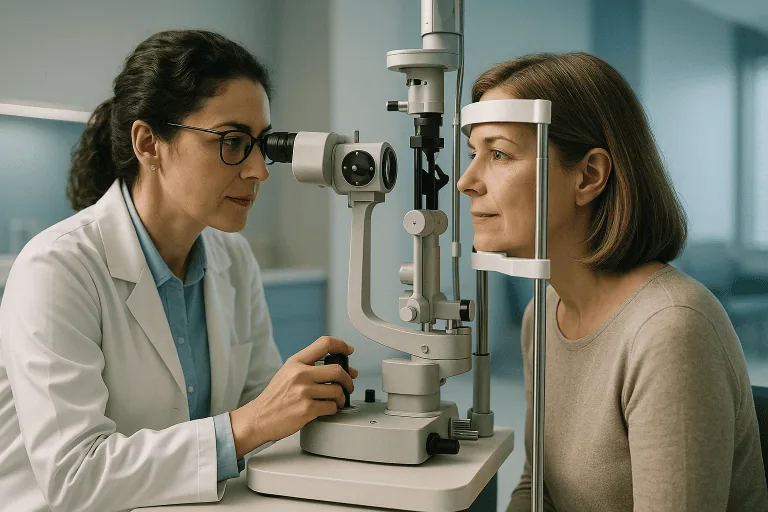
Diagnosis starts with a comprehensive eye examination. This typically includes visual acuity testing, refraction to measure your prescription, slit-lamp examination of the front of the eye, eye pressure measurement, a dilated retinal examination and formal cataract assessment. For surgical planning, ophthalmologists add precise measurements: optical biometry to record the length and curvature of the eye, corneal topography or tomography to map the corneal surface, keratometry, anterior chamber evaluation and, where needed, macular imaging. These tests calculate the lens power, quantify astigmatism and confirm whether the retina and cornea are healthy enough to support the visual outcome you are hoping for.
Some eye conditions call for extra evaluation before any decision. Dry eye disease, corneal irregularity, glaucoma, diabetic eye disease, macular degeneration, previous retinal surgery or prior corneal laser treatment can all influence lens choice and surgical planning. These conditions rarely rule out IOL surgery altogether, but they may reshape expectations and sometimes justify a staged or more cautious approach.
An intraocular lens is worth considering when the expected benefit outweighs the risks and when you understand the likely visual result. Some people aim for excellent distance vision and are perfectly content wearing reading glasses. Others want more spectacle independence and accept the possibility of night halos or subtle contrast changes. Neither preference is wrong; the point is to know which one is yours before the lens is chosen.
Conditions an IOL Can Treat
Cataract
Cataract removal with IOL implantation is the standard surgical procedure for cataracts: the cloudy natural lens is taken out and a clear artificial lens is put in its place, reopening the optical pathway to the retina. Because the replacement lens is chosen to a calculated power, the operation can also correct pre-existing refractive error at the same time, depending on the lens selected and the eye’s measurements. There is no eye drop, tablet or exercise that removes an established cataract; surgery is the treatment.
Presbyopia
Presbyopia: the age-related loss of near focusing that sends most people to reading glasses in mid-life, is another reason patients explore lens-based correction. Multifocal or extended-depth-of-focus IOLs may help selected patients see across more than one distance. Candidacy depends on retinal and corneal health, lifestyle and your tolerance for possible visual phenomena such as halos around lights, which is why honest screening matters more here than anywhere else in lens surgery.
Astigmatism
Astigmatism can be addressed with a toric IOL when the irregular focusing pattern originates in the cornea and is stable enough to correct. The lens must be aligned to a precise axis during surgery, and careful preoperative measurement determines whether toric correction is worthwhile in your case.
High myopia and hyperopia
High short-sightedness or long-sightedness may be treated with refractive lens exchange or a phakic IOL in carefully selected patients. The choice depends on age, prescription, eye anatomy and the state of the natural lens. Younger patients with clear natural lenses may be considered for phakic implants if the internal anatomy of the eye is suitable; older patients with presbyopia or early lens changes are often better served by lens exchange, since their natural lens is already losing function.
Lens damage after trauma or previous surgery
IOL implantation is also relevant when the natural lens has been damaged or removed after eye trauma or earlier surgery. These cases tend to be more complex: they may require specialised fixation techniques, a detailed retinal evaluation and a frank discussion of what visual recovery is realistic.
What is the new treatment for cataracts in 2026?
There is no new treatment that has replaced surgery: removal of the cloudy lens and implantation of an IOL remains the established, effective treatment for cataract. What continues to evolve is the detail, lens optics, measurement technology and surgical instrumentation improve incrementally year on year. Research into pharmacological approaches exists, but nothing of the kind is an available clinical alternative, and headlines suggesting otherwise deserve scepticism. If you are weighing whether surgery is the right route at all, our guide on choosing between surgical and non-surgical treatment sets out a useful way to frame that decision.
How Lens Replacement Surgery Is Performed
Lens replacement surgery, whether for cataract or refractive lens exchange, follows a staged pathway that begins well before the day of the operation. Each stage exists to protect the accuracy of the final result.
Planning and measurement
At the planning stage, the ophthalmology team reviews your medical history, current medications, previous eye procedures, general health and visual goals. Expect questions about your daily life: driving, computer use, reading habits, sport, professional demands and how you feel about glasses. This conversation is what allows the surgeon to recommend lens options that are both medically suitable and genuinely aligned with how you live.
Preoperative testing is detailed because lens power must be calculated precisely. Optical biometry measures the length and curvature of the eye. Corneal mapping evaluates the shape of the cornea and identifies astigmatism or irregularity. Retinal imaging may be added to assess the macula, particularly in patients with diabetes, age-related retinal changes or unexplained vision loss. The tear film and ocular surface are checked too, because dry eye can distort measurements and add to postoperative irritation.
If dry eye, eyelid inflammation or another treatable condition is found, the surgeon may recommend treating it before final measurements are taken: a step that improves measurement reliability. Contact lens wearers are usually asked to stop wearing lenses for a period before testing, since contact lenses temporarily alter corneal shape. Patients with diabetes benefit from particularly careful preparation; our pre-procedure planning guide for patients with diabetes explains what that involves in practice.
What happens on the day of surgery
Cataract surgery and refractive lens exchange usually run as a day-case procedure under local anaesthesia with numbing eye drops, sometimes with mild sedation depending on your needs and the hospital protocol. You are awake throughout. A typical sequence looks like this:
- The eye is numbed with anaesthetic drops and cleaned; the surgical team confirms the eye, the lens and the plan.
- The surgeon makes very small incisions at the edge of the cornea, small enough that they usually seal without stitches.
- Ultrasound energy (phacoemulsification) or another lens-removal technique breaks up the cloudy or natural lens, which is removed in fragments.
- The folded IOL is inserted through the same small opening and unfolds into position inside the lens capsule: the natural membrane that held the original lens.
- The surgeon checks the lens position and, for toric lenses, its alignment, then protects the eye with a shield or dressing.
The procedure for one eye is typically short, often completed in under an hour, although preparation and observation add time to the hospital visit. Most patients go home the same day. If both eyes need treatment, they are commonly scheduled on separate days, so the first eye can begin healing and the surgeon can evaluate its response before treating the second.
How phakic IOL surgery differs
Phakic IOL surgery leaves the natural lens in place. The artificial lens is positioned in front of it, behind the iris or in another appropriate location depending on the lens design and your anatomy. Suitability rests on adequate space inside the eye, healthy corneal endothelial cells and a stable prescription, all of which are checked during the diagnostic workup.
The first hours and days after surgery
After surgery you will usually wear a protective shield, at least at night, and use prescribed antibiotic and anti-inflammatory eye drops on a set schedule. Mild scratchiness, watering, light sensitivity and blurred vision are common early on. Discomfort is generally modest and managed with a straightforward planhow post-procedure pain control works at Acibadem describes the general approach. You will be asked to avoid rubbing the eye, swimming, heavy lifting and dusty environments for a period your surgeon defines, and follow-up visits are scheduled to check healing, eye pressure, lens position and visual progress.
Modern IOL surgery leans on careful diagnostics and microsurgical precision: high-resolution optical measurement, corneal mapping systems, ocular imaging, digital surgical planning, operating microscopes and refined instruments that work through very small incisions. In some cases, laser-assisted steps may be considered for portions of the procedure, depending on your condition and the surgical plan. The value of all this technology is not the equipment itself but the decisions it informs, lens power, astigmatism management, incision placement and confirmation that the rest of the eye is healthy.
Recovery After IOL Surgery: A Realistic Timeline
Recovery varies with the procedure type and the health of your eye, but a common pattern is early visual improvement followed by several weeks of gradual stabilisation. Vision may fluctuate day to day at first; that is expected, not a sign of failure.
| Time Period | What You Can Expect |
|---|---|
| Day 1 | Vision may be brighter but still blurry or fluctuating. Mild irritation, watering and light sensitivity are common. Eye drops and protective instructions begin. |
| First week | Many patients return to light daily activities. Follow-up checks assess healing, eye pressure and lens position. Rubbing the eye and strenuous activity are avoided. |
| First month | Vision generally becomes more stable. Drops are tapered according to the surgeon’s plan. If glasses are still needed, a prescription is usually considered once healing has progressed. |
| Longer term | The IOL stays in place. Some patients later develop clouding of the lens capsule, which can often be treated with a brief laser procedure if it affects vision. |
If you are travelling for treatment, discuss timing before you book anything. Many people can fly after their early postoperative checks if healing is on course, but the plan depends on whether one or both eyes are treated, the lens type, any coexisting eye disease and the length of stay your ophthalmologist recommends. Our guide on flying after surgery, procedure by procedure explains the general principles. A written postoperative plan, and communication with your local eye doctor for ongoing monitoring once you are home, can be arranged when needed.
Living With an IOL: Durability and Long-Term Questions
How long does an intraocular lens last?
An intraocular lens is designed to last for the rest of your life; the biocompatible materials it is made from do not wear out or need routine replacement. What can change over time is the tissue around it. The capsule that holds the lens sometimes turns cloudy months or years later, a condition called posterior capsule opacification, and if it affects vision it is usually treated with a brief outpatient laser procedure, not another operation. The eye itself also continues to age, so conditions such as glaucoma or macular degeneration can still develop and still need care; the IOL does not prevent them.
Can an intraocular lens be removed and replaced?
Yes: an IOL can be removed and exchanged for a different lens, but this is a more delicate operation than the original implantation and is done only when there is a clear reason. Typical reasons include a significant power miscalculation, persistent intolerance of multifocal optics, lens damage, or dislocation of the lens from its intended position. An exchange is technically easier in the early months, before the capsule seals around the implant; later exchanges remain possible but carry more surgical complexity. This is one more argument for choosing carefully the first time.
Can intraocular lens replacement surgery be reversed?
Not in the sense most people mean: once the natural lens has been removed, it cannot be put back, so lens replacement surgery is permanent by design. What can sometimes be done is an exchange, swapping one implant for another, as described above. Phakic IOL surgery is the partial exception: because the natural lens stays in the eye, a phakic implant can be removed and the eye returns broadly to its pre-operative optical state.
Is intraocular lens dislocation an emergency?
IOL dislocation, the lens shifting out of its intended position, is treated by ophthalmologists as an urgent problem that needs prompt specialist assessment, though it is not always operated on the same day. A dislocated lens typically causes a sudden change in vision, doubled or ghosted images, or the sensation of seeing the edge of the implant. It can occur soon after surgery or many years later, and is more likely after eye trauma, in eyes with weak lens-support fibres (as in pseudoexfoliation), or after certain previous eye operations. The timing and technique of repair depend on where the lens has moved and on the health of the rest of the eye, which is why specialist evaluation drives the plan.
Why Acting Early Matters
Cataract surgery is rarely urgent, and its timing should be individual. But waiting too long has real costs. Poor contrast, glare and reduced depth perception can increase the risk of falls, make driving harder and chip away at independence. People quietly begin avoiding evening activities, reading less and feeling less confident in unfamiliar places, often without connecting those changes to their eyes.
Advanced cataracts can also make the operation itself more demanding. A very dense lens needs more energy to remove and may be associated with slower recovery or more postoperative inflammation. A dense cataract can additionally block the ophthalmologist’s view of the retina, which matters for anyone whose retina needs monitoring, patients with diabetes or macular disease most of all.
For refractive lens exchange and phakic IOL candidates, early evaluation is useful for a different reason: candidacy changes over time. Eye anatomy, corneal health, lens clarity and retinal status all shift with age, and a current, comprehensive assessment beats assumptions based on an old prescription. It is also worth knowing that symptoms such as sudden vision loss, eye pain, flashes, new floaters or distortion usually point to conditions other than cataract, and sit outside the scope of planned lens surgery altogether.
Benefits of Intraocular Lens Treatment
The benefits you can realistically expect depend on the reason for surgery, the health of your eye and the lens chosen, but the goals are consistent: clearer vision, better daily function and a lens plan matched to your life.
| Benefit | What It Means for You |
|---|---|
| Clearer vision after cataract removal | The cloudy natural lens is replaced with a clear artificial lens, letting light reach the retina more effectively and easing everyday visual tasks. |
| Personalised refractive correction | The IOL power is calculated for your individual eye, and selected lens types can address distance vision, astigmatism or a wider range of focus. |
| Reduced dependence on glasses in selected patients | Depending on lens design and eye health, some patients need glasses less often for particular activities such as driving, screen work or reading. |
| Same-day procedure in many cases | Most cataract and lens exchange operations are performed without an overnight stay, with follow-up arranged to monitor early healing. |
| Long-term lens stability | Intraocular lenses are designed to remain in the eye long term, although the eye itself may still develop other age-related conditions that need care. |
Factors That Influence Outcomes
A good result with an intraocular lens depends on more than the operation. The first major factor is measurement accuracy. Lens power calculations rest on precise data about the eye’s length, corneal curvature and optical properties, and conditions such as dry eye, an unstable corneal surface or previous refractive laser surgery make those calculations harder, sometimes requiring extra testing or adjusted formulas.
The second factor is the health of the rest of the eye. An IOL clears the optical pathway; it cannot repair vision lost to retinal disease, advanced glaucoma, corneal scarring or optic nerve damage. This is exactly why the retina and optic nerve are examined in detail before surgery. If another condition is present, the surgeon should explain plainly how it may cap the final visual result, and a surgeon who does so is doing you a service, not talking you out of treatment.
Lens selection itself is critical. A monofocal lens may deliver excellent clarity at one distance with few optical side effects, at the price of glasses for other distances. Multifocal and extended-depth-of-focus lenses may reduce spectacle dependence, but they do not suit every eye and can involve glare, halos or reduced contrast in some lighting. Toric lenses improve astigmatism correction, but only with stable alignment and accurate planning behind them.
Expectations shape satisfaction as much as optics do. Someone expecting freedom from glasses for every task may be setting an unrealistic bar; someone highly sensitive to night glare may be happier with a simpler lens and reading glasses. A careful preoperative discussion pins down the actual goal, clearer vision, safer driving, easier reading, less spectacle dependence, or a balance among them.
Surgical technique, postoperative care and your own adherence matter too. Using the prescribed drops, attending follow-up visits and avoiding eye rubbing and unsafe activities during early healing all reduce the chance of problems. Serious complications are uncommon but real: infection, inflammation, raised eye pressure, retinal swelling, retinal detachment, lens movement or persistent visual symptoms. Early detection and treatment make the difference when they occur, which is one reason the follow-up schedule deserves respect.
Finally, general health plays its part. Diabetes, autoimmune disease, certain medications and prior eye trauma can all affect healing. If you are travelling from abroad, complete medical and ophthalmic records, previous eye surgery details, current medications, recent imaging and prescription data, allow the surgical team to plan with the full picture rather than fragments of it.
How Acibadem Approaches Intraocular Lens Treatment
For anyone considering eye surgery outside their home country, confidence is built on careful evaluation, clear communication and coordinated planning, not on marketing. At Acibadem hospitals, intraocular lens treatment begins with a specialist examination and a full diagnostic workup, and the first question is not which lens to implant but whether surgery is appropriate at all, and which lens strategy fits your eye and your life.
When patients have additional eye conditions, glaucoma, retinal disease, diabetes-related changes or corneal problems, care may draw on the relevant subspecialists, so that the surgical plan reflects the whole eye rather than the lens alone. Advanced diagnostic and surgical tools support the process: optical biometry, corneal mapping, ocular imaging, digital planning and microsurgical systems that operate through very small incisions. Their value lies in the judgments they enable, selecting lens power, managing astigmatism, spotting retinal concerns before surgery and monitoring healing afterwards.
Experienced surgeons remain the core of it. IOL surgery requires judgment as well as technical skill, especially in eyes with high prescriptions, previous laser correction, dense cataracts or irregular astigmatism. Part of that judgment is knowing when a premium lens is genuinely suitable, when a simpler lens is the safer recommendation, and when another eye condition should be treated first. Some patients are best served by standard cataract surgery with a monofocal lens; others are candidates for toric, multifocal or extended-depth-of-focus designs; others need dry eye or retinal treatment before lens surgery is sensible. The approach is personalised rather than procedure-driven.
Acibadem International supports patients travelling from abroad with the practical framework cross-border care needs: appointment coordination, medical record review, interpretation support in a wide range of languages, and help with hospital logistics. For eye surgery in particular, the practical details, number of visits, timing between eyes, travel recommendations, drop schedules and follow-up arrangements, are set out clearly before arrival, so nothing about the pathway comes as a surprise.
Making a Well-Informed Decision
An IOL can play an important role in restoring clearer vision after cataract, and in reducing dependence on glasses for carefully selected patients. The best outcomes share the same starting point: an accurate diagnosis, a thorough set of measurements, a frank discussion of lens options and a realistic understanding of what each design can and cannot do.
Many people also seek a second opinion before committing, particularly those offered several lens options, those told they are unsuitable for a specific procedure, and those with previous eye surgery, high astigmatism, retinal findings or complex prescriptions. A structured second opinion clarifies the diagnosis, compares lens choices on their merits, reviews the risks and tests whether the expected benefit truly matches your lifestyle. Whatever path you take, the principle holds: the right intraocular lens is not the most advanced one available. It is the one that fits your eye, your priorities and your medical reality, chosen with full knowledge of the trade-offs, by a surgeon willing to name them.
Preparation
- Before intraocular lens implantation, an ophthalmologist performs a detailed eye examination, vision testing, and biometric measurements to select the appropriate lens power. Patients may be asked to stop certain medications or eye drops before surgery. Fasting instructions may apply if sedation is planned.
Aftercare
- After the procedure, prescribed antibiotic and anti-inflammatory eye drops are used to support healing and reduce infection risk. Patients should avoid rubbing the eye, swimming, heavy lifting, and dusty environments for the recommended period. Follow-up visits are important to check vision, eye pressure, and lens position.
Frequently Asked Questions
What affects the cost of an intraocular lens procedure?
The final cost depends on the clinical indication, lens type, eye measurements, surgeon and hospital fees, diagnostic tests, anaesthesia plan, aftercare, and whether one or both eyes are treated. Travel, accommodation, translation, and coordination services may also affect the overall budget for international patients.
How can I get a personalised quote from Acibadem?
You can request a complimentary consultation and share your eye reports, prescription, previous surgery details, and any imaging if available. An ophthalmology specialist can then advise which options may be suitable and the international patient team can prepare a personalised quote based on your treatment plan.
Is the most advanced lens always the best choice?
Not necessarily. The most suitable lens depends on your eye health, prescription, corneal measurements, retina status, lifestyle, night driving needs, and expectations about glasses. A specialist examination is required before recommending any lens.
What is usually included in an international patient package?
Package contents vary by case, but may include ophthalmology consultation, diagnostic testing, the selected lens implant, surgery-related hospital services, routine postoperative checks, and patient coordination. You should confirm exactly what is included before travelling.
Will I need follow-up care after returning home?
Follow-up is important after intraocular lens surgery. Your surgeon will advise the check-up schedule, medications, and warning symptoms. International patients should also plan access to an eye doctor in their home country if ongoing monitoring is needed.
Medically reviewed by the Acıbadem International Medical Board September 13, 2026
See our medical review board →
Update history
- PublishedJune 8, 2026
- Medical review approvedSeptember 13, 2026
- Last content updateSeptember 12, 2026
Trusted care for international patients
From the Acibadem Blog

When an Intraocular Lens Needs Repositioning or Exchange: What Happens Next
An intraocular lens exchange is an operation to remove an artificial lens implanted during earlier cataract surgery and replace it with a new one.…