Can You Replant Hair? Transplant Options Explained

Hair transplantation redistributes existing healthy hair follicles rather than creating brand-new hair. The best candidates usually have stable hair loss and enough donor hair at the back or sides of the scalp.
Key Takeaways
- Hair transplantation redistributes existing healthy hair follicles rather than creating brand-new hair.
- The best candidates usually have stable hair loss and enough donor hair at the back or sides of the scalp.
- FUE and DHI are common techniques, and the right method depends on individual needs rather than one being universally best.
- Not all hair loss should be treated with transplantation; medical causes may need diagnosis and treatment first.
- Results develop gradually over months, and realistic expectations are important for satisfaction.
- A qualified dermatologist or hair restoration specialist can help decide whether surgical or non-surgical care is more appropriate.
Hair can often be “replanted” through hair transplantation, a procedure that moves healthy follicles from one area of the scalp to another. The best option depends on the cause of hair loss, scalp health, donor hair supply, and personal goals.
Overview: Can Hair Be Replanted?
Yes, hair can often be “replanted,” but the medical term is hair transplantation. In this procedure, healthy hair follicles are taken from an area where hair is growing well, usually the back or sides of the scalp, and placed into areas affected by thinning or baldness. Because the follicles come from the person’s own scalp, they can continue to grow in their new location if they are carefully selected and transplanted.
Hair transplantation does not create new follicles from nothing. Instead, it redistributes existing hair to improve coverage and shape. This is why the amount and quality of donor hair matter so much. People with a strong donor area usually have more options than those with very limited remaining hair.
Modern techniques aim to create a natural hairline and natural direction of growth. Depending on the pattern of hair loss, treatment may focus on the hairline, temples, crown, or diffuse thinning across a wider area. Some people also explore transplantation for eyebrows or beard restoration, but scalp hair loss is the most common reason.
For many patients, a transplant is one part of a broader hair restoration plan. Non-surgical approaches, scalp care, and treatment of underlying conditions may also be important. In selected cases, specialists may discuss non-surgical hair restoration alongside transplant planning.
Who Is a Good Candidate for Hair Transplantation?
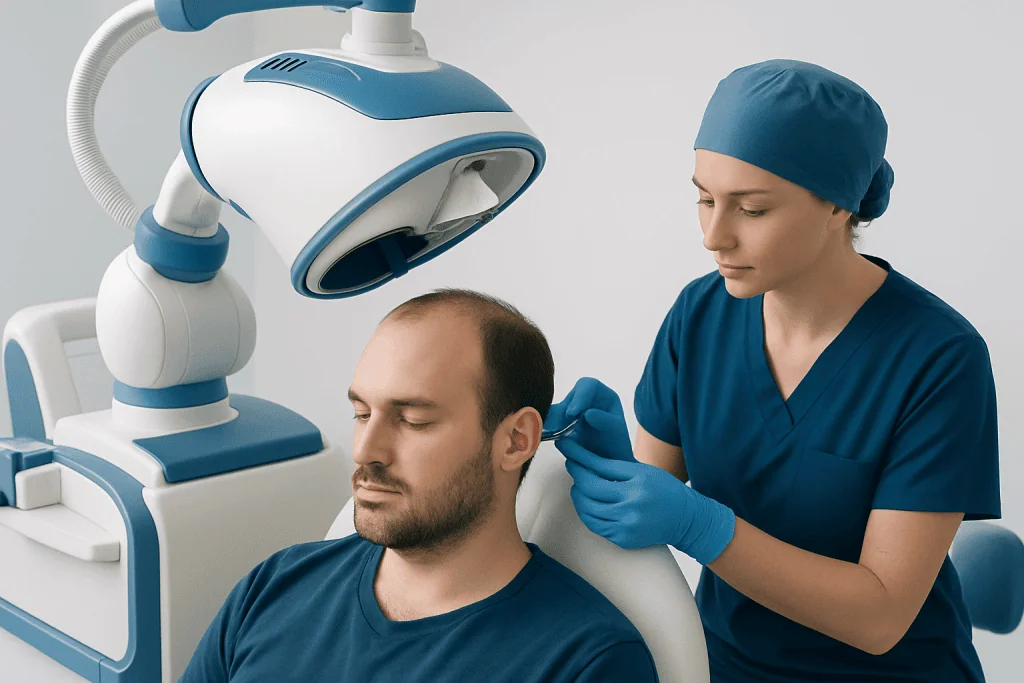
The best candidates are usually people with stable hair loss, healthy scalp skin, and enough donor hair to move. Male and female pattern hair loss are common reasons to consider transplantation. A person’s age is less important than the stability of the hair loss pattern, the long-term plan, and whether expectations are realistic.
A careful evaluation is important because not every type of hair loss should be transplanted. If hair loss is due to an active inflammatory scalp disease, severe scarring, or a medical condition that is not yet controlled, a transplant may not be appropriate right away. For example, people with patchy autoimmune hair loss such as alopecia areata may need medical treatment and monitoring before any surgical option is considered.
Doctors also assess hair characteristics that influence the final appearance, including hair thickness, curl, color contrast with the scalp, and density in the donor area. These details can affect how much coverage can be achieved and how many grafts may be needed over time.
A good candidate also understands that a transplant improves hair distribution but does not stop future hair loss in untreated areas. This is why long-term planning matters. A natural result usually comes from preserving donor hair carefully and placing grafts with an eye toward future changes.
Common Causes of Hair Loss and Why Diagnosis Matters

Before discussing transplant techniques, it is important to understand why the hair is thinning. The most common cause is androgenetic alopecia, also called pattern hair loss. This condition often develops gradually and follows a recognizable pattern, such as recession at the hairline or thinning at the crown.
Other causes include stress-related shedding, nutritional deficiencies, hormonal changes, certain medications, traction from tight hairstyles, and autoimmune or inflammatory scalp disorders. Some skin conditions can affect scalp health as well. For example, untreated seborrheic dermatitis may cause irritation and flaking, while other inflammatory disorders may damage follicles more deeply.
In some people, hair loss is temporary and may improve when the underlying trigger is addressed. In others, it is progressive and may continue over many years. This distinction matters because transplanting hair into an unstable or actively inflamed scalp may lead to disappointing results.
That is why diagnosis should come before treatment selection. A specialist may ask about family history, recent illness, stress, diet, hair care habits, and medications. Looking at the pattern of loss and scalp condition helps determine whether transplantation, medicine, or a combined approach is most suitable.
How Hair Transplant Options Work
Hair transplant procedures use follicular units, which are the natural groupings of one to several hairs. The goal is to remove these units from the donor area and implant them into thinning areas while preserving their structure. Successful transplantation depends on gentle handling, precise placement, and attention to the angle and direction of growth.
One widely used technique is follicular unit extraction, often called FUE hair transplant. In FUE, individual follicular units are removed one by one, usually leaving very small dot-like scars that are less visible than a linear scar. This method is popular because it can support a relatively quick recovery and flexible styling in many patients.
Another option is DHI hair transplant, a technique in which extracted follicles are implanted with a specialized tool that can help control depth, angle, and direction. DHI may be helpful in selected cases where careful density planning is important, although the ideal method always depends on the individual scalp, hair type, and treatment goals.
Some clinics may also discuss broader hair operations or complementary treatments such as medical therapy or camouflage approaches. No single technique is best for everyone. The most appropriate option is the one that matches the person’s pattern of hair loss, donor supply, and long-term expectations.
Diagnosis and Planning Before a Procedure
Hair transplant planning begins with a medical assessment. The doctor examines the scalp, reviews the history of hair loss, and checks for signs of active inflammation, infection, or scarring. Photographs and density measurements may be used to map the donor and recipient areas and to create a treatment plan.
In some cases, laboratory testing may be recommended to look for contributing factors such as iron deficiency, thyroid problems, or hormonal imbalance. If the diagnosis is not clear, a dermatologist may use dermoscopy or, less commonly, a scalp biopsy to better understand the condition affecting the follicles.
Design planning is a major part of the consultation. The hairline should suit the person’s age, facial features, and likely future hair loss pattern. A very low or overly dense hairline may look unnatural later and may also use too many grafts, limiting options for future needs.
Doctors also discuss what the procedure can and cannot achieve. The number of grafts available, expected density, possible need for more than one session, and the timeline for visible growth should all be reviewed clearly. Good planning supports both safety and a more natural-looking outcome.
Recovery, Results, and Possible Risks
After a hair transplant, mild tenderness, redness, and small crusts are common for a short time. Patients usually receive instructions about washing, sleeping position, activity limits, and how to protect the grafts during the early healing period. Following aftercare instructions carefully is one of the simplest ways to support healing.
It is normal for some transplanted hairs to shed in the weeks after the procedure. This early shedding does not mean the transplant has failed; the follicles remain in place and later begin a new growth cycle. Visible regrowth usually develops gradually over several months, and full maturation may take longer.
As with any procedure, there are potential risks. These can include swelling, infection, bleeding, temporary shock loss of nearby hair, uneven density, unnatural direction, or scarring. Risk may be higher if the scalp has underlying disease, if expectations are unrealistic, or if the procedure is not planned carefully.
Long-term results also depend on what happens to the non-transplanted hair. Because native hair may continue to thin with age, some people eventually benefit from medications, supportive therapies, or an additional procedure. The best outcomes come from seeing transplantation as part of an ongoing hair management plan rather than a one-time cosmetic fix.
Alternatives, Self-care, and When to See a Doctor
Not everyone needs or wants surgery. Depending on the diagnosis, doctors may recommend medication, observation, low-level light approaches, camouflage methods, or scalp treatments first. Some people are better served by medical therapy to slow loss and improve scalp health before deciding whether transplantation is worth considering.
Self-care can also support overall hair health. Gentle hair care, avoiding tight hairstyles, addressing nutritional deficiencies, managing stress, and treating scalp conditions promptly can all help create a healthier environment for existing hair. These steps cannot always reverse pattern hair loss, but they may reduce avoidable damage or shedding.
A doctor should be consulted if hair loss is sudden, patchy, accompanied by itching or scalp pain, associated with recent illness or medication changes, or causing emotional distress. Medical review is especially important if there is redness, scaling, scarring, or signs of inflammation, since these can affect whether a transplant is advisable.
For people considering treatment abroad, coordinated assessment and follow-up are important. Acibadem International’s multidisciplinary specialists and JCI-accredited hospitals diagnose and treat hair loss concerns for international patients, helping determine whether transplant or non-surgical care is the better fit.
Frequently asked questions
Is a hair transplant permanent?
Transplanted follicles are generally chosen from areas that are more resistant to pattern hair loss, so the results can be long lasting. However, the person’s existing non-transplanted hair may continue to thin over time, which is why long-term planning is important.
What is the difference between FUE and DHI?
Both methods involve moving healthy follicles from a donor area to a thinning area. FUE refers to the extraction of individual follicular units, while DHI is an implantation approach that uses a specialized tool to place follicles with careful control of angle and depth.
Can women have hair transplants too?
Yes, some women are good candidates for hair transplantation, especially when they have stable thinning and an adequate donor area. Because female hair loss can have different patterns and causes, evaluation by a qualified specialist is especially important.
Does a hair transplant hurt?
The procedure is usually performed with local anesthesia, so discomfort during treatment is generally limited. Mild soreness or tenderness afterward is common, but doctors provide aftercare guidance to help keep recovery comfortable.
How long does it take to see results after a hair transplant?
Early shedding of transplanted hairs is common in the first weeks. New growth usually begins gradually over several months, and the final appearance continues to improve as the hairs mature.
Can all types of hair loss be treated with transplantation?
No. Some forms of hair loss, especially those caused by active inflammation, scarring, or unstable autoimmune disease, may not be suitable for transplantation until the condition is controlled. Proper diagnosis comes first.
References
- American Academy of Dermatology
- British Association of Dermatologists
- National Health Service
- International Society of Hair Restoration Surgery
- Mayo Clinic
This article is for general information only and is not a substitute for professional medical advice. Please consult a qualified doctor about your individual situation.
Hair transplant in Turkey — costs, graft counts & a free assessment
JCI-accredited · board-certified surgeons · reply within 24h
Add us as a Preferred Source to see more of our trusted health content across Google Search, AI Overviews and Discover.

Related Treatments
Related Conditions
More from the Health Library



Related Specialists

Prof. Dr. Sedef Şahin
Dermatology
Prof. Dr. Özlem Dicle
Dermatology
Prof. Dr. Emel Öztürk Durmaz
Dermatology
Assoc. Prof. Dr. Yasemin Koyuncu
Dermatology