LASEK
LASEK is a surface laser vision correction procedure that reshapes the cornea to reduce dependence on glasses or contact lenses for myopia, hyperopia or astigmatism.
Quick answer
LASEK is a surface laser eye surgery that reshapes the cornea to reduce dependence on glasses or contact lenses for myopia, hyperopia, and astigmatism. At Acibadem in Turkey, it is performed after a detailed eye assessment by gently moving the cornea’s outer layer aside, applying the laser correction, and allowing the surface to heal as vision gradually stabilizes.
LASEK: A Laser Operation for Eyesight: What It Is and Who It Suits
LASEK, or laser-assisted subepithelial keratectomy, is a surface laser operation for eyesight. It uses an excimer laser to reshape the cornea, the clear front window of the eye, so that light focuses more accurately on the retina. It is used to correct myopia (nearsightedness), hyperopia (farsightedness) and astigmatism in adults whose prescriptions have stopped changing, and it is often considered when the cornea is too thin, or its structure otherwise unsuitable, for LASIK.
Deciding on any laser operation for eyesight is both a medical decision and a personal one. Many people who consider LASEK have lived with glasses or contact lenses for years and want more freedom in daily life, sport, travel or work. At the same time, caution is reasonable. Your eyes are delicate, your vision is central to how you work and connect with the world, and the questions you are probably asking are practical ones: Is LASEK safe for my eyes? Will it hurt? How long will recovery take? What happens if my vision changes later? This page answers those questions plainly.
Because LASEK is elective, the most important step is not deciding to have surgery. It is confirming that your eyes are suitable and that the procedure matches your visual needs, corneal measurements, prescription stability and long-term eye health. A well-planned laser operation for eyesight starts with measurement, not with a booking. Even a technically flawless procedure is the wrong procedure if the cornea is unstable, the prescription is still changing, the eye surface is unhealthy or your expectations do not match what laser correction can reliably deliver.
At Acibadem, LASEK is approached through detailed preoperative assessment, evidence-based protocols and individualised surgical planning. The conversation begins before treatment: understanding your goals, reviewing your eye history, assessing your candidacy and explaining the expected recovery in realistic terms, including the fact that LASEK recovery is slower than LASIK recovery, and that not every applicant is a candidate.
What Is LASEK?
LASEK is a surface ablation procedure. In practice, that means the laser treatment is applied to the front surface of the cornea rather than under a flap cut into deeper corneal tissue. The very thin outer layer of the cornea, the epithelium, a sheet of cells only a fraction of a millimetre thick, is loosened, usually with a diluted alcohol solution applied for a short period, and gently moved aside. The excimer laser then removes microscopic amounts of corneal tissue in a precisely calculated pattern, changing the curvature of the cornea and therefore its focusing power. Afterwards, the epithelial sheet is repositioned where appropriate and a soft bandage contact lens is placed over the eye to protect the surface while it heals.
LASEK is closely related to PRK, the original surface technique. In PRK the epithelium is removed and grows back entirely; in LASEK it is preserved and repositioned where possible. Both belong to the same family of laser surgery procedures and share the same underlying principle: reshape the cornea, and the eye’s focus changes. It is worth being clear about what LASEK is not. It does not treat eye disease. It is a refractive procedure: it corrects how the eye bends light, nothing more. It does not prevent glaucoma, cataract, retinal problems or the age-related loss of reading vision.
What is laser eye surgery?
Laser eye surgery is the umbrella term for procedures that use a precisely controlled laser to reshape the cornea and reduce dependence on glasses or contact lenses. The family includes LASIK, LASEK, PRK and lenticule-extraction techniques such as SMILE. All of them target the same optical problem, light focusing in front of, behind, or unevenly across the retina, but they reach the corneal tissue in different ways, and that difference drives everything else: who is eligible, how recovery feels, and which risks matter most.
The laser used for the actual reshaping in LASEK is an excimer laser, which emits ultraviolet light that removes tissue with sub-micron precision and without heating the surrounding cornea. Modern platforms track the eye during treatment, pausing or adjusting if the eye moves, so the planned pattern lands where the measurements say it should.
LASEK vs LASIK: what is the difference?
The core of the LASEK vs LASIK comparison is how the surgeon reaches the corneal tissue that the laser reshapes. In LASIK, a thin flap of corneal tissue is created and lifted, the laser is applied underneath, and the flap is laid back down. In LASEK, no flap is cut into the corneal stroma; only the outermost cell layer is moved aside and the laser works on the surface.
That single difference has practical consequences. LASIK recovery is faster and more comfortable, because the surface layer is largely undisturbed, many LASIK patients see well within a day or two. LASEK recovery is slower and initially more uncomfortable, because the surface cells must heal and regenerate over several days. In exchange, LASEK preserves more corneal tissue and avoids flap-related considerations altogether, which is why it may be offered to people with thinner corneas, certain corneal surface characteristics, or occupations and sports where an eye impact could disturb a flap.
Neither procedure is universally better. The right choice depends on corneal thickness, corneal shape, tear film quality, prescription, pupil characteristics, general eye health and your own priorities. If you are also weighing up the flap-based option, our LASIK treatment guide covers that procedure in the same detail.
Who May Be a Candidate for LASEK?
LASEK may be considered by adults who want to reduce dependence on glasses or contact lenses and who have a stable refractive error. Most candidates have worn correction for myopia, hyperopia or astigmatism for years. Some are active in sport. Others struggle with contact lenses because of dryness, irritation or recurrent discomfort. Some live or work in environments, dusty workplaces, water sports, long-haul travel, where glasses and lenses are a genuine burden rather than a mild inconvenience.
A typical candidate is an adult whose prescription has been stable for an appropriate period, whose corneas are healthy, and whose examination shows no conditions that would raise risk. LASEK is often discussed specifically when LASIK is not preferred, because of corneal thickness, corneal structure or lifestyle. That judgement cannot be made from a prescription alone; it requires corneal imaging and a full ophthalmological examination.
The symptoms that bring people to a refractive consultation are usually those of uncorrected or awkwardly corrected refractive error rather than disease: blurred distance vision, difficulty reading road signs, eyestrain, headaches linked to visual effort, the shadowed or doubled edges of astigmatism, or simple frustration with the daily logistics of lenses. Some patients see perfectly well with correction and simply want to depend on it less.
Not everyone who wants LASEK should have it. Reasons to delay, choose another procedure or avoid elective laser correction include:
- an unstable or still-changing prescription;
- corneal disease or a suspicious corneal shape, including early keratoconus;
- significant untreated dry eye or active eye-surface inflammation;
- uncontrolled autoimmune disease or poorly controlled diabetes, which can affect healing;
- pregnancy and breastfeeding, which can temporarily shift the prescription and affect timing;
- expectations that laser correction cannot reliably meet.
A responsible recommendation rests on medical suitability, not on the strength of a patient’s wish to be free of glasses. Being told “not yet” or “not this procedure” is a legitimate, and sometimes the best, outcome of a refractive assessment.
Which Refractive Errors Can LASEK Correct?
LASEK corrects refractive errors: the situations in which the shape of the eye prevents light from focusing precisely on the retina. These errors are common, are usually managed with glasses or contact lenses, and are exactly what a laser operation for eyesight is designed to address at the level of the cornea itself.
Myopia (nearsightedness) makes distant objects blurry while near objects stay clearer. It usually occurs because the eye is slightly too long or the cornea too steep, so light focuses in front of the retina. LASEK flattens the central corneal curvature in a planned pattern to move that focal point back onto the retina.
Hyperopia (farsightedness) causes difficulty with near vision and sometimes distance vision, depending on the degree of error and the patient’s age. Light focuses behind the retina. In selected patients, LASEK steepens the corneal profile to increase focusing power.
Astigmatism arises when the cornea or lens is unevenly curved, more like a rugby ball than a football, so light focuses at multiple points. The result is blur, shadowing or distortion at every distance. LASEK can treat many forms of regular astigmatism by smoothing the curvature into a more balanced optical shape.
Many patients have a combination of these errors, and the treatment pattern is customised to the individual prescription and corneal map. Where LASEK is not the safest or most predictable approach, very high prescriptions, unusual corneal shapes, older patients with early lens changes: the surgeon may recommend a different laser technique, an intraocular lens option, or continued non-surgical correction.
How LASEK Is Performed
LASEK is an outpatient procedure. The laser treatment itself is brief, but the full process spans careful preparation before the day of surgery and structured follow-up afterwards. Understanding each stage removes most of the anxiety, so here is the pathway in order.
Preparation before surgery
Preparation begins with a detailed consultation and diagnostic examination. Your surgeon reviews your visual goals, prescription history, contact lens use, medical history, current eye medications and any previous eye conditions or operations. If you wear contact lenses, you will usually be asked to leave them out for a period before the final measurements, because lenses temporarily mould the cornea and can distort the readings on which your entire treatment plan is built. The exact interval depends on the lens type and your surgeon’s instructions.
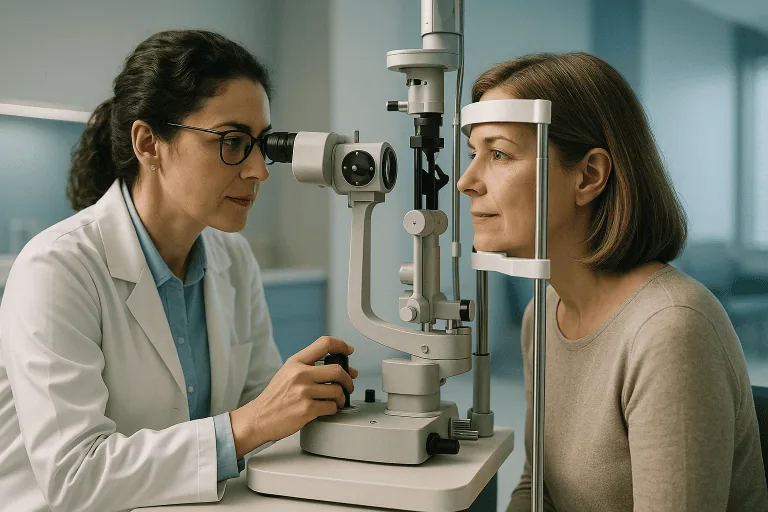
Preoperative testing typically includes refraction, corneal topography or tomography (mapping the shape and elevation of the cornea), pachymetry (measuring corneal thickness), tear film and ocular surface assessment, pupil measurement, eye pressure, and examination of the lens, retina and optic nerve. Together these tests answer two questions: can this cornea safely receive laser reshaping, and is LASEK the best of the available methods for this particular eye?
You will receive instructions about eye drops, hygiene and what to avoid before the procedure. Makeup, lotions and perfume are avoided on the day of surgery, because particles and residue can interfere with the sterile field. Arrange for someone to accompany you home: your vision will be blurry afterwards and you must not drive.
What happens during the LASEK procedure?
You are awake throughout, the eye is numbed with anaesthetic drops, and the sequence is short and standardised:
- Anaesthetic drops numb the eye; a small device holds the eyelids open so you cannot blink onto the surgical field.
- A diluted alcohol solution is applied briefly to loosen the thin epithelial layer on the corneal surface.
- The epithelium is gently moved aside as an intact sheet where possible.
- The excimer laser applies the calculated reshaping pattern, guided by eye-tracking that compensates for small natural eye movements. You will be asked to look at a fixation light.
- The epithelial sheet is repositioned when appropriate.
- A soft bandage contact lens is placed over the eye as a protective dressing while the surface cells heal.
Antibiotic and anti-inflammatory drops are prescribed afterwards to reduce infection risk and control inflammation, and in some cases the surgeon applies an additional medication to the corneal surface during the procedure to lower the risk of surface haze. Both eyes may be treated in the same session, depending on the treatment plan and the surgeon’s recommendation. You will feel pressure, coolness or fluid rather than sharp sensation during treatment.
Technology used in LASEK planning and treatment
The technology matters not because it replaces surgical judgement, but because it feeds that judgement with precise data. Corneal imaging detects subtle irregularities, including early keratoconus, that can rule out laser correction before harm is done. Pachymetry confirms there is enough tissue to remove safely. Wavefront or other advanced optical measurements may be used in selected cases to capture visual distortions that a standard glasses prescription cannot describe.
During treatment, the excimer laser removes tissue in a controlled pattern that may be standard, wavefront-guided or topography-guided depending on your anatomy and prescription. Your surgeon should be able to explain which approach is planned for your eyes and why: a useful test of how individualised the planning really is.
How long does LASEK eye surgery take?
The laser application itself takes well under a minute per eye in most cases, and the whole surgical episode, positioning, epithelial preparation, laser, bandage lens, is measured in minutes per eye. Plan to spend considerably longer at the clinic on the day, for final checks, the procedure itself and postoperative instructions.
Note that people asking “how long does LASEK eye surgery last” sometimes mean the durability of the result rather than the length of the operation; that question is answered in its own section further down this page.
Recovery After LASEK
Recovery after LASEK is gradual, and this is the single most important expectation to set correctly. The corneal surface must regenerate before vision sharpens, which makes the LASEK timeline slower than the LASIK timeline. The trade-off is deliberate: the surface approach preserves corneal structure that a flap-based procedure would alter.
Does LASEK eye surgery hurt?
The procedure itself is not typically painful, because anaesthetic drops numb the eye, most patients report pressure, fluid or mild awareness of touch rather than pain. The honest part of the answer concerns the days after surgery: as the anaesthetic wears off and the surface heals, discomfort is expected. Burning, grittiness, watering and light sensitivity are common in the first few days, and this early period is usually the least comfortable part of the whole process.
The bandage contact lens, the prescribed drops and lubricants, rest, dim lighting and avoiding eye rubbing all help. Discomfort characteristically improves as the epithelium closes over the treated surface, typically within the first several days.
How long after LASEK can I see clearly?
Functional vision returns before sharp vision does. In the first days, vision is blurry and fluctuating; many patients can manage undemanding tasks within the first week, and desk-based work often becomes practical within several days to a week, depending on comfort and visual demands. Clarity then improves progressively over the first weeks, with fine refinement continuing over several months, particularly with higher prescriptions or a sensitive ocular surface.
Driving, extended screen use, exercise, swimming and travel should each resume on your surgeon’s timetable, not a generic one, because they depend on how your surface is healing at follow-up.
| Time period | What patients can expect |
|---|---|
| Day 1 | Vision is blurry. Light sensitivity, watering, burning or a gritty sensation are common. Rest, prescribed drops and strictly avoiding eye rubbing matter most. |
| First week | The corneal surface heals under the bandage contact lens, which is removed at a follow-up visit. Discomfort usually eases over several days; vision fluctuates. |
| First month | Steady improvement for most patients, though clarity can vary day to day. Dryness, glare or halos may occur and are managed with lubricants and monitoring. |
| Longer term | Vision continues to stabilise. Refinement can continue over several months, especially with higher prescriptions or ocular surface sensitivity. |
LASEK surgery side effects
The most common LASEK surgery side effects are temporary and belong to the healing surface: discomfort in the first days, light sensitivity, watering, dryness, fluctuating vision, and glare or halos around lights at night during the early weeks. These usually settle as the epithelium regenerates and the tear film recovers, though dryness can persist longer in some patients and may need ongoing lubrication.
Less common effects include delayed epithelial healing and corneal haze: a subtle surface cloudiness that surface procedures can produce, which is why anti-inflammatory drops and follow-up visits are not optional extras but part of the treatment. Rarer still are infection, undercorrection, overcorrection, regression of the effect over time, and a reduction in the quality (rather than the amount) of vision. Serious complications are uncommon when patients are carefully selected and properly monitored, but no honest clinic will tell you the risk is zero. For a fuller discussion of how refractive-surgery risks are assessed and managed, see our guide to laser eye surgery risks, side effects and safety.
If your plans involve air travel soon after treatment, the practicalities differ between eye procedures, cabin dryness matters more after surface surgery than pressure changes do. Our comparison of flying after eye surgery explains what applies to laser vision correction specifically.
How Long Does LASEK Last?
The corneal reshaping achieved by LASEK is permanent: the tissue removed by the laser does not grow back, and the new curvature is a lasting change to the eye. For most suitably selected patients with a stable preoperative prescription, the correction achieved in the months after surgery remains their working vision for many years.
What LASEK cannot do is stop the eye from ageing. Two natural processes continue regardless of any laser operation for eyesight. The first is presbyopia: the gradual stiffening of the eye’s internal lens that makes near focus harder from midlife onwards. Patients who have distance vision corrected by LASEK will still, in time, need reading glasses or a specific strategy such as monovision for near tasks. The second is cataract, the clouding of the lens later in life, which changes vision independently of the cornea and is treated separately.
A small number of patients experience regression, a partial drift back towards the original prescription, particularly with higher corrections. Where residual error remains and the cornea is suitable, an enhancement procedure can be discussed; where it is not, glasses for specific tasks remain an option.
Does LASEK last forever?
The change made to the cornea is permanent, but “forever-perfect vision” is not a promise any refractive procedure can honestly make. Your eyes will continue to age, presbyopia will arrive on its own schedule, and a minority of patients see some regression of effect. The accurate summary: LASEK is a lasting correction of the refractive error you have today, not an exemption from the changes every eye undergoes over a lifetime. Surgeons ask for evidence of prescription stability before operating precisely so that the correction they lock in is one worth keeping.
Is a Laser Operation Good for Your Eyes?
For the right eyes, yes, laser vision correction is a well-established, extensively studied procedure that has been performed worldwide for decades, and for suitable candidates it reliably reduces dependence on glasses and contact lenses. The qualifier carries the weight: “the right eyes” means a stable prescription, adequate corneal thickness and shape, a healthy ocular surface and realistic expectations. For unsuitable eyes, the same operation can create problems rather than solve them, which is why screening is where safety is actually decided.
What is the downside to laser eye surgery?
The main downsides are the recovery period, the possibility of side effects and the limits of what correction can achieve. With LASEK specifically: several uncomfortable days while the surface heals, weeks of gradually sharpening vision rather than an overnight result, and a period of drops and follow-up appointments. Across laser procedures generally: dryness, night glare or halos that usually fade but occasionally persist, the small chance of needing an enhancement, and the certainty that the procedure will not prevent presbyopia or cataract later in life.
There is also an irreversibility to weigh. Corneal tissue, once removed, is not replaced, which is exactly why conservative planning and honest candidacy assessment matter more than any marketing claim.
What is the fail rate of laser eye surgery?
There is no single “fail rate”, because failure means different things: a residual prescription that needs an enhancement or occasional glasses, side effects that outlast the expected healing window, or, rarely, a complication that reduces vision quality. These outcomes have very different frequencies and very different remedies, and they vary with the prescription being treated, the health of the cornea and the rigour of preoperative screening. What can be said honestly is this: serious, vision-threatening complications are uncommon in properly selected patients, most residual errors can be addressed, and the single biggest protection against a poor outcome is a thorough assessment that is willing to say no. Any clinic quoting you a universal success figure without having measured your eyes is telling you about its marketing, not your risk.
What Influences a Good LASEK Result?
A good LASEK result begins with correct patient selection. The most advanced laser plan cannot compensate for an unsuitable cornea or an unstable prescription, which is why the preoperative evaluation is the most important part of treatment. Corneal thickness, corneal shape, degree of refractive error, tear film quality, age, pupil size and general eye health all influence both safety and visual quality.
Prescription stability deserves particular emphasis. If your myopia, hyperopia or astigmatism is still changing, the correction achieved by surgery will not stay accurate. Surgeons therefore want documented evidence of stability before proceeding. Age matters too: LASEK does not prevent presbyopia, so patients approaching midlife need a specific discussion about reading vision, monovision options or the future need for reading glasses.
Ocular surface health is another major factor. Dry eye can distort preoperative measurements, slow healing and blur the visual result. If dry eye, blepharitis or allergic inflammation is present, it may need treatment before LASEK is scheduled. After surgery, following the drop schedule, attending every follow-up visit and avoiding eye rubbing and contaminated water all directly support the outcome.
The size of the correction shapes expectations as well. Mild to moderate errors are generally more predictable than high prescriptions. Some patients will still want glasses for specific tasks, night driving is the classic example, and a small number may need an enhancement if residual error remains and the eye is suitable for further treatment. These possibilities should be discussed before surgery, not discovered afterwards.
Finally, results depend on communication. A pilot, a jeweller, a competitive swimmer, a software engineer and a frequent night driver all define “good vision” differently. Patients who explain their visual priorities clearly receive plans genuinely matched to their lives, which is what personalised refractive surgery actually means.
How Much Is LASEK? Understanding What Drives the Cost
The price of LASEK varies considerably between clinics, cities and countries, so the more useful question is what a quoted price actually includes. The genuine cost drivers are: the depth of the diagnostic workup (comprehensive corneal imaging and surface assessment versus a basic refraction), the laser platform and whether a customised wavefront- or topography-guided plan is used, the surgeon’s experience, the number of follow-up visits included, the medications and bandage lenses supplied, and the clinic’s policy on enhancement treatment if residual error remains.
A low headline price that excludes follow-up, drops or enhancement can cost more, in money and in outcome, than a higher all-inclusive one. Whatever you are quoted, ask for the itemised scope in writing and confirm who examines you before surgery and who sees you afterwards.
How do you choose the best LASIK surgeon or clinic?
There is no ranking that objectively identifies the best LASIK surgeon or LASEK surgeon, so judge providers by process rather than by advertising. Useful markers: the surgeon personally reviews your corneal imaging; the clinic performs the full diagnostic set described above rather than a quick refraction; more than one procedure is offered, so the recommendation can genuinely fit your eyes instead of the clinic’s single tool; declining unsuitable candidates is treated as normal practice; and recovery is described honestly, including the uncomfortable early days of a surface procedure.
These markers apply wherever you are comparing providers. A clinic that promises identical, effortless results to every enquirer has skipped the step on which safety depends: finding out whether your eyes qualify.
Why Timely Evaluation Matters
LASEK is not an emergency procedure, and waiting is sometimes the correct medical advice, when a prescription is unstable, the eye surface is inflamed or a general health condition needs better control. Timely evaluation still matters, because refractive decisions rest on the current state of the eye. A thorough examination establishes whether you are suitable now, whether treatment should wait, or whether another option is safer.
Postponing assessment can also prolong avoidable problems. Some patients persist with contact lenses despite chronic dryness, inflammation or recurrent infections; an ophthalmologist can determine whether laser correction is reasonable or whether the ocular surface should be treated first. Equally important, some corneal conditions, early keratoconus, irregular astigmatism, cause no symptoms the patient would notice, yet fundamentally change what surgery is safe. Modern corneal imaging detects these warning signs before an unsuitable procedure is performed, allowing monitoring or treatment instead.
Benefits of LASEK
The potential benefits of LASEK are only meaningful in relation to your own measurements, prescription and lifestyle. For suitable candidates, they look like this:
| Benefit | What it means for you |
|---|---|
| Reduced dependence on glasses or contact lenses | Many suitable patients rely less on corrective lenses for daily activities such as walking, exercising, travelling and working. |
| No deeper corneal flap | Because LASEK is a surface procedure, it avoids flap creation entirely, relevant for certain corneas, occupations and contact sports. |
| Personalised laser reshaping | Treatment is planned from your individual prescription and corneal map, supporting an individualised correction rather than a generic one. |
| Option for certain thinner corneas | Some patients who are not ideal LASIK candidates can still be evaluated for LASEK, depending on corneal thickness and shape. |
| Long-term convenience | For suitable patients, LASEK simplifies daily routines by reducing the practical burden of glasses, lenses and lens care. |
Making Your Decision
LASEK is an effective surface laser vision correction option for carefully selected adults with myopia, hyperopia or astigmatism, particularly when a surface procedure is preferred, when corneal characteristics call for a cautious approach, or when someone wants to reduce dependence on glasses or lenses without a corneal flap. Its honest trade-off is a slower, initially less comfortable recovery in exchange for preserving corneal structure.
The decisive step is a comprehensive refractive evaluation. With accurate measurements and a frank discussion of your goals, an ophthalmologist can establish whether LASEK is appropriate for your eyes, whether another procedure would serve your vision better, or whether treatment should wait. A careful decision made on that basis, rather than on a headline price or a hurried promise, is what a good result actually rests on.
Preparation
- A detailed eye examination measures corneal thickness, refraction and overall eye health to confirm suitability for LASEK. Patients may need to stop wearing contact lenses before testing and surgery as advised by the ophthalmologist. Avoid eye makeup, perfume and lotions on the procedure day, and arrange someone to accompany you afterward.
Aftercare
- A protective contact lens is usually placed while the surface of the eye heals, and prescribed eye drops help reduce discomfort and infection risk. Do not rub the eyes, avoid swimming and dusty environments, and attend scheduled follow-up visits. Vision may fluctuate during the first days and gradually stabilizes over the following weeks.
Frequently Asked Questions
What affects the cost of LASEK?
The final cost depends on your prescription, corneal measurements, eye surface health, diagnostic tests, surgeon and clinic factors, laser technology, follow-up plan and whether travel support is included. A personalised assessment is needed before an accurate quote can be prepared.
How can I get a personalised LASEK quote in Turkey?
You can request a free consultation and share recent eye examination results if available. The medical team may ask for corneal scans, prescription details and general health information before confirming suitability and preparing a personalised quote.
Are LASEK packages usually all-inclusive?
Package content varies by provider. Some packages may include consultation, diagnostic tests, surgery, medication guidance, early follow-up, interpreter support and transfer assistance, while other services may be separate. Always ask for a written list of what is included.
Does a lower treatment cost mean lower quality?
Not necessarily. Cost differences may reflect local operating expenses, package structure, exchange conditions, hospital model and travel services. Patients should evaluate accreditation, surgeon experience, technology, safety protocols and aftercare rather than cost alone.
Will I need follow-up care after travelling for LASEK?
Yes. LASEK requires post-operative checks to monitor healing, comfort, vision and the corneal surface. International patients should clarify the follow-up schedule, remote communication options and what to do if they need care after returning home.
Is this information medical or financial advice?
No. This is general educational information. A specialist examination is required to decide whether LASEK is suitable, and a personalised quote should be requested before making treatment or travel decisions.
Medically reviewed by the Acıbadem International Medical Board September 8, 2026
See our medical review board →
Update history
- PublishedJune 8, 2026
- Medical review approvedSeptember 8, 2026
- Last content updateSeptember 8, 2026