Shoulder Impingement Treatment
Shoulder impingement treatment aims to reduce pain and restore shoulder movement when tendons are compressed during arm elevation. Care may include rehabilitation, injections, activity changes, or arthroscopic surgery if needed.
Quick answer
Shoulder impingement treatment relieves compression of the rotator cuff tendons and bursa beneath the acromion. Most people start with activity modification and a structured exercise programme to restore shoulder mechanics; an image-guided steroid injection may reduce pain enough for rehabilitation to progress. Arthroscopic surgery is reserved for persistent symptoms or structural problems such as significant tendon tears. Recovery typically takes weeks to months, depending on the approach.
Shoulder Impingement: What It Is and How It Is Treated
Shoulder impingement is a condition in which the rotator cuff tendons, or the thin fluid-filled cushion above them called the subacromial bursa, are compressed and irritated when you raise your arm. It typically causes pain at the front or outer side of the shoulder during overhead movement, and it affects athletes, office workers, manual workers and older adults alike. Treatment ranges from structured rehabilitation and activity changes to image-guided injections and, in carefully selected cases, arthroscopic surgery.
The problem often announces itself quietly. A sharp pinch when you reach for a seatbelt. A twinge lifting a suitcase into an overhead compartment. Discomfort fastening clothing behind your back, or an ache that wakes you when you roll onto that side at night. For many people, shoulder impingement begins as an occasional pinch with overhead activity, then gradually becomes a persistent ache that interferes with work, exercise and sleep. Simple tasks you never thought about, placing an item on a high shelf, drying your hair, reversing the car, start to demand planning.
Uncertainty is part of the burden. You may wonder whether you have torn a tendon, whether you should rest the arm completely, whether an injection is safe, or whether surgery is inevitable. None of these questions has a single universal answer, which is exactly why a careful diagnosis matters more than a quick label. Two shoulders with identical pain can have quite different underlying problems, and the right plan for one may be the wrong plan for the other.
The aims of treatment are consistent, however: reduce pain, calm inflammation, improve the mechanics of how the shoulder moves, and protect the rotator cuff tendons from ongoing irritation. For most people, care begins with non-surgical treatment, above all a structured rehabilitation programme and sensible activity modification. Injections may be used when pain is too high for rehabilitation to progress. Surgery is considered when symptoms persist despite well-conducted conservative care, or when imaging shows structural problems that rehabilitation alone is unlikely to fix.
What Is Shoulder Impingement Syndrome?
Shoulder impingement syndrome is the clinical name for pain caused by pinching of the rotator cuff tendons and subacromial bursa during arm elevation. You may also see it called subacromial impingement or rotator cuff-related shoulder pain. These terms are closely related; they describe slightly different aspects of the same clinical problem, and clinicians increasingly use them interchangeably.
Understanding the anatomy makes the condition easier to grasp. The rotator cuff is a group of four tendons that lift and rotate the arm while keeping the ball of the shoulder joint centred in its shallow socket. Above these tendons sits a narrow corridor beneath the acromion, the bony roof formed by part of the shoulder blade. The bursa, a thin, lubricated cushion, normally lets the tendons glide smoothly through that corridor thousands of times a day.
When the shoulder does not move efficiently, or when the tissues in this space become swollen, the corridor effectively narrows. The tendons and bursa get pinched between bone above and bone below. The result is pain with overhead motion, weakness, night discomfort and, over time, restricted range of motion. Every element of treatment, exercise, injection or surgery, is ultimately about restoring room and smooth gliding in this space.
Symptoms: How Shoulder Impingement Feels and Who It Affects
The most typical symptom is pain on the front or outer side of the shoulder, often radiating down towards the upper arm but rarely past the elbow. Many people describe a painful arc: the shoulder hurts most when the arm is raised between shoulder height and overhead, yet may feel easier once fully elevated. Pain frequently increases when reaching behind the back, putting on a jacket, lifting weights away from the body, or lying on the affected side. Night pain is common, and for many people it is the symptom that finally prompts them to seek help.
What Does an Impinged Shoulder Feel Like?
An impinged shoulder usually feels like a sharp pinch or catch during specific movements, layered over a dull background ache that worsens after activity and at night. It is rarely painful at complete rest with the arm by your side. That pattern, movement-specific pain, a painful arc between roughly shoulder height and overhead, and night discomfort on the affected side, is what distinguishes impingement from conditions such as frozen shoulder, where stiffness dominates, or arthritis, where deep joint pain tends to be more constant.
Other symptoms may include:
- Weakness or early fatigue when lifting the arm
- A catching or pinching sensation with overhead movement
- Loss of confidence using the arm above shoulder level
- Reduced ability to train, swim, serve, throw or perform manual work
- Stiffness that develops when the arm is protected and under-used for too long
- Pain that settles with rest but returns as soon as activity resumes
Impingement does not respect age or occupation. Younger athletes develop it through repetitive throwing, swimming or racket sports. Adults with desk-based work develop it through sustained posture strain, rounded shoulders and reduced upper-back mobility. People in trades develop it through repeated lifting and overhead tasks that load the tendon faster than it can recover. Older adults develop it against a background of age-related tendon change, where a tendon that has quietly weakened over years finally becomes symptomatic. Sometimes symptoms begin after a minor injury; often they appear gradually, with no single event you can point to.
Treatment becomes worth pursuing when pain limits daily activities, sleep, work or sport; when symptoms keep returning despite rest; when weakness raises concern about a tendon injury; or when you need a structured plan to return safely to a higher level of activity.
Causes and Related Conditions
What Causes Shoulder Impingement?
Shoulder impingement is caused by a mismatch between the space available beneath the acromion and the tissues that must glide through it, either the space narrows, the tissues swell, or the shoulder moves in a way that repeatedly drives them together. In practice, most cases involve a combination of factors rather than one clean cause, which is why treatment plans that address only one element often disappoint.
The contributing conditions fall into several groups. Rotator cuff tendinopathy is a state in which the tendons become painful, thickened and less tolerant of load, usually after a period of doing more than the tendon could adapt to. Subacromial bursitis is inflammation and swelling of the bursa itself, which further crowds the space. External impingement describes the classic mechanical pinching of cuff and bursa under the acromion during elevation. Some people have partial-thickness rotator cuff tears, where part of the tendon’s depth is damaged; whether these need surgery depends on the depth of the tear, the symptoms and the function of the arm, not on the scan appearance alone. Others have calcific tendinitis, a painful calcium deposit within the tendon that can mimic or aggravate impingement.
Structural factors matter too. A hooked or curved acromion, bone spurs, thickened ligaments or arthritis of the acromioclavicular joint, the small joint where the collarbone meets the shoulder blade, can all narrow the tendon’s corridor. But imaging findings must be interpreted with restraint. Many people have age-related changes on scans and no symptoms at all. A bone spur on an X-ray does not automatically explain your pain, and treating the picture rather than the person is a well-recognised route to poor results.
Movement and lifestyle factors complete the picture. In athletes, impingement is often linked to shoulder blade dyskinesis (inefficient shoulder blade movement), loss of internal rotation, posterior capsule tightness or simple overuse from repeated throwing and serving. In office workers and frequent travellers, prolonged sitting posture, neck tension and a stiff upper back gradually alter shoulder mechanics. In manual workers, the tendon is simply asked to do more, more often, than it can repair between shifts. Identifying which of these applies to you is a core part of building a treatment plan that actually holds.
Diagnosis: Finding Out Why Your Shoulder Is Pinching
Diagnosis begins with a detailed history and physical examination, not with a scan. The physician wants to know when symptoms began, which movements trigger pain, what treatments you have already tried, whether there was an injury, and whether conditions such as diabetes, thyroid disease or inflammatory disease might influence healing. The examination looks beyond the shoulder joint itself: neck mobility, shoulder blade control, posture, strength and flexibility can all feed into impingement symptoms. Specific clinical tests reproduce impingement-type pain and help separate it from frozen shoulder, cervical spine problems, arthritis, instability and nerve-related conditions.
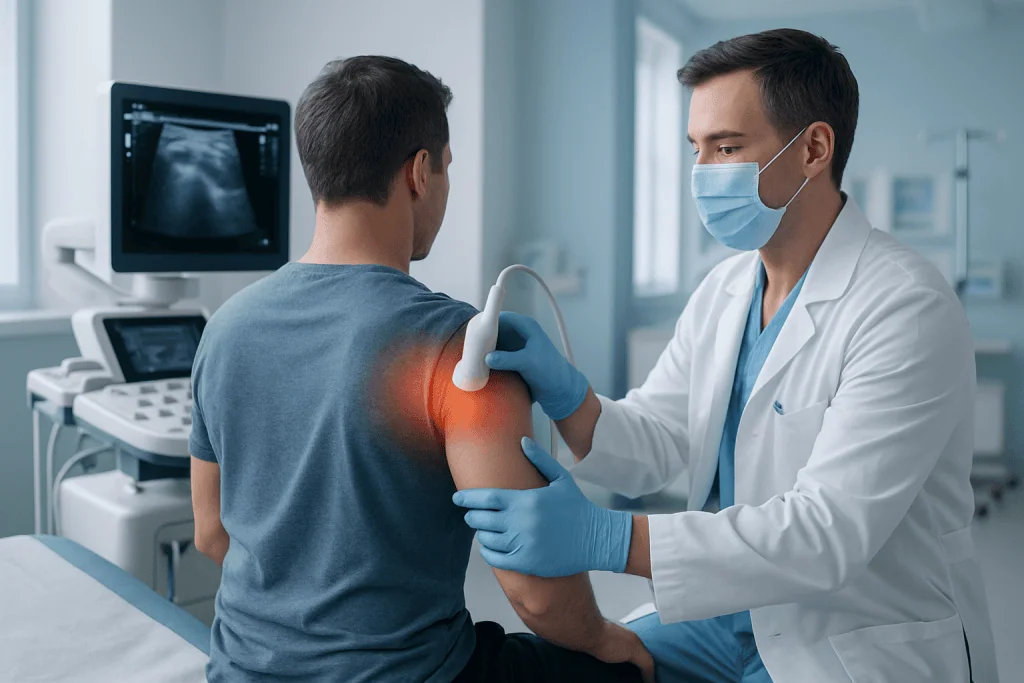
Imaging is added when it will answer a specific question, when symptoms are persistent, severe, recurrent, associated with weakness, or not improving as expected. X-rays show bone shape, joint narrowing, calcium deposits, acromioclavicular arthritis and bone spurs. Ultrasound evaluates the rotator cuff tendons dynamically, comparing sides and watching the tendon move in real time; it can also guide injections. MRI provides the most detailed soft-tissue picture: tendon quality, partial or full-thickness tears, bursitis, labral problems and other structures that ultrasound cannot fully assess.
How Can You Tell the Difference Between a Torn Rotator Cuff and Impingement?
The clearest distinguishing feature is weakness: impingement mainly causes pain with movement, while a significant rotator cuff tear also causes genuine loss of strength, sometimes to the point where lifting the arm becomes difficult or impossible. Tears are more likely after a fall or sudden load, and more likely with advancing age. The distinction is not always obvious from symptoms alone, because pain itself can make a strong tendon test weak. This is where examination technique and, when needed, ultrasound or MRI earn their place: a partial tear, a full-thickness tear and simple tendon irritation can each feel similar from the inside but call for different plans. Sudden weakness, pain after a fall, or an inability to lift the arm are all reasons for the diagnosis to be clarified promptly rather than assumed.
Scans and reports from previous care retain real value in this process. Reviewing existing imaging often shows whether repeat studies are necessary or whether the pictures already answer the clinical questions, and it can reveal whether an earlier diagnosis deserves a second look. A shoulder labelled “impingement” for a year sometimes turns out to be early frozen shoulder, referred neck pain or an unrecognised tendon tear.
How Shoulder Impingement Treatment Is Performed
Shoulder impingement syndrome therapy progresses in stages, and the stages exist for a reason: each one answers a question the previous one raised. Did pain settle with activity change and exercise? If not, does an injection create enough relief for rehabilitation to work? If not, is there a structural problem that surgery can correct? Skipping stages rarely speeds things up, because each stage also gathers information about your particular shoulder.
How Do You Fix Shoulder Impingement?
Most cases of shoulder impingement settle without surgery, through a staged plan that reduces irritation first and rebuilds capacity second. The typical sequence looks like this:
- Calm the shoulder down. Temporarily reduce the specific movements that provoke sharp pain, usually overhead loading, heavy lifting away from the body and sudden pulling, without stopping shoulder use altogether. Short-term medication may support this stage if your doctor judges it appropriate for your medical history.
- Restore movement and mechanics. Regain pain-free mobility, improve posture and shoulder blade control, and correct the movement patterns that were driving the pinching.
- Rebuild strength and load tolerance. Progressively strengthen the rotator cuff and the muscles that stabilise the shoulder blade, so the tendon corridor stays open under load.
- Return to full activity gradually. Reintroduce sport, training or work tasks step by step, with enough conditioning to prevent the cycle restarting.
Injections and surgery slot into this framework when the staged plan stalls: they are tools within the process, not alternatives to it.
Physical Therapy Treatment for Shoulder Pain
Physical therapy treatment for shoulder pain is the foundation of impingement care, because impingement is as much a movement problem as a tissue problem. A physiotherapist designs the programme around your examination findings, not just the diagnosis label. Two people with “impingement” may need opposite emphases: one needs mobility in a stiff posterior capsule, the other needs stability in a lax, poorly controlled shoulder. A structured physical therapy programme typically runs over weeks, with exercises progressed as the shoulder responds, and it works best when it is supervised, adjusted and honest about setbacks. Where symptoms are complex or long-standing, care may be coordinated through a physical medicine and rehabilitation team, which can combine exercise with other rehabilitation methods and track progress objectively.
When your shoulder is in pain, the natural instinct is to stop using it, and this instinct, followed too far, is one of the most common reasons recovery stalls. Complete rest leads to stiffness and weakness, which then make the original problem worse. The skill lies in modifying load, not eliminating it.
Shoulder Pain Exercise Therapy: What a Programme Includes
Shoulder pain exercise therapy for impingement moves through recognisable phases, even though the details are individual:
- Early phase: pain-free range of motion, gentle stretching, shoulder blade positioning drills and correction of obvious movement faults. The goal is to move without repeatedly re-irritating the tendon and bursa.
- Middle phase: rotator cuff strengthening with controlled resistance, scapular stabiliser training, and upper-back mobility work. Loads increase gradually, guided by how the shoulder feels in the following twenty-four hours.
- Late phase: functional loading, pressing, pulling, carrying and, for athletes, sport-specific patterns such as throwing or serving progressions. This phase decides whether the improvement survives contact with real life.
Progress is rarely a straight line. Temporary flare-ups after a step up in load are common and are usually a signal to adjust the pace, not abandon the plan.
Medication and Activity Modification
Short courses of anti-inflammatory medicines or pain relievers can reduce symptoms while rehabilitation gets under way, when your physician judges them appropriate. Suitability depends on your medical history, stomach, kidney, heart and blood-thinning considerations all matter, so decisions about any medication belong with your treating doctor. Activity modification runs alongside: it means changing how and how much you load the shoulder for a defined period, then reintroducing activity in a planned way, rather than an open-ended ban on using the arm.
Injections When Pain Limits Progress
If pain stays high enough to block effective exercise, an injection may be considered. A corticosteroid injection into the subacromial space reduces inflammation in the bursa and surrounding tissue; ultrasound guidance helps the physician place it precisely. The honest way to think about an injection is as a window: a period of lower pain during which rehabilitation can finally progress. It is not a substitute for correcting mechanics and strength deficits, and a shoulder that receives an injection but no rehabilitation frequently ends up back where it started.
Repeated steroid injections are used cautiously, because overuse may affect tendon quality. Before recommending one, the physician weighs symptom severity, imaging findings, tendon condition, medical factors such as diabetes, and the timing of any possible surgery. For people with persistent pain that resists standard approaches, a pain management (algology) team can contribute additional options and help distinguish tendon pain from other pain sources.
When Is Arthroscopic Surgery Considered?
Surgery is not the first step for most people with shoulder impingement. It becomes a reasonable discussion when symptoms persist after a genuine, structured period of conservative care; when function remains significantly limited; or when imaging identifies pathology that rehabilitation cannot address: a clinically relevant rotator cuff tear, painful acromioclavicular joint disease, or mechanically significant bone spurs.
The usual approach is shoulder arthroscopy. Through small incisions, a camera and fine instruments enter the shoulder. The surgeon inspects the joint, rotator cuff, biceps tendon, labrum, cartilage and subacromial space directly: a view no scan fully replicates. Depending on the findings, the operation may include removal of inflamed bursal tissue, smoothing of bone that contributes to compression, treatment of the acromioclavicular joint if it is a pain source, or repair of a torn rotator cuff. The procedure is personalised to what is actually found: for some people, arthroscopy confirms the tendon is intact and addresses inflamed tissue; for others, tendon repair becomes the main event, with rehabilitation planned accordingly. Modern surgical decision-making is guided by symptoms, examination and imaging together, not by the mere presence of minor bone changes on a scan.
Technology Used During Diagnosis and Treatment
The technology in modern shoulder care exists to answer questions precisely, not to multiply tests. Digital X-ray evaluates bone alignment, acromion shape, calcium deposits and joint changes. High-resolution ultrasound shows tendon movement, bursal swelling and partial tendon damage in real time, and guides injections to the right spot. MRI supplies detailed soft-tissue information when deeper tendon, labral or joint problems are suspected. During arthroscopy, magnified camera views on a surgical monitor let the surgeon assess structures invisible from outside, while specialised instruments work through small portals. Anaesthesia and monitoring systems support safety during procedures, and post-operative rehabilitation tools track movement, strength and function over time so progress is measured rather than guessed.
How Long Does Treatment Take?
Non-surgical care usually requires several weeks to several months, depending on how long symptoms have been present, the condition of the tendon, the consistency of your rehabilitation and the demands you place on the arm. Arthroscopy is typically a short-stay or outpatient procedure; the operating time varies with what is found and treated. If only decompression or bursal treatment is performed, rehabilitation moves relatively quickly. If a rotator cuff repair is required, recovery is deliberately more protective, because the tendon must heal securely to bone before it is loaded. After surgery you receive specific guidance on sling use, wound care, pain control, sleeping positions and early exercises, and the restrictions depend entirely on which procedure was performed.
Why Acting Early Matters
Will Shoulder Impingement Go Away on Its Own?
Sometimes, mild, recent impingement can settle with sensible activity changes and simple exercise, without any formal treatment. But “waiting it out” while continuing the same provoking activities rarely works, and long delays carry costs. When a shoulder hurts, people instinctively stop using it normally. Over months, that avoidance reduces mobility, weakens the stabilising muscles and shifts strain onto the neck, upper back and opposite shoulder, so the original problem acquires companions.
Persistent irritation can also sensitise the tendon. A tendon that initially complained only during overhead sport may later hurt with ordinary daily tasks. Broken sleep erodes recovery capacity, mood and work performance. And in some people, particularly where there is a true tendon tear, ongoing overload or age-related degeneration: an untreated rotator cuff problem can progress rather than plateau.
Early evaluation matters most when there is sudden weakness, pain after a fall, an inability to lift the arm, significant night pain, symptoms lasting more than several weeks, or no improvement with basic measures. A timely diagnosis separates simple overload from tendon tear, frozen shoulder, arthritis or nerve compression, conditions that look similar from the outside but need different plans. Acting early does not mean choosing surgery early. Usually it means starting the right rehabilitation, breaking harmful activity cycles, getting appropriate imaging when it will change the plan, and making informed decisions before the condition becomes more limiting.
Benefits of Shoulder Impingement Treatment
The central benefits are reduced pain, restored shoulder mechanics and a safer return to the activities that matter to you, with a clearer understanding of why the problem happened.
| Benefit | What It Means for You |
|---|---|
| Pain reduction | Less discomfort during reaching, lifting, dressing, driving and sleeping, with fewer painful flare-ups in daily life. |
| Improved range of motion | Greater ability to raise the arm, reach behind the back and perform overhead tasks with less pinching. |
| Better shoulder strength and control | Rehabilitation strengthens the rotator cuff and shoulder blade muscles so the shoulder moves more efficiently under load. |
| Reduced reliance on medication | As symptoms improve, many people need fewer pain relievers or anti-inflammatory medicines. |
| Return to work and sport | A structured plan helps you resume activities gradually, with guidance on safe loading and prevention. |
| Clarification of the diagnosis | Specialist assessment and appropriate imaging establish whether impingement stands alone or is linked to tendon tears, arthritis or other conditions. |
Recovery Timeline After Shoulder Impingement Treatment
Recovery depends on whether treatment is non-surgical, injection-based or surgical, and above all on whether a tendon repair was required. The timeline below describes the typical shape of recovery rather than a schedule every shoulder must follow.
| Time Period | What You Can Expect |
|---|---|
| Day 1 | For non-surgical care, activity modification and gentle exercises begin. After an injection, brief soreness may precede the improvement in pain. After surgery, the arm may be in a sling and pain-control instructions are provided. |
| First week | Rehabilitation focuses on reducing irritation while keeping safe movement. Surgical patients have wound checks and guidance on sling use and early exercises matched to the procedure performed. |
| First month | Many non-surgical patients progress to strengthening and better shoulder blade control. After arthroscopy without tendon repair, motion usually advances steadily. If a tendon was repaired, protection remains the priority. |
| Months 2 to 3 | Strength, endurance and functional tasks take a larger role. More activities return as pain and control allow. Tendon repair recovery continues more slowly, under close supervision. |
| Longer term | Lasting results depend on continued strengthening, posture awareness and gradual return to higher loads. Athletes and manual workers may need sport- or job-specific conditioning before resuming everything. |
Factors That Influence a Good Result
The single most important factor is diagnostic accuracy. Pain that looks like impingement can actually stem from frozen shoulder, cervical spine disease, arthritis, instability, a significant rotator cuff tear, or a combination. A treatment plan built on the wrong diagnosis is generic at best and counterproductive at worst, which is why the assessment stage deserves patience rather than shortcuts.
Symptom duration matters. Recent symptoms generally respond faster than pain that has been present for many months, because long-standing pain breeds stiffness, weakness and compensatory movement habits that each take time to undo. Tendon quality matters too: tendons affected by degeneration, partial tearing or calcific deposits need a different plan, and often a different timeline, than tendons that are simply overloaded.
Rehabilitation quality and consistency sit at the centre of most outcomes. Exercises must be specific enough to address your actual deficits and progressive enough to rebuild capacity, without repeatedly provoking symptoms. Doing too little fails to build strength; doing too much too soon keeps the inflammation alive. A good programme is adjusted continuously as the shoulder responds, which is one practical argument for supervised rehabilitation over a printed sheet of generic exercises.
Your general health shapes the result as well. Diabetes, smoking, inflammatory disease, thyroid conditions, sleep quality, nutrition and overall fitness all influence tissue healing and pain sensitivity. So do your goals: a recreational golfer, a competitive swimmer, a construction worker and a frequent business traveller need different timelines, different loading targets and different advice about what “back to normal” means.
For surgical patients, the specific procedure strongly shapes recovery. Arthroscopic treatment of bursitis or mechanical narrowing follows a different rehabilitation pathway than rotator cuff repair. Surgical technique, tissue quality, adherence to post-operative restrictions and consistent access to physiotherapy all contribute to the final result. And it is worth being clear about what a good result actually is: not just less pain, but restored function, sleeping comfortably, lifting safely, reaching with confidence, returning to the activities you chose, and knowing how to keep the problem from coming back.
How Shoulder Impingement Care Is Organised at Acibadem
At Acibadem, shoulder impingement is treated as a functional problem as much as a pain condition. The aim is not to quiet symptoms briefly, but to establish why the shoulder is pinching, identify any associated tendon or joint problems, and build a plan matched to your anatomy, daily demands and sport or work requirements.
Care draws on several specialties working together where needed: orthopaedics, sports medicine, radiology, physiotherapy, anaesthesia and pain management. Complex cases, imaging showing rotator cuff tears, previous surgery, arthritis, calcific tendinitis or overlapping neck and shoulder symptoms, may be reviewed collaboratively, so the plan reflects more than one perspective. Diagnostic pathways use digital radiography, ultrasound, MRI and image-guided procedures when clinically indicated, always in service of specific questions: Is the rotator cuff intact? Is there bursitis? A partial tear? Is the acromioclavicular joint involved? Is there a different diagnosis that better explains the pain?
Second opinions occupy an honest place in this process. Some people have been told they need surgery when structured rehabilitation has never genuinely been tried. Others have completed months of therapy without improvement and need a more detailed evaluation for tendon damage or mechanical causes. In both situations, a fresh review of history, examination and imaging can change the direction of care, sometimes towards surgery, sometimes firmly away from it.
When surgery is performed, minimally invasive arthroscopic techniques limit soft-tissue disruption, and the rehabilitation plan is aligned precisely with what was done: an important detail, because physiotherapy content and the pace of return to work or sport differ substantially between decompression-type procedures and tendon repair. After treatment, the team provides medical reports and detailed therapy recommendations so that rehabilitation continues consistently through every stage of follow-up, with progress measured against clear functional goals rather than guesswork.
Keeping Your Shoulder Healthy After Treatment
Preventing recurrence is largely about not abandoning the habits that produced the recovery. The strength gained in rehabilitation fades if training stops entirely, so a maintenance routine, even a short one, two or three times a week, protects the investment. Rotator cuff and shoulder blade exercises, upper-back mobility work and attention to posture during long desk or travel days all keep the tendon corridor open under load.
Load management is the other half. Most flare-ups follow a sudden jump in demand: a new training block, a house move, a season’s first week of overhead sport. Increasing load gradually, and respecting the twenty-four-hour response of the shoulder rather than only how it feels in the moment, allows the tendon to adapt instead of react. Athletes benefit from sport-specific conditioning before full return; manual workers benefit from pacing and technique adjustments that spread load across the body rather than concentrating it in one tendon.
Finally, keep perspective on scans and symptoms. Minor imaging findings are common and often meaningless without symptoms; a brief ache after unusual activity is not automatically a relapse. What deserves attention is the return of the familiar pattern, the painful arc, the night pain, the loss of confidence overhead, especially if it persists beyond a couple of weeks of sensible self-management.
Making Sense of Your Options
Shoulder impingement is, for most people, a treatable problem, provided the underlying causes are identified and addressed rather than papered over. Rehabilitation, activity changes and the selective use of injections resolve most cases. Arthroscopic surgery has a genuine role for the minority whose symptoms persist despite good conservative care, or whose imaging reveals structural problems that need repair or correction. The order matters: diagnosis first, mechanics and strength second, procedures where they earn their place. A shoulder treated in that sequence tends not only to stop hurting, but to stay reliable, through work, training, sleep and everything you lift, reach for and carry along the way.
Preparation
- An orthopedic or rehabilitation specialist evaluates pain, range of motion, strength, and daily activity limitations. X-rays, ultrasound, or MRI may be requested to assess rotator cuff tendons and exclude other shoulder problems. Patients should share previous injuries, medications, and any prior shoulder treatments.
Aftercare
- Follow the prescribed exercise program to improve posture, rotator cuff strength, and shoulder mobility. Avoid repetitive overhead activity until pain and function improve. If injections or surgery are used, follow wound care, medication, and rehabilitation instructions closely.
Frequently Asked Questions
What affects the cost of shoulder impingement treatment?
The main factors are the chosen treatment pathway, required imaging, whether injections or arthroscopy are needed, hospital setting, surgeon expertise, anaesthesia needs, rehabilitation, and international patient services such as translation or transfers.
How can I get a personalised quote?
You can request a complimentary consultation and share your symptoms, previous imaging, medical reports, and treatment history. A specialist review helps determine the likely care plan and provide a personalised estimate.
Is surgery always required for shoulder impingement?
No. Many patients are managed with rehabilitation, activity changes, and pain control. Surgery is considered only when clinically appropriate, especially if symptoms persist or imaging shows structural issues that may benefit from arthroscopic treatment.
What is usually included in an international patient package?
Package content varies, but it may include specialist consultation, hospital coordination, imaging review, procedure planning, interpreter support, transfers, and follow-up guidance. The exact inclusions should be confirmed in the written quote.
Can my existing MRI or medical reports be used?
Yes, previous MRI, ultrasound, X-ray images, and reports can often be reviewed before travel. The specialist may still request updated imaging or examination if needed for safe treatment planning.
Is the information here medical or financial advice?
No. This is general educational information. Final treatment suitability and cost can only be confirmed after specialist assessment and a personalised quotation.
Medically reviewed by the Acıbadem International Medical Board August 31, 2026
See our medical review board →
Update history
- PublishedJune 7, 2026
- Medical review approvedAugust 31, 2026
- Last content updateSeptember 8, 2026
References2
- Shoulder Injuries and Disorders medlineplus.gov
- Shoulder pain nhs.uk
Trusted care for international patients
From the Acibadem Blog

Shoulder Impingement vs Rotator Cuff Tear: How Doctors Tell the Two Apart and Why It Matters
Shoulder impingement is irritation of the rotator cuff tendons and the bursa as they pass beneath the bony roof of the shoulder blade; a…

How Shoulder Impingement Is Diagnosed: The Exam Tests and When an Ultrasound or MRI Is Ordered
Shoulder impingement is diagnosed mainly by a clinician's history and hands-on examination: where the pain sits, which movements provoke it, and how the shoulder…

Does Shoulder Impingement Go Away? Realistic Results From Rehab, Injections and Surgery
Shoulder impingement often settles, but rarely overnight. Most people improve with a structured exercise program that strengthens the rotator cuff and shoulder-blade muscles, with…

What Causes Shoulder Impingement? How Tendons Get Pinched and Why Overhead Work Makes It Worse
Shoulder impingement happens when the rotator cuff tendons or the bursa above them are squeezed against the bony roof of the shoulder (the acromion)…