FUE Hair Implants: Technique, Recovery, and Results

FUE stands for follicular unit extraction, a method that removes and implants hair follicles one by one. FUE hair implants are commonly used for male and female pattern hair loss and selected cases of hairline, beard, or eyebrow restoration.
Key Takeaways
- FUE stands for follicular unit extraction, a method that removes and implants hair follicles one by one.
- FUE hair implants are commonly used for male and female pattern hair loss and selected cases of hairline, beard, or eyebrow restoration.
- Recovery is gradual, with small crusts and shedding early on, followed by new growth over several months.
- Results depend on donor hair quality, scalp health, surgical planning, and realistic expectations.
- A specialist assessment is important to confirm the cause of hair loss before treatment.
- Not every type of hair loss is suitable for transplantation, especially active inflammatory or autoimmune scalp conditions.
FUE hair implants are a modern hair restoration method that transfers individual hair follicles from a donor area to thinning or bald areas. The technique is widely used because it can create natural-looking results, leaves very small scars, and usually involves a relatively comfortable recovery.
Overview of FUE Hair Implants
FUE hair implants, also called follicular unit extraction, are a hair restoration procedure in which individual hair follicles are taken from a donor area, usually the back or sides of the scalp, and placed into areas with thinning or hair loss. Because the follicles are moved one by one, the surgeon can design the hairline and distribute grafts in a way that aims to look natural and blend with existing hair.
This method is different from older strip-based techniques because it does not usually require removing a long strip of scalp. Instead, tiny circular extractions are made around follicular units. This generally means very small dot-like scars rather than a linear scar, which is one reason many people ask about FUE hair transplant when exploring hair restoration options.
FUE can be used for pattern hair loss in men and women, and in selected cases for scar camouflage, beard restoration, or eyebrow reconstruction. However, it is not a cure for ongoing hair loss. It redistributes existing healthy follicles, so long-term planning matters, especially if hair thinning may continue over time.
Who May Be a Good Candidate
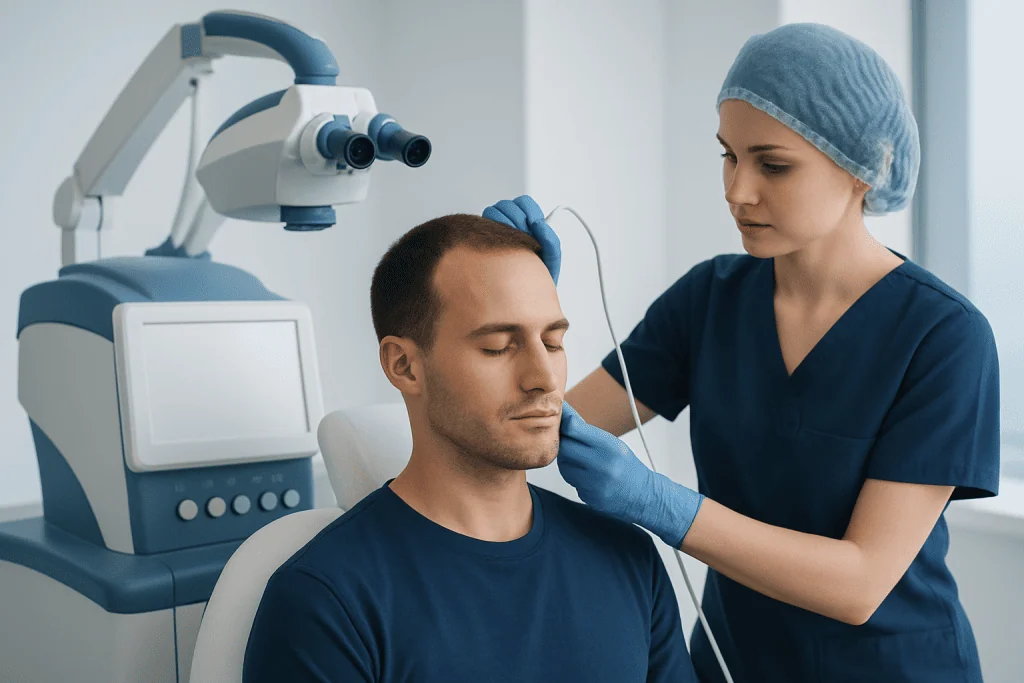
Good candidates for FUE hair implants usually have stable hair loss, enough healthy donor hair, and realistic expectations about what the procedure can achieve. The best candidates often have androgenetic alopecia, also known as pattern hair loss, because the hair at the back and sides of the scalp is often more resistant to thinning.
A detailed scalp examination is important before any procedure. A doctor will look at donor density, hair shaft thickness, hair color and curl, scalp flexibility, and the size of the treatment area. These factors all influence how full the result may appear. In some people, medical treatment or watchful waiting may be recommended before surgery.
Not all hair loss is suitable for transplantation. People with active scalp inflammation, uncontrolled medical conditions, or certain forms of patchy hair loss may need other treatment first. For example, autoimmune hair loss such as alopecia areata usually requires medical assessment rather than immediate transplant surgery. Similarly, scalp conditions such as seborrheic dermatitis may need treatment if irritation or flaking is active.
Women may also be candidates, but the pattern and cause of hair thinning should be assessed carefully. Diffuse thinning across the whole scalp can affect donor suitability. In some cases, options such as hair transplant for women or medical hair restoration strategies are discussed as part of a personalized plan.
How the FUE Technique Is Performed
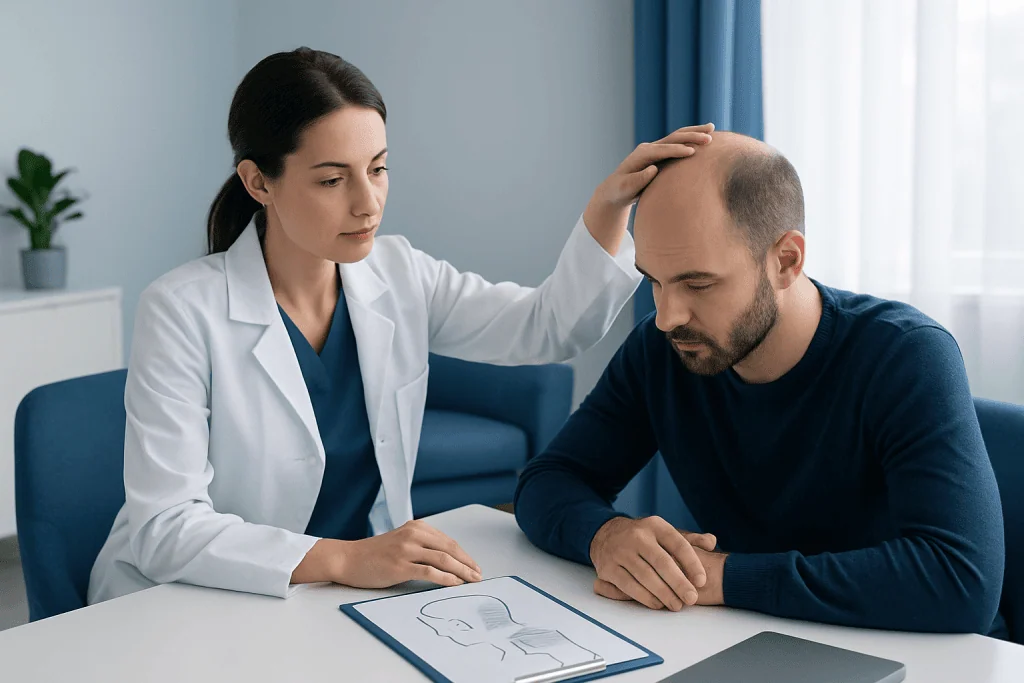
On the day of the procedure, the scalp is usually cleaned and the donor and recipient areas are prepared. Local anesthesia is commonly used so the scalp becomes numb while the patient remains awake. Depending on the plan, some or all of the donor hair may be trimmed to improve access to the follicles, although selected patients may ask about approaches such as hair transplant without shaving.
The surgeon then uses a very small punch tool to extract follicular units from the donor area. These units naturally contain one to a few hairs. The grafts are carefully handled and preserved before implantation. Tiny recipient sites are then created in the thinning area, taking into account angle, direction, density, and hairline design. This artistic and technical planning plays a major role in achieving a natural appearance.
After the sites are prepared, the grafts are implanted one by one. Single-hair grafts are often placed at the front of the hairline for softness, while larger grafts may be used behind that area to increase density. Depending on the number of grafts, the procedure may take several hours or may be performed in stages.
Some clinics also offer related methods such as DHI hair transplant, which uses a different implantation approach. The most suitable method depends on the anatomy of the scalp, the styling goals, the available donor supply, and the experience of the treating team.
Recovery and Healing Timeline
Recovery after FUE hair implants is usually manageable, but patience is important. In the first few days, mild swelling, redness, tenderness, and tiny crusts can appear in both the donor and implanted areas. Patients are usually given instructions on washing, sleeping position, and activity limits to protect the grafts during this early period.
Most crusting begins to clear within about one to two weeks. It is normal for many of the newly transplanted hairs to shed during the first several weeks. This can be surprising, but it is a standard part of the process called shock shedding. The follicles remain under the skin and usually begin producing new hair later.
Visible regrowth often starts gradually after several months. Early growth may look fine, light, or uneven before improving in thickness and coverage. Many people begin to notice more meaningful change between about 6 and 9 months, while fuller maturation can continue for 12 months or longer, especially at the crown.
During recovery, patients are usually advised to avoid scratching the scalp, intense exercise for a short time, swimming until cleared by their doctor, and hats or helmets that rub the grafts too early. Following aftercare instructions closely can help support healing and protect the transplanted follicles.
Results, Benefits, and Limitations
The main goal of FUE hair implants is to create a natural-looking improvement in hair coverage, frame the face, and restore confidence in appearance. Because the transplanted hair generally comes from a more permanent donor zone, it often continues to grow in its new location. When done well, results can look soft, age-appropriate, and difficult for others to detect as a transplant.
FUE offers several advantages. It avoids a long linear scar, allows precise graft placement, and can be useful for people who prefer shorter hairstyles. It may also be used in smaller areas such as sideburns, beard, or scars. If a previous procedure produced an unsatisfactory result, some patients may also benefit from hair transplant repair after a careful evaluation.
At the same time, FUE has limits. The donor area is finite, so it cannot create unlimited density. People with extensive baldness may need to prioritize the hairline and frontal scalp over other regions. Results also depend on hair characteristics; thicker, curlier, or lighter hair may create a fuller visual effect than fine, straight hair.
It is also important to understand that existing non-transplanted hair may continue to thin over time. For that reason, doctors may discuss medical treatment, supportive therapies, or future planning as part of long-term hair restoration. The best outcome is not only technical success on the day of surgery, but also a sensible strategy for the years ahead.
Risks, Side Effects, and Possible Complications
FUE hair implants are generally considered safe when performed by qualified professionals, but every procedure has potential risks. Common short-term effects include swelling, redness, itching, numbness, and temporary discomfort. Small scabs in the treated areas are expected during healing.
Less common complications can include infection, prolonged inflammation, folliculitis, poor graft growth, visible unevenness, or an unnatural hairline if planning is inadequate. Some people may also experience temporary shock loss of surrounding native hair. In most cases this improves, but the possibility should be discussed before treatment.
Scarring from FUE is usually minimal and appears as tiny dot-like marks in the donor region, but it can still be noticeable in some people, especially if the donor area is overharvested or shaved very short. People with a tendency toward raised scars should mention this to their doctor, as conditions such as keloid formation may affect procedural planning.
Choosing an experienced medical team, confirming the diagnosis of hair loss, and following aftercare instructions all help reduce risk. A pre-procedure consultation should include a clear discussion of expected benefits, likely limitations, and what can reasonably be achieved in one session.
Preparation, Self-care, and When to Seek Medical Advice
Preparation usually begins with a consultation, photographs, and a review of medical history, medications, allergies, and prior hair treatments. Patients may be asked to avoid smoking, alcohol, or certain medicines before the procedure if their doctor advises it. The exact instructions vary, so it is important to follow the clinic’s guidance rather than general internet advice.
After treatment, gentle scalp care matters. Patients are usually told how and when to wash the scalp, when normal exercise can resume, and how to protect the area from sun exposure. A healthy routine that supports overall hair health may also be discussed. In some cases, complementary options such as non-surgical hair restoration may be part of the broader plan to help maintain existing hair.
A doctor should be contacted if there is increasing pain, spreading redness, pus, fever, heavy bleeding, or swelling that feels severe or unusual. Medical advice is also important if there is concern that the original cause of hair loss has not been fully evaluated. Successful treatment begins with the right diagnosis.
For international patients seeking assessment and treatment, Acibadem International’s multidisciplinary specialists in JCI-accredited hospitals evaluate hair loss causes and offer personalized hair restoration care, including surgical and non-surgical options when appropriate.
Frequently asked questions
What does FUE stand for in hair transplantation?
FUE stands for follicular unit extraction. It is a technique in which individual hair follicle units are removed from a donor area and implanted into areas of thinning or baldness.
Are FUE hair implants permanent?
Transplanted follicles are usually taken from areas that are more resistant to common pattern hair loss, so they often continue to grow in their new location for the long term. However, surrounding non-transplanted hair can still thin over time, which is why long-term planning is important.
How long does it take to see FUE results?
Early shedding of transplanted hairs is common in the first weeks and does not usually mean the procedure has failed. Noticeable regrowth often begins after a few months, with more complete cosmetic results developing over 6 to 12 months or longer.
Is FUE hair transplant painful?
The procedure is usually performed under local anesthesia, so the scalp is numb during treatment. Some tenderness, tightness, or mild discomfort can occur afterward, but this is commonly manageable with the aftercare plan provided by the doctor.
Does FUE leave scars?
FUE usually leaves very small dot-like scars in the donor area rather than a long linear scar. These marks are often hard to notice, but visibility can vary based on healing, hairstyle, skin tone, and how many grafts were taken.
Can women have FUE hair implants?
Yes, some women are good candidates for FUE hair implants, especially when there is a stable pattern of hair loss and adequate donor hair. A careful medical assessment is important because diffuse thinning or non-pattern hair loss may require a different approach.
References
- American Academy of Dermatology
- International Society of Hair Restoration Surgery
- National Health Service
- Mayo Clinic
- MedlinePlus
This article is for general information only and is not a substitute for professional medical advice. Please consult a qualified doctor about your individual situation.
Hair transplant in Turkey — costs, graft counts & a free assessment
JCI-accredited · board-certified surgeons · reply within 24h
Add us as a Preferred Source to see more of our trusted health content across Google Search, AI Overviews and Discover.

Related Treatments
Related Conditions
More from the Health Library



Related Specialists

Prof. Dr. Sedef Şahin
Dermatology
Prof. Dr. Özlem Dicle
Dermatology
Prof. Dr. Emel Öztürk Durmaz
Dermatology
Assoc. Prof. Dr. Yasemin Koyuncu
Dermatology