FUE Hair Transplant: How It Works and Who It Suits

FUE stands for follicular unit extraction, a method that transplants individual hair follicles. It may suit people with stable hair loss, healthy donor hair, and realistic goals.
Key Takeaways
- FUE stands for follicular unit extraction, a method that transplants individual hair follicles.
- It may suit people with stable hair loss, healthy donor hair, and realistic goals.
- A specialist evaluation is important to confirm the cause of hair loss before surgery.
- Results develop gradually over months, and more than one session may sometimes be needed.
- Good aftercare helps support healing and the final cosmetic result.
FUE hair transplant is a hair restoration technique that removes individual follicular units from a donor area and places them into areas of thinning or baldness. It can create a natural-looking result for carefully selected patients, but success depends on the pattern of hair loss, donor hair quality, scalp health, and realistic expectations.
Overview: What Is an FUE Hair Transplant?
FUE hair transplant, short for follicular unit extraction, is a procedure used to restore hair in areas affected by thinning or baldness. In this method, a surgeon removes naturally occurring groups of one to four hairs, called follicular units, from a donor area, usually the back or sides of the scalp. These follicles are then implanted into areas where hair density has decreased.
The main goal of FUE is to create a natural hairline and improve overall coverage while preserving the appearance of the donor area. Because follicles are taken one by one rather than as a strip of scalp, FUE usually leaves many tiny dot-like scars instead of one linear scar. This is one reason many people prefer it, especially if they like to wear their hair short.
FUE is not a cure for the underlying cause of hair loss, and it does not stop future thinning in untreated areas. Instead, it redistributes existing hair from a more permanent donor zone to places where hair has been lost. For some patients, FUE may be part of a broader restoration plan that can also include medicines or non-surgical hair restoration.
How the Procedure Works
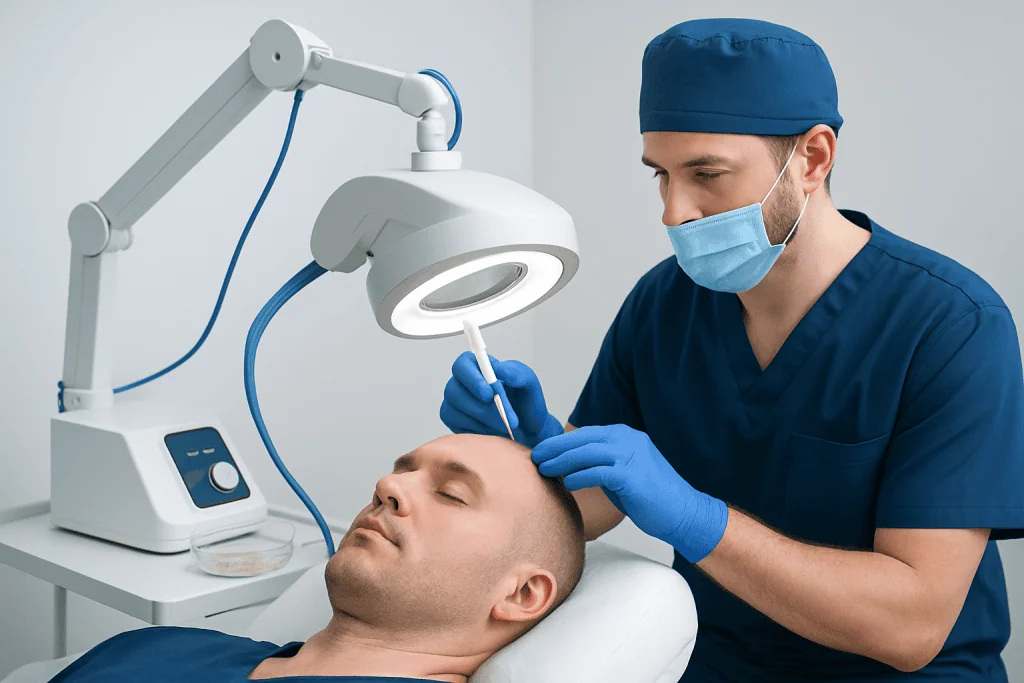
Before the procedure, the scalp and hair are examined carefully, and the surgeon designs the treatment plan. This includes assessing the donor area, estimating how many grafts may be needed, and deciding where the new hairline or added density should be placed. The aim is to match the natural direction, angle, and distribution of hair growth.
On the day of treatment, the scalp is usually prepared and a local anesthetic is used to keep the procedure comfortable. Individual follicular units are then extracted from the donor area using a very small punch tool. After they are collected, the follicles are kept in a controlled environment to protect them until implantation.
The surgeon then creates tiny recipient sites in the thinning area and places each graft carefully. This placement is important because natural-looking results depend on more than simply moving hair; they also depend on how the grafts are positioned. A typical FUE hair transplant is often completed in a single day, although larger sessions may take longer or be divided into stages.
Some clinics may offer related techniques based on similar principles, such as DHI hair transplant, which uses a different implantation approach. The best method depends on the individual’s hair characteristics, cosmetic goals, and the surgeon’s assessment.
Who It May Suit Best

FUE may suit adults with pattern hair loss who have enough healthy donor hair and a stable or predictable pattern of thinning. It is commonly considered for male and female pattern hair loss, receding hairlines, thinning at the crown, and some cases of scar camouflage. People who prefer to avoid a linear donor scar may also be interested in FUE.
A good candidate usually has realistic expectations. Hair transplantation can improve density and frame the face, but it may not restore the same fullness a person had in childhood or adolescence. The visible result also depends on hair thickness, curl, color contrast between hair and scalp, and how advanced the hair loss is.
Not every type of hair loss is suitable for transplantation. For example, active inflammatory scalp disease, unstable shedding, or autoimmune conditions such as alopecia areata may make surgery less effective or inappropriate until the condition is fully assessed and controlled. Scalp health matters as well, because disorders such as seborrheic dermatitis or other skin conditions can affect planning and aftercare.
FUE can also be adapted for selected patients who want facial hair restoration or targeted cosmetic improvement, although this article focuses on scalp transplantation. In some cases, other approaches such as hair transplant for women or tailored non-surgical options may be more appropriate depending on the pattern of hair loss.
Causes of Hair Loss and Why Diagnosis Matters
Hair loss has many possible causes, and a correct diagnosis is one of the most important steps before any transplant is considered. The most common reason people seek FUE is androgenetic alopecia, also called pattern hair loss. This condition tends to affect the temples, frontal hairline, or crown in men, and often causes diffuse thinning over the top of the scalp in women.
However, not all thinning is due to pattern hair loss. Stress-related shedding, nutritional deficiencies, hormonal changes, certain medicines, traction from tight hairstyles, and scalp disorders can also lead to hair loss. In some situations, treating the underlying cause may improve hair growth without surgery.
A transplant works best when the hair loss pattern is understood and reasonably stable. If a person is still losing large amounts of native hair, transplanted grafts may survive but surrounding hairs may continue to thin, which can affect the long-term cosmetic outcome. This is why many specialists discuss future hair loss, family history, and medical treatment options during planning.
People with inflammatory or scarring scalp conditions need especially careful assessment. If the scalp is irritated by a disease such as psoriasis, surgery may need to be delayed until the skin is calmer and the diagnosis is clear. A thoughtful evaluation helps protect both safety and results.
Evaluation, Preparation, and Recovery
Consultation usually includes a medical history, scalp examination, and a discussion about goals, expectations, and available options. The specialist may assess the donor area density, hair shaft thickness, scalp laxity, and the likely progression of future hair loss. Photographs are often taken to support planning and follow-up.
Patients are usually advised about how to prepare in the days before the procedure. Instructions may include avoiding smoking if possible, limiting alcohol, and reviewing regular medicines with the medical team. It is important to follow personalized guidance, because medical history and routine treatments vary from person to person.
After FUE, mild redness, swelling, and small crusts around the grafts are common for a short time. Tiny marks in the donor area also heal gradually. Most people can return to light daily activities relatively soon, but the scalp needs protection during the early healing period, and washing instructions should be followed carefully.
Newly transplanted hairs often shed in the first weeks, which can be expected. The follicles remain under the skin and usually begin producing new hair growth later. Visible improvement develops gradually over several months, and the final appearance may continue to mature over a longer period as the hairs thicken and blend with existing hair.
Benefits, Limitations, and Possible Risks
One of the main advantages of FUE is that it can produce a natural-looking result when grafts are placed with careful attention to hairline design and hair direction. It also avoids a linear scar in the donor area, which may appeal to people who prefer shorter hairstyles. For selected candidates, FUE can improve hair density, facial balance, and self-confidence.
Still, FUE has limitations. The number of grafts available is restricted by donor hair supply, and not every person has enough donor density for the coverage they want. Very advanced baldness may require prioritizing the hairline and frontal scalp rather than attempting to fully cover all thinning areas. Some patients may need more than one session to achieve their preferred result.
As with any procedure, there are possible risks. These can include bleeding, infection, temporary swelling, numbness, uneven growth, poor graft survival, or an unnatural appearance if planning or placement is not ideal. Some people may also notice temporary shock loss, where nearby existing hairs shed before recovering.
Choosing an experienced medical team helps reduce avoidable problems, but no technique can guarantee a perfect result. A clear discussion of expected density, scar pattern, and long-term maintenance is an important part of informed decision-making.
Treatment Options Beyond FUE and Long-Term Care
FUE is only one part of hair restoration care. Depending on the cause of hair loss, a doctor may recommend medical treatments to slow further thinning, improve scalp health, or support existing hair. In some cases, combining surgery with medical management offers a more balanced long-term plan than either approach alone.
Other procedural options may also be discussed. These can include sapphire transplant techniques, approaches that avoid full shaving such as hair transplant without shaving, or supportive therapies chosen according to hair type and cosmetic goals. If a previous procedure produced a disappointing outcome, some people may benefit from hair transplant repair.
Long-term care after transplantation usually focuses on protecting both transplanted and non-transplanted hair. Gentle scalp care, treatment of dandruff or inflammation if present, and regular follow-up can all be helpful. Patients are often reminded that the native hair around transplanted grafts may still thin over time, so ongoing monitoring matters.
Near the end of the decision process, many people find it useful to seek care at centers with dermatology and hair restoration expertise. Acibadem International’s multidisciplinary specialists in JCI-accredited hospitals diagnose and treat hair loss for international patients, helping determine whether FUE or another option is the better fit.
When to See a Doctor
It is a good idea to see a doctor if hair loss is sudden, patchy, associated with itching or pain, or accompanied by redness, scaling, or scarring of the scalp. Medical advice is also important if thinning begins at a young age, progresses quickly, or is causing significant distress. An early assessment can help identify treatable causes and prevent delays in care.
Anyone considering FUE should have a formal evaluation before committing to surgery. A specialist can confirm whether the hair loss pattern is suitable for transplantation, estimate donor capacity, and explain what result is realistically achievable. This consultation also helps rule out conditions that may need medical treatment first.
People should seek prompt medical attention after any hair procedure if they develop increasing pain, spreading redness, fever, pus, or unexpected bleeding. These symptoms do not always mean a serious problem, but they should be assessed without delay. Safe, individualized guidance from a qualified doctor is always the best next step.
Frequently asked questions
How long does an FUE hair transplant take?
The length of the procedure depends on how many grafts are being transplanted. Smaller sessions may take several hours, while larger sessions can take most of the day. The surgical team explains the expected timing during the consultation.
Is FUE hair transplant permanent?
Transplanted follicles are usually taken from areas that are more resistant to pattern hair loss, so the results can be long lasting. However, the procedure does not stop ongoing thinning in the surrounding native hair. This is why long-term planning and follow-up are important.
Does FUE leave scars?
FUE usually leaves many very small scars in the donor area rather than one long linear scar. These tiny marks are often less noticeable, especially after healing, but they are still a form of scarring. Their visibility can vary with haircut length, skin type, and how many grafts are taken.
When will new hair start to grow after FUE?
It is common for transplanted hairs to shed early after the procedure. New growth usually begins gradually after a few months, and the appearance continues to improve over time. Full maturation often takes longer than patients first expect.
Can women have an FUE hair transplant?
Yes, some women are good candidates for FUE, especially when hair loss follows a stable pattern and the donor area is suitable. Female hair loss can have different causes than male pattern baldness, so careful diagnosis is essential before surgery.
Who should avoid or postpone FUE?
People with uncontrolled scalp disease, active infection, unstable hair loss, or insufficient donor hair may need to avoid or delay transplantation. Surgery may also be postponed if the cause of hair loss has not been clearly diagnosed. A specialist can explain whether treatment of the underlying condition should come first.
References
- American Academy of Dermatology
- International Society of Hair Restoration Surgery
- National Institute for Health and Care Excellence
- Mayo Clinic
- British Association of Dermatologists
This article is for general information only and is not a substitute for professional medical advice. Please consult a qualified doctor about your individual situation.
FUE Hair Transplant in Turkey — costs, top hospitals & a free quote
JCI-accredited · board-certified surgeons · reply within 24h
Add us as a Preferred Source to see more of our trusted health content across Google Search, AI Overviews and Discover.

Hair Transplant
Modern FUE and DHI hair restoration with natural, lasting results.
Related Treatments
Related Conditions
More from the Health Library



Related Specialists

Prof. Dr. Sedef Şahin
Dermatology
Prof. Dr. Özlem Dicle
Dermatology
Prof. Dr. Emel Öztürk Durmaz
Dermatology
Assoc. Prof. Dr. Yasemin Koyuncu
Dermatology