

Skin Cancer Warning Signs: Moles, Melanoma, and Dermatology Checks

New, changing, bleeding, itching, or non-healing skin spots should be assessed by a qualified doctor. The ABCDE rule helps identify possible melanoma: asymmetry, border irregularity, color variation, diameter, and evolution.
Key Takeaways
- New, changing, bleeding, itching, or non-healing skin spots should be assessed by a qualified doctor.
- The ABCDE rule helps identify possible melanoma: asymmetry, border irregularity, color variation, diameter, and evolution.
- Skin cancer can appear anywhere on the body, including areas not commonly exposed to the sun.
- Dermatologists use full-body skin examinations, dermoscopy, and biopsy when needed to diagnose suspicious lesions.
- Sun protection, avoiding tanning beds, and regular skin checks can reduce risk and support early detection.
Skin cancer is often highly treatable when found early, and many warning signs can be noticed during regular skin self-checks. Understanding mole changes, melanoma features, and when to see a dermatologist helps people seek timely, appropriate care.
Overview
Skin cancer begins when skin cells grow abnormally. It is most commonly linked to ultraviolet radiation from the sun or tanning devices, although genetics, immune status, and previous skin damage also play a role. The main types include basal cell carcinoma, squamous cell carcinoma, and melanoma. Basal cell and squamous cell cancers are more common, while melanoma is less common but more likely to spread if it is not detected and treated early.
Skin cancer warning signs can be subtle. A person may notice a new spot, a mole that looks different from others, a sore that does not heal, or a patch that repeatedly crusts, bleeds, or changes. Some skin cancers appear as pearly bumps, scaly plaques, dark streaks under a nail, or flat brown or pink lesions. Because appearances vary, any persistent or changing skin finding deserves attention.
Regular dermatology checks are important because trained clinicians can examine areas that are difficult to see, such as the scalp, back, soles of the feet, and behind the ears. Many suspicious spots are benign, but a professional examination helps decide whether monitoring, dermoscopy, or biopsy is appropriate.
Common Skin Cancer Warning Signs
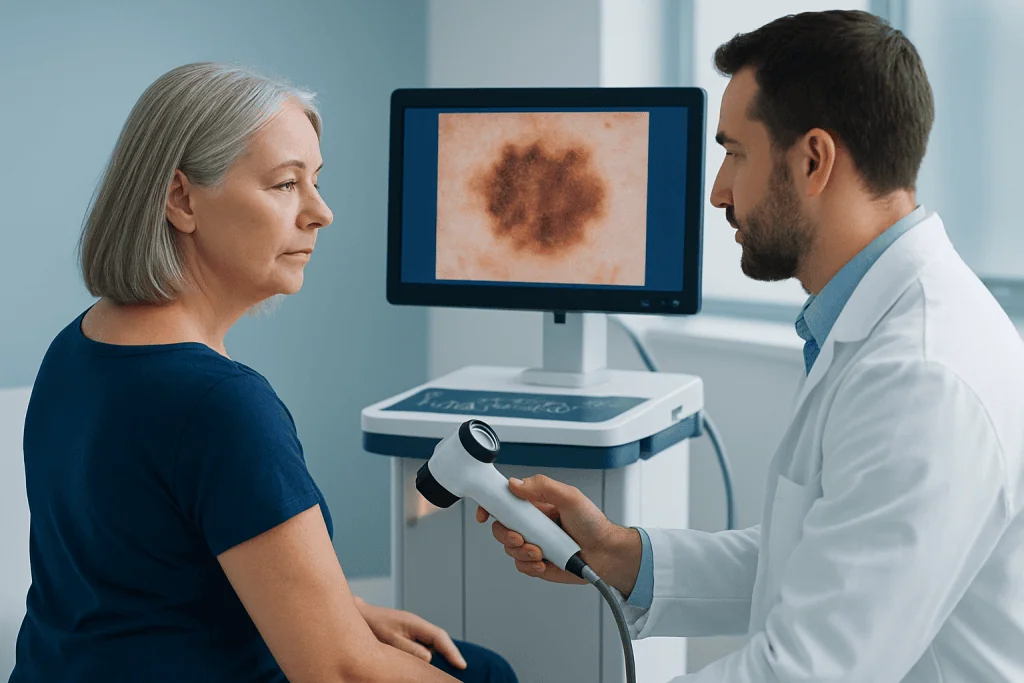
Warning signs often involve change. A mole or patch that becomes larger, darker, lighter, raised, painful, itchy, or prone to bleeding should be evaluated. A spot that looks noticeably different from a person’s other moles is sometimes called an ugly duckling lesion and may need closer assessment. Skin cancer may also appear as a sore that heals and returns, a rough scaly area, or a shiny bump with visible small blood vessels.
The ABCDE rule is a helpful guide for identifying possible melanoma. It does not diagnose cancer, but it can help people decide when to arrange a dermatology appointment.
- A – Asymmetry: one half of the mole does not match the other half.
- B – Border: edges are irregular, blurred, notched, or uneven.
- C – Color: several colors are present, such as brown, black, red, white, blue, or grey.
- D – Diameter: the spot is growing or is larger than many other moles, though melanomas can be small.
- E – Evolution: the lesion changes in size, shape, color, surface, or symptoms.
Not all skin cancers fit the ABCDE pattern. Some melanomas are pink, red, or skin-colored rather than dark. Others may arise under a nail, on the palms or soles, inside the mouth, or in genital areas. For this reason, a persistent abnormal skin change should be checked even if it does not look like a typical mole.
Moles, Melanoma, and What Changes Matter

Most moles are harmless clusters of pigment-producing cells. They often develop during childhood and young adulthood and may remain stable for many years. Normal moles are usually symmetrical, evenly colored, and similar in appearance to a person’s other moles. However, melanoma can develop from an existing mole or appear as a new lesion on otherwise normal skin.
Important mole changes include rapid growth, an irregular outline, new color variation, bleeding without injury, persistent itching, tenderness, crusting, or a raised area within a previously flat mole. A new dark spot in adulthood should be observed carefully, especially if it changes or looks unlike other marks. People with many moles or atypical moles may benefit from regular dermatology follow-up and, in some cases, clinical photography to track changes over time.
Melanoma can occur in people of all skin tones. In darker skin, it may be more likely to appear on less sun-exposed areas such as the palms, soles, or under nails. A dark streak in a nail, especially if it widens, changes, or affects the surrounding skin, should be assessed by a dermatologist. Early evaluation can clarify whether a lesion is harmless or requires biopsy.
Causes and Risk Factors
Ultraviolet radiation is a major risk factor for skin cancer. This includes sunlight and artificial sources such as tanning beds. Sunburns, especially blistering sunburns earlier in life, can increase future risk. Long-term cumulative sun exposure is also important, particularly for people who work outdoors or spend significant time outside without protection.
Personal and family history matter. A person who has had skin cancer before has a higher chance of developing another one. A family history of melanoma, numerous moles, atypical moles, fair skin that burns easily, light eyes, red or blond hair, and a tendency to freckle can increase risk. However, skin cancer can affect anyone, including people who tan easily or have darker skin.
Other risk factors include a weakened immune system, certain inherited conditions, previous radiation therapy, chronic wounds or scars, and exposure to some chemicals such as arsenic. Age also contributes, because skin damage can accumulate over time. Risk factors help guide screening frequency, but they should not be the only reason to seek care; a changing lesion should be checked regardless of risk profile.
Diagnosis and Dermatology Checks
A dermatology check usually begins with a medical history and a full skin examination. The doctor may ask when a spot first appeared, whether it has changed, and whether there are symptoms such as itching, pain, bleeding, or crusting. A full-body examination may include the scalp, nails, soles, and areas that are hard to inspect at home. Patients can help by pointing out any spots that concern them.
Dermatologists often use dermoscopy, a handheld tool that magnifies and illuminates the skin, to examine structures not visible to the naked eye. Dermoscopy can help distinguish benign lesions from suspicious ones and may reduce unnecessary biopsies. In people with many moles, digital monitoring or total-body photography may be recommended to compare lesions over time.
If a lesion looks suspicious, the doctor may perform a biopsy. This means removing all or part of the spot so a pathology specialist can examine the tissue under a microscope. A biopsy is the only reliable way to confirm skin cancer and identify the type. If melanoma is diagnosed, additional testing may be considered depending on the depth and features of the tumor.
Treatment Options
Treatment depends on the type of skin cancer, its size, location, depth, and whether it has spread. Many basal cell and squamous cell carcinomas are treated with minor surgical procedures that remove the cancer along with a margin of normal-looking skin. Mohs micrographic surgery may be used in selected cases, especially on the face or other areas where tissue preservation is important.
Other treatment options may include curettage and electrodesiccation, cryotherapy for certain superficial lesions, prescription topical medicines, photodynamic therapy, radiation therapy, or laser-based approaches in specific circumstances. The choice is individualized and should be discussed with a dermatologist or oncology team. Follow-up is important because people who have had one skin cancer may develop another.
Melanoma treatment usually begins with surgical removal. If melanoma is deeper or has features that suggest a higher risk, doctors may evaluate nearby lymph nodes and consider additional therapies such as immunotherapy, targeted therapy, or radiation in selected cases. Decisions are based on pathology results, staging, general health, and patient preferences.
Prevention and Self-Care
Skin cancer prevention focuses on reducing ultraviolet exposure while maintaining a healthy, active lifestyle. People can protect their skin by seeking shade, wearing broad-brimmed hats and UV-protective clothing, using sunglasses, and applying broad-spectrum sunscreen to exposed areas. Sunscreen should be used as directed on the product label and reapplied, especially after swimming, sweating, or towel drying.
Avoiding tanning beds is strongly recommended. Artificial tanning exposes the skin to ultraviolet radiation and can increase skin cancer risk. Outdoor activities are safest when planned outside peak sun hours when possible, and extra care is needed near water, snow, sand, and high altitudes because UV exposure can be stronger or reflected.
Monthly skin self-checks can support early detection. A mirror or a partner can help examine the back, scalp, buttocks, backs of the legs, soles, between toes, and under nails. It may be useful to take dated photos of moles or spots for comparison. Self-checks do not replace professional examinations, but they help people notice changes sooner.
When to See a Doctor
A person should arrange a dermatology appointment if they notice a new or changing mole, a sore that does not heal, a lesion that bleeds or crusts repeatedly, a spot that looks different from others, or any skin change that persists for several weeks. Urgent assessment is especially important for rapidly growing lesions, dark streaks under a nail, or pigmented spots on the palms or soles that are changing.
People with a personal history of skin cancer, a strong family history of melanoma, many atypical moles, or a weakened immune system should ask a dermatologist how often they need professional skin checks. The right schedule varies; some people need only periodic checks, while others benefit from closer follow-up.
International patients who need evaluation can seek care from qualified dermatology and oncology services. Acibadem International’s multidisciplinary specialists and JCI-accredited hospitals diagnose and treat skin cancers, including melanoma, for international patients as part of coordinated medical care. Any concerning skin finding should be discussed with a qualified doctor rather than monitored indefinitely at home.
Frequently asked questions
What does an early skin cancer look like?
Early skin cancer can look like a new mole, a changing spot, a scaly patch, a shiny bump, or a sore that does not heal. Some are dark, while others are pink, red, or skin-colored. Because appearances vary, persistent or changing lesions should be checked by a dermatologist.
Are all changing moles melanoma?
No. Many changing moles are benign, and some changes occur due to irritation, hormones, or aging. However, melanoma is more treatable when found early, so changes such as growth, irregular borders, multiple colors, bleeding, or itching should be professionally assessed.
How often should someone have a dermatology skin check?
The best schedule depends on personal risk factors, including previous skin cancer, family history, number of moles, skin type, and immune status. Some people may need annual checks, while others need more frequent monitoring. A dermatologist can recommend an appropriate interval.
Can melanoma appear on skin that is not exposed to the sun?
Yes. Melanoma can develop on areas such as the soles, palms, under nails, scalp, or mucous membranes. This is one reason full-body self-checks and professional examinations are important, even for areas not usually exposed to sunlight.
Is itching a sign of skin cancer?
Itching can happen for many harmless reasons, including dry skin, eczema, or irritation. However, a mole or spot that persistently itches, hurts, bleeds, crusts, or changes should be evaluated. Symptoms are most important when they occur together with visible changes.
Can sunscreen completely prevent skin cancer?
Sunscreen reduces ultraviolet exposure when used correctly, but it cannot prevent all skin cancers by itself. It works best as part of a broader plan that includes shade, protective clothing, hats, sunglasses, and avoiding tanning beds. Regular skin checks remain important.
References
- World Health Organization
- American Academy of Dermatology Association
- National Cancer Institute
- European Academy of Dermatology and Venereology
- Cancer Research UK
This article is for general information only and is not a substitute for professional medical advice. Please consult a qualified doctor about your individual situation.
Skin Cancer in Turkey — costs, top hospitals & a free quote
JCI-accredited · board-certified surgeons · reply within 24h
Add us as a Preferred Source to see more of our trusted health content across Google Search, AI Overviews and Discover.

Medical Oncology Department
Medical treatment of cancer with chemotherapy, immunotherapy and targeted therapies under a multidisciplinary tumor board.
60 specialists in this unitRelated Treatments
Related Conditions
More from the Health Library



Related Specialists

Prof. Dr. Sedef Şahin
Dermatology
Prof. Dr. Şükrü Yazar
Aesthetic Plastic & Reconstructive Surgery
Prof. Dr. Emel Öztürk Durmaz
Dermatology
Prof. Dr. Özlem Dicle
Dermatology