Laser Surgery
Laser surgery uses focused light energy to treat tissue precisely, most often for vision correction such as LASIK. It aims to improve eyesight with minimal incision and rapid recovery.
Quick answer
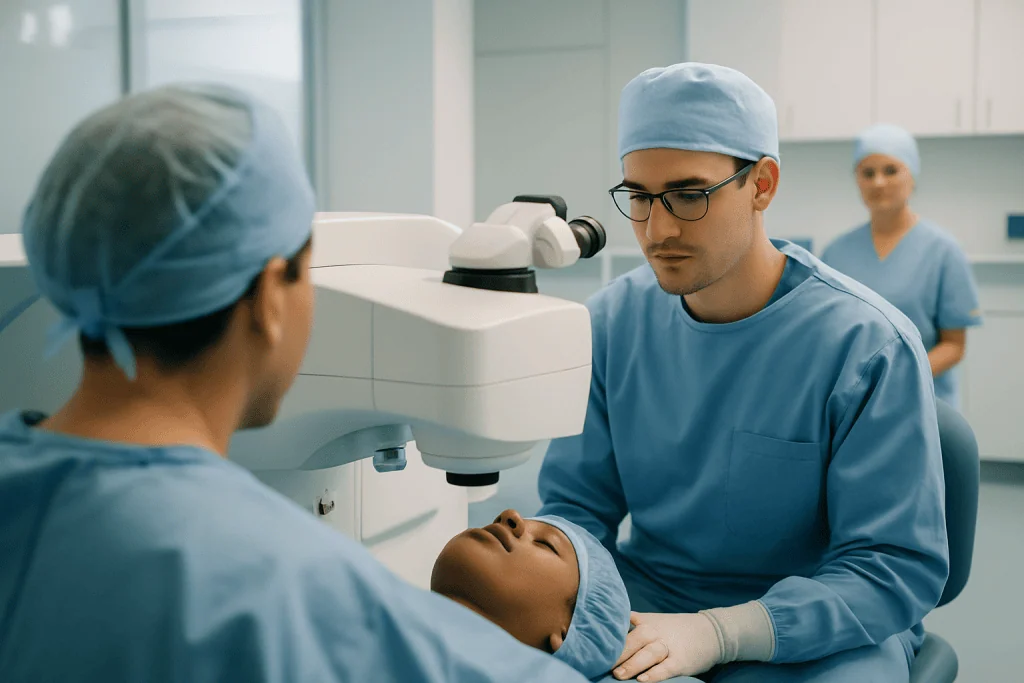
LASIK eye surgery is a laser procedure that reshapes the cornea so light focuses correctly on the retina, correcting short-sightedness, long-sightedness and astigmatism. The surgeon creates a thin corneal flap, applies an excimer laser to reshape the tissue beneath, then repositions the flap without stitches. It is an outpatient procedure performed under numbing drops, and many patients notice clearer vision within a day or two.
What Is LASIK Eye Surgery?
LASIK eye surgery is a laser procedure that reshapes the cornea, the clear front surface of the eye, so that light focuses correctly on the retina. It corrects refractive errors: short-sightedness (myopia), long-sightedness (hyperopia) and astigmatism. It is intended for adults with a stable prescription and healthy eyes who want to reduce their dependence on glasses or contact lenses.
People usually begin researching LASIK eye surgery after years of practical frustration: dry, irritated eyes from contact lenses, glasses that get in the way of sport or travel, or simply waking up unable to see the alarm clock. At the same time, the idea of a procedure on your eyes can feel intimidating. The most common questions are direct ones. Does it hurt? Is it safe? Will the result last? What happens if my eyes are not suitable?
This page answers those questions as plainly as the evidence allows. Two points are worth stating at the outset. First, LASIK eye surgery reshapes the eye with a high degree of precision, and for many patients recovery is fast enough that daily life resumes within days. Second, a good outcome depends less on the laser than on what happens before it: careful patient selection, detailed diagnostic testing, an experienced ophthalmology team and a treatment plan matched to the structure and health of each individual eye. Not everyone is a candidate, and a responsible programme will tell you so.
For international patients there is a further layer: travelling for a procedure requires clarity about the treatment pathway, realistic scheduling around recovery, and access to language support before, during and after treatment. At Acibadem, laser vision correction is treated as a medical decision first. The starting point is whether surgery is appropriate at all, not which procedure to book. A separate LASIK eye surgery treatment guide covers the practical planning side in more depth.
What Laser Surgery Means in Ophthalmology
Laser surgery uses highly focused light energy to treat tissue with precision, and in ophthalmology it most commonly refers to procedures that reshape the cornea to change how light focuses inside the eye. When the cornea’s curvature does not bend light correctly, the image reaching the retina is blurred. This is a refractive error: a focusing problem, not a disease.
The purpose of corneal laser treatment is often misunderstood. It does not “strengthen” the eye, and it does not repair the retina or the optic nerve. It changes the way light enters the eye. By adjusting the corneal curvature by microscopic amounts, the laser helps images focus more accurately on the retina, improving unaided vision. Because the change is physical and permanent at the corneal level, the correction itself does not wear off, although the eye continues to age around it, a point covered later on this page.
It is also worth separating refractive laser surgery from other uses of medical lasers. Lasers are used across many fields, from laser dentistry to retinal and glaucoma procedures, and the word alone tells you little about what a treatment involves. This page deals specifically with laser correction of refractive errors.
Is a laser operation for eyesight the same as LASIK?
A laser operation for eyesight is a general description that covers several distinct procedures, and LASIK is the best known of them. LASIK stands for laser-assisted in situ keratomileusis. The surgeon creates a thin corneal flap, lifts it gently, and uses an excimer laser to reshape the corneal tissue underneath. The flap is then repositioned, where it adheres naturally without stitches. LASIK’s defining feature is that the reshaping happens beneath a protective flap of the patient’s own tissue, which is a major reason early recovery is usually quick and comfortable compared with older techniques.
What other vision laser treatment options exist?
Vision laser treatment is not limited to LASIK; surface-based techniques reshape the cornea without creating a flap at all. In these procedures, the surgeon removes or displaces the thin outer layer of the cornea and applies the excimer laser directly to the surface. The outer layer then regrows over the following days. Surface procedures typically involve a longer and less comfortable early recovery than LASIK, but they may be the safer choice for patients with thinner corneas, certain corneal surface characteristics, or occupations and sports that carry a risk of eye impact. Which technique is appropriate depends on corneal thickness and shape, eye surface health, lifestyle, age and the type of refractive error, which is why the diagnostic stage matters more than the brand name of any procedure.
Who May Be Suitable for Laser Eye Surgery?
Laser eye surgery may be appropriate for adults who want to reduce their dependence on glasses or contact lenses and whose prescription has been stable. Stability matters because the laser corrects the prescription measured today; if your eyes are still changing, the correction can be outdated within a few years. Patients often consider the procedure when glasses interfere with work, physical activity or travel, or because contact lenses cause irritation, dryness, recurrent infections or simple daily inconvenience.
Typical candidates have one or more refractive errors. Myopia, or short-sightedness, makes distant objects appear blurred. Hyperopia, or long-sightedness, can make near tasks difficult and may also affect distance vision, especially with age. Astigmatism causes distorted or shadowed vision because the cornea or lens has an irregular curvature. Many patients have a combination of these.
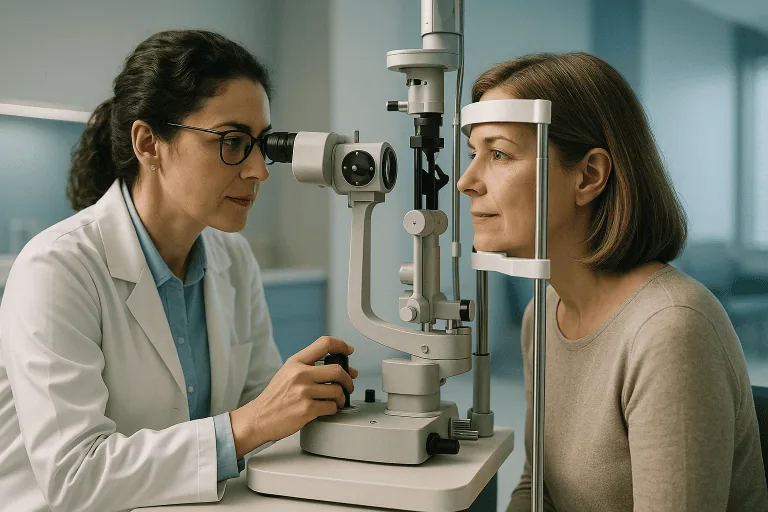
Assessment for eye surgery of this kind is considerably more thorough than a standard glasses prescription check. The ophthalmology team evaluates visual acuity, refraction, eye pressure, tear film quality, pupil size, corneal thickness and the detailed shape of the cornea. Corneal mapping identifies subtle irregularities that could increase risk, including early signs of keratoconus, a progressive weakening of corneal structure that rules out LASIK. A dilated retinal examination may also be performed to assess the back of the eye, particularly in patients with higher myopia, where retinal thinning is more common.
You will usually be asked to stop wearing contact lenses for a period before the diagnostic measurements. Lenses temporarily mould the shape of the cornea, and measurements taken too soon after lens wear can mislead the surgical plan. The exact lens-free interval depends on the type of lens you use, soft lenses need less time than rigid ones, and your clinic will specify it. This step is inconvenient, but it directly protects the accuracy of your treatment.
Some factors can make LASIK unsuitable or require it to be postponed: significant dry eye, an unstable prescription, thin or irregularly shaped corneas, certain autoimmune conditions, pregnancy, some medications, and retinal or optic nerve disease. Patients with dry eye symptoms may need the eye surface treated and re-measured before any decision. Patients with corneas unsuitable for a flap may still be candidates for a surface technique. And in some cases, the safest recommendation is not to proceed at all. A careful “no” is as much a part of good refractive surgery as the procedure itself, and it is one of the clearest signs that a programme puts selection ahead of volume.
Conditions Laser Vision Correction Addresses
Laser vision correction is used to treat refractive errors, focusing problems rather than diseases. In the right patient, it can improve functional vision across most daily activities and substantially reduce the need for corrective eyewear.
The most common indication is myopia. People with myopia usually see well up close but struggle with road signs, screens across a room, presentations or faces at a distance. Myopia occurs when the eye is slightly too long or the cornea too steep, so light focuses in front of the retina rather than on it. The laser flattens the central cornea by a calculated amount to move the focal point back.
Hyperopia is an indication in selected patients. In long-sightedness, light tends to focus behind the retina. Younger people often compensate unconsciously by using the eye’s own focusing muscles, which can cause eyestrain and headaches rather than obvious blur. As the eye’s natural focusing ability declines with age, the problem becomes harder to mask. Laser correction for hyperopia steepens the central cornea, and its predictability depends on the degree of error and corneal characteristics.
Laser correction may also be considered for patients who cannot tolerate contact lenses, whose occupation makes glasses impractical, or who want greater freedom for sport, swimming and travel. What it does not do is stop the eye from ageing. Most people develop presbyopiaa natural loss of near focusing ability, from midlife onwards, and will eventually need reading glasses regardless of earlier laser treatment. For some patients, monovision or blended-vision strategies can extend useful near vision, but these approaches require simulation, counselling and often a contact lens trial before anyone commits to them surgically.
Can laser eye surgery fix an astigmatism?
Yes, regular astigmatism is one of the standard indications for laser vision correction, alongside myopia and hyperopia. Astigmatism occurs when the cornea or lens has different curvatures in different directions, like the side of a rugby ball rather than a football, creating blurred, streaked or doubled edges at all distances. Modern laser planning measures the axis and magnitude of the astigmatism and applies an asymmetric correction to even out the curvature. The important qualifier is the word “regular”: astigmatism caused by an irregular or structurally weak cornea, as in keratoconus, is not treated with standard LASIK, because removing tissue from an already weak cornea can make the condition worse. This is precisely what corneal mapping is designed to detect before any treatment decision is made.
How LASIK Eye Surgery Is Performed
Preoperative assessment and planning
The pathway begins with a comprehensive consultation. Your ophthalmologist reviews your vision history, prescription stability, general health, medications, previous eye conditions, contact lens use and, importantly, your expectations. The examination then works through the diagnostic tests described above: refraction, corneal topography or tomography, corneal thickness measurement, tear film assessment, pupil evaluation and examination of the front and back of the eye.
These tests do two jobs at once. They screen out risk factors such as dry eye, keratoconus or early corneal weakness, retinal concerns, cataract, glaucoma or inflammation. And they provide the raw data for the surgical plan itself. In some patients, additional imaging or a specialist opinion is recommended before any decision. If a measurement looks borderline or inconsistent, it is repeated, repeating tests is a sign of careful planning, not delay for its own sake.
The plan is then customised to your optical measurements and eye anatomy. Modern diagnostics allow the team to analyse the shape, thickness and optical behaviour of the cornea in detail. The goal is not only sharper vision on a chart, but preserved corneal strength and good visual quality, including in low light.
Preparation before the procedure
Before surgery you receive specific instructions covering contact lens discontinuation, eye drops, makeup and arrival time. Contact lenses may need to be stopped days or weeks in advance depending on lens type. Avoid eye makeup, creams and perfumes on the day itself: particles and residues can interfere with the sterile field around the eye.
LASIK is performed on an outpatient basis, and general anaesthesia is not normally needed. Numbing drops keep the eye comfortable and you remain awake throughout; a mild relaxant may be offered when appropriate. The surgical team talks you through each step, because knowing what to expect genuinely reduces anxiety. You may feel pressure, and you will notice lights and sounds, but significant pain is not typical during the procedure itself.
What happens during the LASIK procedure?
The procedure follows a fixed sequence, and each step is brief:
- Stabilising the eye. The surgeon gently stabilises the eye and applies a device to hold the eyelids open, so blinking is not something you need to think about.
- Creating the flap. A thin flap is created on the surface of the cornea, using either a femtosecond laser or a specialised surgical instrument, depending on the treatment plan and technology in use.
- Lifting the flap. The flap is lifted carefully to expose the inner corneal tissue.
- Laser reshaping. The excimer laser removes microscopic amounts of tissue according to the preplanned correction, changing how light focuses inside the eye. This is the shortest step, often lasting well under a minute per eye.
- Repositioning the flap. The surgeon lays the flap back into place, where it begins to adhere naturally. No stitches are usually required.
When both eyes are being treated, the second eye typically follows during the same visit, although the recommendation can vary with individual circumstances. Surface techniques follow a different sequence, the outer corneal layer is removed or displaced rather than a flap being created, and a protective contact lens is usually placed at the end while the surface regrows.
Technology used in laser eye surgery
Laser vision correction depends on precise measurement and controlled delivery. Diagnostic imaging maps the cornea’s curvature and thickness, which is what allows the surgeon to screen for abnormalities and plan the correction. Wavefront or optical analysis may be added in selected cases to characterise subtle visual distortions beyond the standard prescription. During treatment, eye-tracking systems follow the small involuntary movements every eye makes, keeping the laser pattern accurately placed even if your gaze drifts slightly.
The excimer laser itself removes tissue in extremely small increments under computer guidance. But technology is not the main determinant of a good result. The surgeon’s judgement, in selecting candidates, interpreting borderline measurements, and choosing between LASIK, a surface technique or no surgery at all, matters at least as much as the hardware.
How long does the procedure take, and what happens immediately after?
The laser application itself takes only a short time, and the entire visit, including preparation and postoperative checks, is commonly completed within a few hours. You should not drive yourself home. In the first several hours, blurry vision, tearing, light sensitivity, burning or a gritty sensation are all common, and they usually settle with rest and the prescribed drops.
A follow-up examination is scheduled soon after the procedure to confirm the eye is healing appropriately. You receive detailed instructions on antibiotic and anti-inflammatory drops, lubricating drops, avoiding eye rubbing, protecting the eyes at night, and when to return to work and exercise. Many LASIK patients notice improved vision within a day or two, although fluctuation during healing is normal. Surface procedures involve a slower start: several days of discomfort and gradually improving vision are expected before things settle.
Is Laser Eye Surgery Safe?
Laser vision correction is a well-established procedure with a long clinical track record, but no eye operation is without risk, and honest counselling starts from that fact. Safety in refractive surgery is built in layers: rigorous candidate screening to exclude eyes that would heal poorly or destabilise, accurate measurement, appropriate choice of technique, sterile technique during the procedure, and structured follow-up afterwards. Most of what protects you happens before the laser is ever switched on. A programme that screens strictly, and declines to operate when findings are unfavourable, is doing the single most important thing it can for your safety.
What are the risks with LASIK eye surgery?
The recognised risks of LASIK include dry eye symptoms (usually temporary, occasionally persistent), glare, halos or starbursts around lights at night, under- or over-correction leaving a residual prescription, flap-related complications, infection, inflammation, and, rarely, corneal weakening over time. Some of these are more likely in particular situations: night-vision symptoms with larger pupils or higher corrections, dryness in patients who already had dry eyes, residual prescription with very high or complex corrections. Some patients with a residual prescription can have an enhancement treatment later; others are not suitable for enhancement because of corneal thickness or healing factors, which is why the possibility should be discussed before the first procedure, not after. A fuller discussion of complications and how they are managed is available in our guide to laser eye surgery risks, side effects and safety.
What LASIK does not do also belongs in a safety discussion. It does not protect the eye against future disease, injury or the natural changes of ageing. A patient who has had laser correction still needs routine eye examinations throughout life, exactly as before.
Why Early Evaluation Matters
Laser vision correction is elective, so it is rarely urgent. Early evaluation is still worthwhile, for reasons that have little to do with the surgery itself. Many people live for years with contact lens intolerance, recurrent irritation or lifestyle limitations without knowing whether they are candidates for treatment. A detailed assessment clarifies the options and often identifies conditions worth treating regardless of any surgical decision, dry eye and eyelid inflammation are the common examples.
Evaluation also matters because a change in vision is not always a simple prescription issue. Cataract, keratoconus, glaucoma, retinal disease and diabetic eye disease can all present as blurred or fluctuating vision, and each needs medical management rather than laser correction. Assuming that new blur just means new glasses can delay care that protects long-term eye health.
Timing interacts with age and stability. A patient whose prescription is still shifting may simply need to wait. Someone approaching the age when near vision changes become noticeable may need a different strategy from a younger patient, perhaps a different correction target, perhaps a different procedure entirely. The earlier these factors are on the table, the easier the planning.
Delay does not usually close the door on laser surgery by itself. But continuing to wear poorly tolerated contact lenses can worsen dryness and inflammation, and raises infection risk in some patients. And waiting until presbyopia or early cataract is well established can change which treatment makes sense. A professional assessment replaces assumptions with measurements, which is the only sound basis for choosing when, or whether, to proceed.
Benefits of Laser Vision Correction
For suitable candidates, laser vision correction offers practical, quality-of-life benefits. The table below sets them out with their honest limits attached, because a benefit stated without its qualifier is closer to marketing than medicine.
| Benefit | What It Means for You |
|---|---|
| Reduced dependence on glasses or contact lenses | Many patients manage daily activities with far less reliance on corrective eyewear, although some still need glasses for specific tasks, and reading glasses become likely with age. |
| Rapid visual recovery in many LASIK patients | Vision often improves quickly after LASIK, allowing a return to routine activities within a short period, subject to the surgeon’s guidance. |
| Minimal-incision approach | Laser procedures reshape the cornea with very small tissue changes and usually require no stitches. |
| Personalised treatment planning | Detailed measurements tailor the correction to your prescription, corneal anatomy and visual needs. |
| Improved convenience for active lifestyles | Travel, exercise, swimming and work in environments where glasses or lenses are impractical become simpler. |
| Potential relief from contact lens problems | For patients with lens discomfort, dryness or irritation, reducing lens dependence may improve day-to-day comfort where surgery is appropriate. |
Recovery Timeline After Laser Eye Surgery
Eye surgery on the cornea heals in stages, and the pace varies with procedure type, prescription, eye surface health and individual healing. Most LASIK patients follow a broadly similar pattern.
| Time Period | What Patients Can Expect |
|---|---|
| Day 1 | Vision may be blurry or hazy at first. Tearing, light sensitivity and a gritty sensation are common. Rest, prescribed drops and strict avoidance of eye rubbing matter most on this day. |
| First week | Many LASIK patients notice significant visual improvement. Follow-up visits check healing. Swimming, eye makeup, dusty environments and strenuous activity are usually avoided until the surgeon clears them. |
| First month | Vision continues to stabilise. Dryness or night-time glare can occur and is typically managed with lubricating drops and monitoring. |
| Three to six months | Healing and visual stability generally continue. Mild fluctuations remain possible, particularly with dry eye or higher prescriptions. |
| Longer term | Results are often stable where the original prescription was stable, but natural age-related changes such as presbyopia or cataract can still develop over time. |
Surface laser procedures shift this timeline: the first days are more uncomfortable, vision improves more gradually, and the early milestones arrive later than after LASIK. Your surgeon will give you a schedule matched to your actual procedure rather than a generic one.
When can you fly after LASIK?
Most patients can fly relatively soon after LASIK, but the sensible answer depends on your healing, your follow-up schedule and the dryness of cabin air, which many people notice more after laser treatment. The practical questions, how soon, with what precautions, and how the answer differs for other eye procedures, are covered in our comparison guide, Flying After Eye Surgery: LASIK, Retinal Laser and Cataract Compared. The clinical principle is simple: your first follow-up examinations should happen before you get on a plane, because that is when any early healing issue would be caught.
What Shapes a Good Result
A good result in laser vision correction is not defined only by reading small letters on a chart. It includes visual comfort, night vision quality, eye surface health and satisfaction with the balance between benefits and limitations. Several factors influence all of these.
Candidate selection comes first. Patients with healthy corneas, stable prescriptions, realistic expectations and no uncontrolled eye disease tend to do best. Corneal thickness and shape carry particular weight, because the laser removes a small amount of tissue: if the cornea is too thin or shows signs of structural weakness, LASIK is not advisable, whatever the patient’s motivation.
Accurate measurements are the foundation of the plan. Contact lens wear, dry eye or an unstable tear film can all distort preoperative testing, which is why lenses are stopped and dryness treated before final measurements are taken. A plan built on distorted data delivers a distorted correction.
The type and degree of prescription influence predictability. Mild to moderate short-sightedness behaves differently from very high prescriptions or complex astigmatism. Some patients achieve excellent unaided distance vision yet still reach for glasses for night driving, fine detail or reading. These possibilities should be explained before treatment, not discovered after it.
Age and near vision needs change the calculus. Patients in their forties and beyond may already be developing presbyopia. Correcting both eyes fully for distance sharpens the horizon but makes near tasks more dependent on reading glasses. Monovision, correcting one eye for distance and one for near, helps selected patients, but not everyone adapts to it, which is why a contact lens trial is often recommended before committing to that approach surgically.
Dry eye and ocular surface health deserve special attention. Temporary dryness is common after laser correction, and patients with pre-existing dryness tend to notice it more. Treating dry eye before surgery improves measurements, comfort and recovery. Long-term dryness is less common but does occur, so an honest account of your history helps the team plan realistically.
Postoperative care is the part the patient controls. Following the drop schedule your surgeon prescribes, attending follow-up appointments, avoiding eye rubbing and respecting activity restrictions all support proper healing. Patients travelling internationally should build enough time into the trip for initial recovery and early follow-up before returning home.
Does LASIK permanently fix eyes?
The corneal reshaping itself is permanent: the tissue removed by the laser does not grow back, and a correction based on a stable prescription generally holds. What LASIK cannot do is stop the eye from changing for other reasons. Presbyopia will still arrive in midlife and make reading glasses likely. Cataract can still develop decades later and be treated in the normal way. Occasionally a residual or returning prescription justifies an enhancement, where the cornea allows one. So the accurate summary is: LASIK permanently corrects the refractive error it was planned for, but it does not exempt the eye from ageing. Patients weighing a repeat or corrective procedure after earlier treatment elsewhere may find it useful to read about when to consider a second opinion before deciding.
How Much Does Laser Eye Surgery Cost?
There is no single honest number, because the cost of laser eye surgery depends on variables that differ from patient to patient and clinic to clinic. The main drivers are: the technique used (LASIK, a surface procedure or another approach), the technology involved in flap creation and laser delivery, the depth of the diagnostic work-up, the surgeon’s experience, what the quoted price includes, drops, follow-up visits, and whether any later enhancement is covered, and the country and city where treatment takes place. Two quotes that look similar can cover very different things, so the useful comparison is always the full pathway, itemised, rather than the headline figure.
A per-patient factor also matters: your own eyes. A straightforward moderate myopia correction and a complex astigmatism in a borderline cornea are not the same procedure in planning terms, and pricing that ignores the difference should prompt questions. Any figure quoted before your eyes have been measured is an estimate at best.
Will insurance pay for LASIK?
In most health systems and under most private policies, LASIK is classed as an elective procedure and is not routinely covered. Some insurers and employer schemes offer partial benefits, discounts through partner networks, or allowances that can be applied to refractive surgery, and rules differ widely between countries and policies. The only reliable answer comes from your own insurer, in writing, before you commit, including whether preoperative testing and postoperative care fall under any benefit, not just the procedure itself.
How Acibadem Approaches Laser Vision Correction
Patients considering laser eye surgery away from home usually want more than technical capability. They want rigorous medical evaluation, clear communication and an organisation that understands the logistics of travelling for care. Acibadem’s approach to refractive surgery is built around those needs.
The pathway begins with assessment, not with a recommendation for surgery. Ophthalmologists evaluate the prescription, corneal measurements, tear film, overall eye health, lifestyle and expectations. Where findings suggest something beyond a refractive error, cataract, retinal disease, glaucoma or corneal irregularity, patients are referred for further ophthalmic evaluation before any decision is made. That multidisciplinary mindset matters most precisely when symptoms turn out to involve more than a focusing problem.
Diagnostic and laser technologies support the planning: corneal mapping, thickness measurement, eye surface evaluation and computer-guided laser systems. Their value lies in how they are applied, identifying risk, personalising the procedure and supporting consistent follow-up, rather than in the equipment list itself.
For patients coming from abroad, Acibadem International provides coordination services designed to make the journey manageable: assistance with appointments, medical record transfer, translation and interpretation in more than 20 languages, hospital navigation and communication with clinical teams. Previous prescriptions, eye reports and medical history shared before travel allow the care team to advise on the likely evaluation pathway in advance, so the on-site schedule can realistically fit consultation, testing, treatment where appropriate, and an early recovery review before the flight home.
Refractive patients arrive with different goals, and the plan reflects that. A young professional may want distance vision for work and travel. An athlete may prioritise freedom from glasses during sport. A patient in their forties needs counselling about reading vision and presbyopia before choosing a correction target. Someone with dry eye or contact lens intolerance may need the eye surface treated before surgery is even considered. Aligning the medical plan with the individual’s anatomy, safety profile and daily life is the substance of personalised care.
One principle underpins all of it: choosing care abroad should never mean choosing speed over safety. A strong refractive programme will recommend postponement, additional testing, a different procedure or no surgery when that is the safer course. For many patients, that willingness is the most reassuring thing a clinic can demonstrate.
Making a Sound Decision
Laser surgery can be an effective option for people who want clearer unaided vision, but the most important step is not the procedure: it is the evaluation that determines whether your eyes are suitable and which approach offers the best balance of safety, vision quality and long-term comfort.
A sound decision process has recognisable features. Your prescription has been stable long enough to trust. Your corneas have been mapped and measured, not assumed. Dryness and surface problems have been addressed before final measurements. The surgeon has explained not only the expected benefit but the specific limitations that apply to your eyes, night vision, reading vision, the possibility of residual prescription, and has been willing to discuss alternatives, including waiting. And the schedule, especially for anyone travelling, leaves genuine room for follow-up rather than treating recovery as an afterthought. When those elements are in place, whatever you decide, you are deciding on the basis of your own measurements and honest counsel, which is exactly where a decision about your eyes belongs.
Preparation
- A detailed eye examination is performed to assess corneal thickness, refraction, eye pressure, and overall suitability. Contact lenses may need to be stopped before testing and surgery. Patients should share all medications, eye conditions, and previous eye surgery history with the ophthalmologist.
Aftercare
- Mild dryness, glare, or irritation can occur for a short time after laser eye surgery. Prescribed eye drops should be used as directed, and rubbing the eyes must be avoided. Follow-up visits are important to monitor healing and visual results.
Frequently Asked Questions
What affects the cost of laser eye surgery?
The final cost depends on the type of laser procedure, eye measurements, prescription, corneal health, surgeon assessment, technology used, and what is included in follow-up care. Travel and accommodation can also affect the overall budget for international patients.
How can I get a personalised quote?
A personalised quote usually requires recent eye test information or an in-person diagnostic assessment. Acibadem International can arrange a free consultation process to review your needs and explain package inclusions before treatment planning.
Is the cheapest laser surgery option always appropriate?
No. The appropriate option should be based on eye health, safety, and expected visual outcome rather than price alone. A specialist must confirm whether LASIK, surface laser, SMILE, or another approach is suitable.
What is usually included in an international patient package?
Packages may include ophthalmology consultation, diagnostic tests, procedure coordination, medication guidance, follow-up planning, interpreter support, and assistance with travel logistics. Exact inclusions should be confirmed before booking.
Will I need follow-up after laser surgery?
Yes. Follow-up is important to check healing, vision quality, dry eye symptoms, and any concerns after treatment. International patients should discuss how follow-up will be managed after they return home.
Can everyone have laser vision correction?
No. Suitability depends on prescription stability, corneal thickness and shape, eye surface health, age-related eye changes, and general eye conditions. A specialist assessment is required before any recommendation can be made.
Medically reviewed by the Acıbadem International Medical Board September 1, 2026
See our medical review board →
Update history
- PublishedJune 8, 2026
- Medical review approvedSeptember 1, 2026
- Last content updateSeptember 1, 2026
References1
Trusted care for international patients
From the Acibadem Blog
Who Is a Candidate for LASIK? Corneal Thickness, Stable Prescription and Eye Pressure
A typical LASIK candidate is an adult whose glasses or contact lens prescription has stayed stable for at least a year, whose cornea is…
Laser Eye Surgery Recovery Timeline: Day One Blur, the First Week and Returning to Screens
A typical LASIK recovery timeline runs in stages: hazy, watery vision for the first several hours, noticeably clearer sight within one to two days,…