Shoulder Prosthesis
Shoulder prosthesis, or shoulder replacement, replaces damaged shoulder joint surfaces with implants to reduce pain and improve movement, commonly for severe arthritis or complex fractures.
Quick answer
Shoulder replacement surgery removes the damaged surfaces of the shoulder joint and replaces them with an artificial prosthesis. Depending on the state of the rotator cuff and bone, surgeons use an anatomic, reverse or partial design. The operation usually takes a few hours under anaesthesia, followed by weeks in a sling and several months of guided rehabilitation.
Shoulder Replacement Surgery: What It Is and Who It Helps
Shoulder replacement surgery removes the worn or broken surfaces of the shoulder joint and replaces them with a prosthesis: an artificial ball, a resurfaced socket, or both. It is performed to relieve severe joint pain and restore usable movement when arthritis, a complex fracture or long-standing tendon failure has damaged the shoulder beyond repair. It is usually considered after medication, injections, physiotherapy and activity changes have stopped providing meaningful relief.
The shoulder is involved in more of daily life than most people realise until it fails. Reaching a shelf, washing your hair, fastening clothing, driving, lifting a suitcase, holding a child, sleeping through the night, each depends on a joint that moves further and more freely than any other in the body. When the joint is severely damaged, pain tends to become constant rather than occasional. It may wake you at night, erode your independence and make even simple tasks feel unpredictable. Many people quietly reorganise their lives around the shoulder long before they say the word surgery out loud.
For most patients, the decision to consider a shoulder prosthesis comes after months or years of conservative care. Medication, injections, physiotherapy, activity modification or previous procedures may no longer give meaningful relief. Some patients are dealing with advanced arthritis. Others have a complex fracture after a fall, damage linked to a previous operation, a long-standing rotator cuff tear, or loss of blood supply to the bone of the upper arm.
It is reasonable to feel cautious about replacing a joint. Patients ask whether the operation is truly necessary, how uncomfortable recovery will be, how long the implant may last and whether movement will return. These are the right questions. Shoulder replacement surgery is a major orthopaedic procedure, and it does not suit every shoulder problem. When it is carefully planned and performed for the right indication, however, it can reduce pain substantially and help many patients return to daily activities with better comfort and function.
At Acibadem, care within the shoulder replacement pathway is built around three things: a detailed diagnosis, careful surgical planning and structured rehabilitation. The aim is not simply to place an implant. It is to understand why the shoulder has failed, choose the most appropriate type of prosthesis, protect the surrounding soft tissues during surgery and support you through a recovery that continues for months after you leave the hospital.
What Is a Shoulder Prosthesis?
A shoulder prosthesis is an artificial joint implant used to replace the damaged parts of the shoulder. The shoulder is a ball-and-socket joint: the ball is the rounded upper end of the humerus, the bone of the upper arm, and the socket is a shallow dish on the shoulder blade called the glenoid. In a healthy joint these surfaces are covered with smooth cartilage, so the shoulder glides with almost no friction through a wider arc of motion than any other joint you have.
When the cartilage wears away or the bone itself is damaged, the joint surfaces become rough, deformed, painful or unstable. A shoulder prosthesis replaces those damaged surfaces with precisely shaped components. Which design is right for you depends on the condition of the joint, the state of the rotator cuff tendons, your bone quality and what you need the arm to do, not on preference alone.
Is there a difference between a prosthesis and an implant in the shoulder?
In everyday clinical use there is no practical difference: a shoulder prosthesis is a type of implant. Strictly speaking, “implant” is the broader word: it covers anything placed in the body during shoulder surgery, including anchors, plates, screws and pins used for fracture fixation or tendon repair. “Prosthesis” refers specifically to a device that replaces a body part, in this case the joint surfaces themselves. So every shoulder prosthesis is an implant, but not every shoulder implant is a prosthesis. If your surgeon uses the two words interchangeably when discussing joint replacement, they mean the same device.
Anatomic total shoulder replacement
An anatomic total shoulder replacement reproduces the natural structure of the joint as closely as possible. The damaged ball is replaced with a smooth metal component, and the socket is resurfaced with a matching low-friction component. This option is most often considered when the rotator cuff tendons are intact and working, and the main problem is arthritis of the joint surfaces. With a functioning cuff, the anatomic design lets the shoulder move in a way that closely resembles its original mechanics.
What is reverse shoulder replacement?
Reverse shoulder replacement is a prosthesis design that deliberately swaps the geometry of the joint: a ball-shaped component is fixed to the socket side of the shoulder blade, and a socket-shaped component is fitted to the upper end of the arm bone. The full procedure is often described as reverse total shoulder replacement. This reversal changes the mechanics of the joint so that the large deltoid muscle on the outside of the shoulder can lift the arm, even when the rotator cuff is severely torn or no longer functions. Reverse shoulder replacement surgery is commonly chosen for cuff tear arthropathy, certain complex fractures in older bone, revision of failed implants and some severe deformities where an anatomic design would be unstable or would wear poorly.
A history of the reverse shoulder prosthesis
The reverse concept is older than many patients expect. Early reversed designs appeared in the 1970s, but they placed the new centre of rotation too far from the shoulder blade; the forces generated at the socket were too great, and the components tended to loosen. The breakthrough came in the 1980s, when the French surgeon Paul Grammont rethought the geometry: he moved the centre of rotation inwards, towards the shoulder blade, and lowered the arm slightly, which put the deltoid muscle under useful tension while dramatically reducing the loosening forces on the socket component. Modern reverse prostheses are refinements of that principle. What began as a salvage option for shoulders with no other solution has become a routine, well-studied part of shoulder surgery worldwide, and its indications have gradually broadened as designs and techniques have matured.
Partial shoulder replacement (hemiarthroplasty)
A partial shoulder replacement, also known as hemiarthroplasty, replaces only the humeral head, the ball, and leaves the natural socket in place. It may be considered in selected fracture patterns, avascular necrosis, or specific joint conditions where the socket surface remains acceptable. In some shoulders a resurfacing approach, which caps the ball rather than replacing it with a stemmed component, may be appropriate, although its use depends on anatomy, bone quality and the surgeon’s assessment during planning.
How much does a total shoulder replacement prosthesis weigh?
A shoulder prosthesis is lighter than most people imagine: the combined components typically weigh in the region of a few hundred grams, broadly comparable to the bone and cartilage removed to make room for them. The exact weight varies with the design, the size of the components and the materials used. You will not feel the implant as a weight inside the arm. If the arm feels heavy in the weeks after surgery, that sensation almost always comes from swelling, the sling and temporary muscle weakness, not from the prosthesis itself, and it settles as rehabilitation progresses.
Whatever the design, the purpose of every shoulder prosthesis procedure is the same: to reduce pain, improve the mechanics of the joint and help the shoulder work more reliably. The exact implant is chosen after clinical examination and imaging. A well-matched plan considers your diagnosis, age, bone structure, tendon status, general medical condition, occupation, lifestyle and expectations.
Who May Need Shoulder Replacement?
Shoulder replacement may be considered when the joint is severely damaged and non-surgical treatments no longer give adequate relief. The typical candidate has persistent pain, progressive stiffness, weakness or loss of function that interferes with daily life. Some patients have lived with symptoms for years and arrive at the decision slowly. Others need urgent or semi-urgent treatment because of a fracture or a sudden structural failure of the joint.
Common symptoms include deep shoulder pain, pain that worsens with movement, night pain, difficulty raising the arm, grinding or catching sensations, restricted range of motion and weakness. You may notice that you can no longer reach overhead, place your hand behind your back, lift familiar objects, dress independently or sleep on the affected side. In advanced arthritis, the shoulder can feel stiff and painful even at rest.
Diagnosis begins with a medical history and physical examination. The orthopaedic specialist assesses range of motion, strength, stability, areas of tenderness, previous injuries and operations, and the function of the rotator cuff and deltoid muscles. The examination also considers whether the pain may in fact be coming from the neck, the nerves or other structures around the shoulder: an important check, because operating on the joint will not help pain that originates elsewhere.
Imaging is essential. Standard X-rays show loss of joint space, bone deformity, bone spurs, fracture patterns, failure of previous implants or abnormal positioning of the humeral head. Computed tomography may be used to study bone loss, the shape of the glenoid socket, the complexity of a fracture, or to plan implant positioning in three dimensions. Magnetic resonance imaging or ultrasound may be used to assess the rotator cuff tendons and soft tissues when the examination leaves doubt. In selected cases, blood tests or aspiration of fluid from the joint may be recommended to look for infection, inflammatory arthritis or other medical concerns before any decision about surgery is made.
Is shoulder replacement a big surgery?
Yes, shoulder replacement is major surgery, and it is honest to describe it that way. It involves anaesthesia, removal of bone, placement of implant components and a recovery measured in months rather than weeks. At the same time, it is a well-established, carefully standardised operation performed with detailed preoperative planning, specialised instruments and structured aftercare. “Big” does not mean unpredictable: the stages of the operation and the phases of recovery are well understood, and most of the demands it places on you come after surgery, in the form of protected movement and steady rehabilitation, rather than during the hospital stay itself.
Patients weighing up shoulder replacement surgery often seek a second opinion, because they have been told they need an operation, because the shoulder problem is complex, or because they are unsure which type of prosthesis fits their anatomy. A second opinion is especially valuable when there is severe deformity, a failed previous operation, a deficient rotator cuff, a fracture in older bone, or genuine uncertainty between an anatomic and a reverse design.
Conditions Treated With a Shoulder Prosthesis
Shoulder prosthesis surgery is used for a defined set of conditions that cause advanced joint damage, severe pain or loss of shoulder mechanics. The most common indication is osteoarthritis, a degenerative condition in which cartilage gradually wears away. Over time the joint space narrows, bone spurs form and the shoulder becomes painful and stiff. When the arthritis is advanced and conservative care no longer works, replacing the joint surfaces can bring meaningful improvement in both pain and function.
Rheumatoid arthritis and other inflammatory joint diseases can also destroy the shoulder. These conditions may damage the soft tissues as well as the cartilage, including the tendons, so careful assessment is needed, because the state of the rotator cuff and the bone often decides which type of prosthesis is appropriate.
Cuff tear arthropathy is another important indication. It develops when a long-standing, irreparable rotator cuff tear allows the joint to move abnormally, leading over time to arthritis and weakness. Patients typically struggle to lift the arm and experience both pain and functional loss. A reverse prosthesis is commonly considered here, because it lets the deltoid muscle take over the work the cuff can no longer do.
Complex fractures of the upper humerus, particularly in older adults or in bone weakened by osteoporosis, may require shoulder replacement when the fragments cannot be reliably reconstructed. Some fractures cut off the blood supply to the humeral head or shatter it into multiple pieces, making repair unpredictable. Depending on the fracture pattern and the condition of the soft tissues, either a hemiarthroplasty or a reverse replacement may be the more sensible choice.
Avascular necrosis, also called osteonecrosis, occurs when the blood supply to the humeral head is reduced, causing the bone to collapse and the joint surface to fail. Early stages may be managed with other methods, but advanced collapse with arthritis often requires prosthetic replacement.
Other indications include post-traumatic arthritis after an old injury, severe joint deformity, failed previous shoulder surgery, failed implants requiring revision, and certain tumour-related reconstructions. Revision shoulder replacement is more demanding than first-time surgery: bone loss, scar tissue, tendon damage or implant loosening may all be present, and each changes the plan. These cases benefit most from experienced surgical teams and detailed preoperative analysis.
How Shoulder Prosthesis Surgery Is Performed
Preparing for shoulder surgery
Preparation for shoulder surgery begins well before the day of the operation. The purpose of this phase is to confirm the diagnosis, select the correct procedure, reduce medical risk and make sure you understand what recovery will ask of you. It often begins with a detailed review of your medical records, X-rays, MRI or CT scans, laboratory results, previous operative reports and a description of your current symptoms and limitations.
Before surgery, the orthopaedic surgeon explains the recommended implant type and why it fits your anatomy and diagnosis. An anatomic replacement may be suitable when the rotator cuff is healthy and the joint surfaces are arthritic. A reverse prosthesis may be preferred when the cuff is severely torn, when the fracture pattern demands it, or when a previous operation has failed. In complex cases the plan is reviewed with relevant specialists, and medical optimisation may involve anaesthesiology, cardiology, internal medicine, endocrinology or other departments as needed.
Preoperative testing usually includes blood work, electrocardiography where appropriate, an anaesthesia assessment and a fresh review of the imaging. Your regular medicines, particularly blood thinners, are reviewed by the medical team, and any decision to adjust them before surgery is made by your treating doctors, not left to you to judge. Diabetes control, blood pressure, heart disease, smoking, dental infection, skin problems and similar factors are evaluated because they influence healing and infection risk. You will also be told what to expect regarding fasting, hospital admission, pain management, how long the arm will be immobilised and how early rehabilitation will start.
Anaesthesia and pain control
The procedure is performed in an operating theatre under anaesthesia. Many patients receive general anaesthesia, often combined with a regional nerve block that numbs the shoulder and arm and helps control pain in the first hours and days after surgery. The anaesthesiology team chooses the safest combination for you based on your medical history and the type of procedure planned.
The operation, step by step
The details vary with the prosthesis type, but a typical shoulder replacement follows a recognisable sequence:
- An incision is made at the front or side-front of the shoulder to reach the joint.
- Muscles and tendons are carefully protected, or released in a controlled way, depending on the surgical approach.
- The damaged humeral head is removed or reshaped, and the canal of the upper arm bone is prepared to receive the stem or humeral component.
- The glenoid socket is assessed. For a total replacement it is prepared and fitted with a smooth socket component; for a reverse replacement it is reconstructed to carry the ball component instead, with the matching socket fitted on the arm side.
- Trial components are placed, and the surgeon tests the shoulder’s stability and range of motion on the operating table.
- The final implants are fixed, with bone cement or with press-fit designs intended for bone to grow onto the implant surface, depending on bone quality and design.
- The soft tissues are repaired in layers and the incision is closed.
Precise implant positioning is one of the most important parts of the operation. Surgeons work from preoperative imaging, intraoperative measurements, anatomical landmarks and specialised instruments to align the components in a way that supports stability, range of motion and implant longevity. In selected cases, three-dimensional planning based on CT imaging helps the surgeon understand bone deformity and decide component size and orientation before the first incision. Planning never replaces judgement in theatre, though: the surgeon adapts to the actual bone and tissue quality found during surgery.
Modern shoulder prostheses are made from medical-grade materials chosen for durability, biocompatibility and smooth motion between the moving surfaces. The material combination and fixation method vary with the prosthesis type, the bone quality and the surgeon’s judgement: there is no single “best” implant for every shoulder, only the best-matched implant for a particular one.
The operation often takes a few hours. Duration depends on whether the case is a first-time replacement, a fracture reconstruction or a revision; severe deformity, existing implants and bone loss all take longer. Afterwards you are monitored in the recovery area before transfer to your room, where the team keeps a close eye on pain control, circulation, nerve function, the wound and your general condition.
How long will I stay in hospital?
Hospital stay varies with the patient and the complexity of the procedure. Some patients are ready to leave after a short inpatient stay; others need longer monitoring because of age, medical conditions, fracture severity or revision surgery. Before discharge, the team reviews wound healing, pain control and early arm function, and makes sure you can manage dressing, hygiene and your first home exercises safely, with clear instructions for the weeks ahead.
Recovery After Shoulder Replacement Surgery
Recovery after shoulder replacement surgery is staged: it moves from protection and pain control to mobility, then strengthening, then a gradual return to routine activities. The pace differs from person to person, but the sequence is consistent.
| Time Period | What Patients Can Expect |
|---|---|
| Day 1 | The arm is protected in a sling. Pain is managed with medication and, when used, the lingering effect of a regional nerve block. The team monitors circulation, nerve function, the wound and your recovery from anaesthesia. |
| First Week | You learn safe ways to move, sleep, dress and care for the incision. Hand, wrist and elbow exercises are encouraged. Shoulder movement begins only according to your surgeon’s instructions. |
| First Month | The sling is worn as directed. Gentle rehabilitation progresses gradually. Pain usually eases, but fatigue, swelling, bruising and stiffness can persist. Lifting and active shoulder use remain restricted. |
| Months 2 to 3 | Many patients advance to more active motion and early strengthening, depending on healing and the type of surgery. Daily activities become easier, although heavy use is still avoided. |
| Months 3 to 6 | Strength, endurance and range of motion continue to improve. Many routine activities resume, within limits set by your surgeon and the implant type. |
| Longer Term | Improvement can continue for many months. Long-term success depends on protecting the implant, maintaining strength and flexibility, and avoiding activities that place excessive stress on the prosthesis. |
Is a shoulder replacement painful?
There is pain after shoulder replacement: it is a major operation, and pretending otherwise would not serve you. What patients consistently report, however, is that the character of the pain changes: the deep, grinding, bone-on-bone ache of arthritis is typically relieved early, while the surgical pain from the incision and soft tissues is temporary and manageable. Regional nerve blocks, planned pain medication and correct sling use keep the early days tolerable, and discomfort generally settles over the following weeks. Many patients say the operated shoulder feels better within weeks than the arthritic shoulder felt before surgery, but strength and motion take considerably longer to rebuild than pain takes to fade.
How long will I wear the sling?
Sling time is set by your surgeon and usually lasts several weeks, because it depends on what was done inside the shoulder. A straightforward anatomic replacement with healthy tendons, a reverse replacement, a fracture reconstruction and a revision each place different demands on healing tissue, and each has its own protocol. The sling is not a formality: it protects tendon repairs and gives soft tissues time to heal around the new joint. Following your specific protocol, neither abandoning the sling early nor clinging to it beyond the point your team advises, matters more to your result than any general rule found online.
What can you never do again after shoulder replacement?
There are very few absolute “nevers”, but there are lasting sensible limits. Most surgeons advise permanently avoiding repeated heavy overhead lifting, high-impact loading through the arm and contact sports that risk falls onto the shoulder, because these stress the fixation of the implant and can shorten its working life. Some movements are restricted only temporarily, in the early months while tissues heal, and the specific list differs between anatomic and reverse designs. Daily living, dressing, cooking, driving, swimming, golf, gentle gym work, is realistic for many patients once cleared. The honest summary: you protect the prosthesis for life, but you do not live around it the way you lived around the pain.
Most patients experience their greatest pain relief earlier than their functional recovery. Regaining strength and range of motion takes time: the shoulder must adapt to new mechanics, soft tissues must heal and muscles that have been guarding a painful joint for years need reconditioning. During the early months you will be advised to avoid heavy lifting, sudden pushing or pulling, and activities with a risk of falling. The long-term aim is comfortable use of the arm for daily living, self-care, light household tasks and approved recreation, with high-impact and heavy-load activities discouraged to protect the implant.
Living With a Shoulder Prosthesis Long Term
A shoulder prosthesis is not something you think about daily once recovery is complete, and that is the point, but it does reward a small amount of ongoing attention. Most surgeons recommend periodic follow-up visits with X-rays even when the shoulder feels entirely well, because early wear or loosening of components can be silent for a long time before it causes symptoms. Catching such changes early keeps any future treatment simpler.
Protecting the implant in daily life is mostly a matter of habit rather than restriction. Lifting with the load close to the body, avoiding sudden jerking movements, keeping the shoulder muscles conditioned with the maintenance exercises your physiotherapist teaches you, and taking sensible precautions against falls all reduce stress on the fixation between implant and bone. Bone health matters too: managing osteoporosis, maintaining adequate nutrition and staying generally active support the bone that anchors the prosthesis.
Infection prevention remains relevant for the life of the implant. An artificial joint can, rarely, become infected by bacteria that enter the bloodstream from elsewhere in the body, dental infections and untreated skin infections are classic examples. For this reason it is worth telling every doctor and dentist who treats you that you have a joint prosthesis, so they can factor it into their own decisions about your care. Good dental hygiene and prompt treatment of infections anywhere in the body are simple, worthwhile habits.
Practical matters usually resolve themselves with time. Airport security scanners may detect the implant; an implant card or a brief medical report is normally enough to explain it. Sleeping positions become comfortable again as the soft tissues settle. Driving, work and recreation resume on the timetable your surgeon sets, which depends on the side operated on, the type of work you do and how your rehabilitation is progressing. How long an implant lasts varies from person to person, activity level, bone quality, implant design and fixation all play a part, which is exactly why the long-term habits above are worth keeping.
Why Acting Early Matters
Severe shoulder disease does not always require immediate surgery, but waiting too long can make treatment more complex. Advanced arthritis can lead to increasing stiffness, bone erosion and deformity of the glenoid socket, and a worn, deformed socket is technically harder to reconstruct well. A long-standing rotator cuff tear can progress to muscle wasting and fatty degeneration, closing the door on tendon repair and changing the type of prosthesis you may need. Fractures managed poorly can heal in bad alignment or collapse into instability and chronic pain.
Delay also has a daily cost. Chronic pain disturbs sleep, reduces physical activity, increases reliance on pain medication and chips away at independence. People start avoiding movements because they fear pain, and that avoidance feeds further stiffness and weakness. In older adults, an arm that cannot be used safely makes it harder to use walking aids, carry objects or break a fall.
There are medical considerations too. Long-term use of anti-inflammatory drugs or repeated injections is not appropriate for every patient, especially where kidney, stomach, heart, blood pressure or diabetes concerns exist. Corticosteroid injections can be useful in selected cases, but their timing relative to surgery is something your doctors weigh carefully, because an injection given too close to an operation may influence infection risk.
Early specialist evaluation does not mean immediate surgery. It means understanding the diagnosis, monitoring progression, identifying non-surgical options while they are still reasonable, and, if surgery does become the right answer, planning it before avoidable complications develop, with time to gather imaging, complete medical optimisation and prepare for rehabilitation without pressure.
Benefits of Shoulder Prosthesis Treatment
What a shoulder prosthesis can realistically offer depends on your diagnosis, the implant type, the condition of your soft tissues, the quality of your rehabilitation and your overall health, but the goals are consistent across most patients.
| Benefit | What It Means for You |
|---|---|
| Reduction in shoulder pain | Many patients experience significant relief from arthritis or fracture-related joint pain, especially pain during daily movement and sleep. |
| Improved ability to use the arm | Tasks such as dressing, grooming, reaching, eating and light household activities may become easier as mobility improves. |
| Better shoulder mechanics | Replacing damaged joint surfaces can reduce grinding, catching and painful bone-on-bone contact. |
| Greater independence | Improved comfort and function may reduce reliance on others for personal care and routine activities. |
| Structured recovery plan | A guided rehabilitation programme helps protect the implant, restore movement gradually and rebuild strength safely. |
| Appropriate solutions for complex conditions | Reverse and revision prosthesis options may help patients with rotator cuff deficiency, severe deformity, fractures or previous failed procedures. |
What Is the Downside of Shoulder Replacement?
The main downsides of shoulder replacement are the length of recovery, the permanent activity limits and the fact that no artificial joint lasts forever. Rehabilitation takes months of consistent effort, and the shoulder will never be quite the same as a healthy natural joint. Implant surfaces wear over time, and some patients, particularly younger, more active ones, may eventually need revision surgery. These are not reasons to avoid the operation when it is genuinely indicated, but they are reasons to be sure it is.
As with any major operation, complications are possible, even though surgical teams work systematically to prevent them. They include infection, injury to nerves or blood vessels, fracture of the bone during or after surgery, dislocation or instability of the new joint, a particular consideration with some reverse designs, loosening of the components over time, and stiffness if rehabilitation stalls. Anaesthetic risks are assessed individually before surgery. Your surgeon should discuss which of these matter most in your specific case, because the risk profile of a first-time anatomic replacement in healthy bone is quite different from that of a revision in a shoulder with bone loss and scar tissue.
The final downside is the gap between expectation and anatomy. A prosthesis restores comfort and useful function; it does not restore youth. Patients who understand this before surgery are consistently the ones most satisfied after it.
What Influences a Good Outcome?
A good result after shoulder prosthesis surgery rests on several connected factors. The first is the accuracy of the diagnosis. Shoulder pain can come from arthritis, rotator cuff disease, fracture, instability, infection, nerve compression or referred pain from the neck. Choosing the right treatment requires certainty about the true source of the pain and the functional loss.
The second is choosing the right implant. An anatomic replacement performs well when the rotator cuff is functional and the bone anatomy is suitable. A reverse design is better when the cuff cannot support normal mechanics. In fracture cases the decision depends on the number and position of bone fragments, the blood supply, bone quality, your age and your ability to take part in rehabilitation. Revision procedures require additional assessment of implant fixation, bone loss, infection risk and soft tissue condition.
Bone quality and glenoid shape matter. Severe bone loss or deformity may require advanced planning, specialised implant options, bone grafting or modified techniques. Preoperative CT imaging helps the surgeon understand the three-dimensional structure of the joint and plan component placement precisely, while intraoperative assessment remains essential because the surgeon must adapt to the anatomy actually encountered.
Soft tissues strongly influence function. The rotator cuff, the deltoid, the joint capsule and the remaining tendons all affect stability and motion. If tendons are repaired during surgery, rehabilitation must be more protective. If muscles have been weak for years, strength returns gradually and sometimes incompletely. Patients with neurological conditions, severe stiffness or long-standing disuse should expect a longer road.
General health counts. Diabetes control, nutrition, smoking status, cardiovascular health, immune function, kidney disease, obesity and medication use all influence healing and infection risk. Patients who prepare medically before surgery and follow the postoperative instructions carefully, wound care, attending therapy, avoiding falls, respecting lifting restrictions, tend to have a smoother recovery.
Rehabilitation is a major part of the outcome, and it rewards patience over heroics. This is not a procedure where you should push through pain or progress aggressively without guidance. Too little movement invites stiffness; too much stress too early can compromise healing. The therapy plan must match the surgical technique and your condition, and steady communication among surgeon, physiotherapist, patient and family keeps the programme safe and consistent.
Finally, expectations should be realistic. Shoulder replacement is designed above all to reduce pain and restore function for daily living. Many patients gain meaningful range of motion, but results vary, the joint will not feel exactly like a natural one, and some limitation may remain, particularly after complex fractures, revision surgery, severe rotator cuff disease or long-standing stiffness. A thoughtful preoperative discussion of likely benefits, possible risks and sensible long-term activity choices is part of good care, not an afterthought.
Shoulder Prosthesis Care at Acibadem
Patients considering shoulder replacement usually want more than an operation: they want a clear diagnosis, a plan they can scrutinise and careful support before and after the hospital stay. Acibadem’s approach combines orthopaedic expertise with hospital systems built around exactly that.
Shoulder prosthesis care is led by experienced orthopaedic surgeons who evaluate both routine and complex shoulder problems. The decision between anatomic, reverse, partial or revision replacement is based on clinical examination, imaging, tendon function, bone structure, medical condition and your own goals. When needed, cases are discussed with relevant specialists through multidisciplinary boards, particularly complex fractures, revision surgery, suspected infection, inflammatory disease, tumour-related reconstruction and patients with significant medical risk.
Diagnostic pathways support accurate planning: digital radiography, cross-sectional imaging such as CT, soft tissue imaging when indicated, and laboratory testing are used to clarify both the cause of pain and the technical demands of the operation. Three-dimensional assessment can be useful in complex deformity or glenoid bone loss. The purpose of these tools is practical, to help the surgeon understand your anatomy, choose the implant strategy, anticipate difficulties and reduce avoidable uncertainty in theatre.
Operating theatres and perioperative services are organised to support complex orthopaedic procedures. Anaesthesia teams assess medical risk and plan pain control, which may include regional techniques. Surgical teams use specialised instruments for implant sizing, bone preparation, alignment and fixation, supported by infection prevention protocols, blood management strategies and structured postoperative monitoring.
Rehabilitation planning is built into the pathway rather than bolted on. You receive instructions on sling use, wound care, home exercises, safe movement and how your medication plan will be managed by the team. If your follow-up continues with a physician or physiotherapist closer to home, the team prepares reports and rehabilitation recommendations so that care remains consistent, continuity that matters, because recovery continues for months after the hospital stay. And if you need to fly in the months after surgery, the practical points in the guide to flying after knee or hip replacement surgerytiming, mobility during the flight, and airport security with an implant, apply in much the same spirit to a shoulder prosthesis, and your surgeon will confirm when flying is sensible in your case.
Weighing the Decision
Living with severe shoulder pain narrows life in quiet but significant ways, and shoulder replacement surgery is one legitimate answer when medication, injections, therapy or previous procedures no longer help. The key is careful evaluation: the condition of the joint, the rotator cuff, the bone, your general health and the goals that actually matter to you.
It is not the same operation for every person. An older patient with a complex fracture, an active patient with osteoarthritis, a person with cuff tear arthropathy and a patient facing revision surgery each need a different strategy. A personalised plan aligns the surgical approach with your anatomy, your lifestyle and realistic expectations, and a shoulder prosthesis chosen and placed on that basis gives you the best conditions for a shoulder you can rely on again.
Preparation
- Before surgery, the orthopedic team evaluates shoulder mobility, imaging, general health, medications, and anesthesia fitness. Blood tests and X-rays or MRI may be requested. Patients are usually advised to stop smoking, adjust blood thinners if prescribed, and avoid eating or drinking for several hours before surgery.
Aftercare
- After surgery, the arm is usually supported in a sling and pain control is provided. Physical therapy begins gradually to restore safe movement, strength, and daily function. Patients should protect the shoulder from heavy lifting and follow wound care, medication, and follow-up instructions closely.
Frequently Asked Questions
What affects the cost of shoulder prosthesis surgery?
The main factors are the type of implant, whether the surgery is primary or revision, the underlying diagnosis, surgeon and hospital fees, anesthesia, imaging, hospital stay, rehabilitation and travel-related services. A personalised quote requires medical record review and specialist assessment.
How can I get a personalised quote from Acibadem?
You can request a free consultation and share recent shoulder X-rays, MRI or CT scans if available, medical reports, medication details and information about previous shoulder treatments. The orthopedic team reviews suitability and the international patient team explains what is included in the proposed package.
Does a shoulder replacement package usually include rehabilitation?
Some packages include initial physiotherapy guidance and discharge planning, while ongoing rehabilitation may be arranged separately depending on your recovery plan and travel schedule. This should be confirmed before booking treatment.
Will the implant type change the quote?
Yes. Anatomical, reverse, partial and revision implants may involve different implant systems, surgical complexity and hospital resources. The specialist decides which option is clinically appropriate after examination and imaging review.
Are travel and interpreter services included?
International patient packages may include interpreter support, appointment coordination and airport transfer services, but inclusions can vary. Accommodation, companion travel and extended stays should be clarified during the quote process.
Medically reviewed by the Acıbadem International Medical Board August 31, 2026
See our medical review board →
Update history
- PublishedJune 8, 2026
- Medical review approvedAugust 31, 2026
- Last content updateAugust 31, 2026
References2
- Shoulder replacement medlineplus.gov
- Shoulder Replacement my.clevelandclinic.org
Trusted care for international patients
From the Acibadem Blog

When a Broken Shoulder Is Replaced Rather Than Repaired: Shoulder Prosthesis After Fracture
A shoulder prosthesis for fracture is an artificial ball, or ball and socket, implanted when the top of the upper arm bone has shattered…
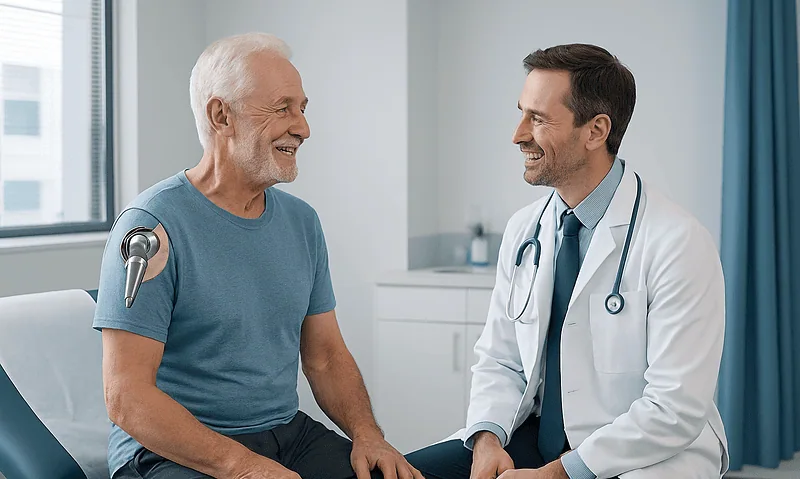
What a Shoulder Prosthesis Can Restore: Realistic Movement, Strength and Overhead Reach
A shoulder prosthesis usually restores pain-free everyday movement rather than a completely normal shoulder. Most people regain the ability to dress, wash, drive and…