

Sapphire FUE Hair Transplant: What Makes It Different?

Sapphire FUE is a type of FUE hair transplant, not a completely separate method. Its distinguishing feature is the use of sapphire blades to create recipient channels.
Key Takeaways
- Sapphire FUE is a type of FUE hair transplant, not a completely separate method.
- Its distinguishing feature is the use of sapphire blades to create recipient channels.
- Natural-looking results depend more on planning and surgeon experience than on blade material alone.
- It is most often used for pattern hair loss when donor hair is stable and sufficient.
- Recovery is usually similar to standard FUE, with temporary redness, scabbing, and shedding of transplanted hairs.
Sapphire FUE hair transplant is a variation of follicular unit extraction that uses sapphire-tipped blades when creating channels for implanted hair grafts. The main difference is in the recipient-site creation step, which may support precise placement, but results still depend most on patient selection, graft quality, and surgical expertise.
Overview: What Is Sapphire FUE Hair Transplant?
Sapphire FUE hair transplant is a modern hair restoration procedure based on the well-established FUE technique. In FUE, individual hair follicles are removed from a donor area, usually the back or sides of the scalp, and then implanted into thinning or bald areas. In the sapphire variation, the main difference is that the surgeon uses sapphire-tipped blades to create the tiny recipient channels where the grafts are placed.
This means Sapphire FUE is best understood as a refinement of FUE hair transplant rather than a completely different operation. The extraction step is still performed with FUE principles, and the overall goals remain the same: to move healthy follicles to areas of hair loss in a way that looks natural and suits the person’s facial proportions, age, and hair characteristics.
People often consider Sapphire FUE for male or female pattern hair loss, hairline lowering, temple filling, or scar camouflage in selected cases. It is not suitable for every cause of shedding. For example, autoimmune hair loss such as alopecia areata usually needs medical evaluation before any transplant is considered, because active disease may affect results.
What Makes It Different From Standard FUE?
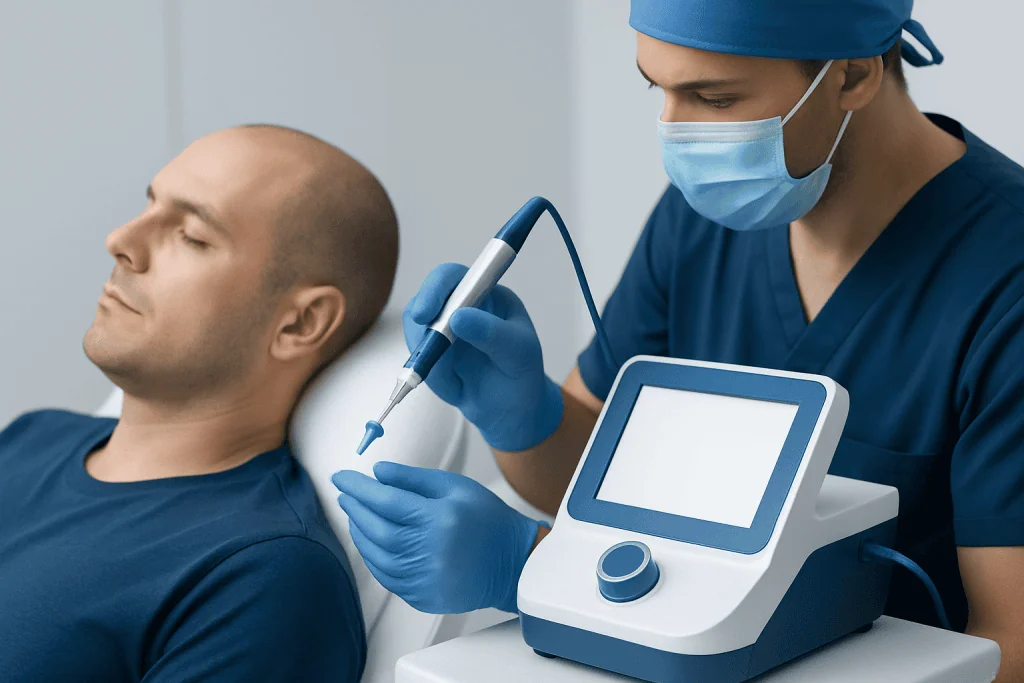
The defining difference in Sapphire FUE is the blade used to open recipient sites. Traditional channel creation may be done with steel blades or needles, while Sapphire FUE uses blades made with sapphire tips. These blades are very sharp and can be designed in fine sizes, which may help the surgeon create small, controlled incisions tailored to the angle and direction of natural hair growth.
In practical terms, this can support careful graft placement, especially in the frontal hairline and other visible areas where natural orientation matters most. A well-planned channel pattern helps determine density, direction, and the final cosmetic appearance. However, blade material alone does not guarantee a better result. The surgeon’s understanding of hairline design, donor management, and graft handling remains far more important.
Patients may also hear Sapphire FUE compared with DHI hair transplant. In DHI, grafts are often placed with an implanter pen that can combine channel creation and implantation. Sapphire FUE and DHI are both accepted techniques, but they differ in workflow, tools, and which situations they may suit best. The right choice depends on the scalp, the pattern of hair loss, the number of grafts needed, and the medical team’s expertise.
Who May Be a Good Candidate?

A good candidate for Sapphire FUE usually has stable pattern hair loss, enough donor hair, and realistic expectations about what a transplant can achieve. The procedure redistributes existing hair rather than creating new follicles, so donor supply is always limited. People with a strong donor area and localized thinning or recession often benefit most.
Evaluation should include the cause of hair loss, scalp health, hair caliber, curl pattern, contrast between hair and skin color, and the likely future progression of thinning. Some scalp conditions may need treatment first. For example, active inflammation from seborrheic dermatitis or severe scaling can affect comfort, healing, and planning if not controlled before surgery.
Not everyone with hair loss is ready for transplantation. Patients with sudden diffuse shedding, untreated hormonal or nutritional issues, active scalp disease, or unrealistic expectations may be advised to delay surgery and consider non-surgical hair restoration first. In women, assessment can be especially important because the pattern of hair thinning may be more diffuse, and options such as hair transplant for women are selected carefully on an individual basis.
How the Procedure Is Performed
The process usually begins with consultation, scalp examination, and planning. The clinician reviews the pattern of hair loss, donor capacity, medical history, medications, and expectations. Photographs may be taken, and the new hairline or treatment zones are marked. Good planning is essential because transplanted hair should continue to look natural as the person ages and as non-transplanted hair may continue to thin.
On the day of the procedure, the donor area is prepared and local anesthesia is used. Individual follicular units are extracted with a small punch, then sorted and preserved carefully. Next, the surgeon creates recipient channels in the target area using sapphire blades. These channels are made with attention to depth, angle, direction, and spacing so that the grafts can sit securely and mimic natural hair growth.
Finally, the follicular grafts are implanted into the prepared sites. Depending on the number of grafts, the procedure can take several hours. Some centers may discuss related options such as sapphire transplant for scalp restoration or other personalized hair procedures. The exact approach depends on the treatment plan, donor hair quality, and whether the goal is a hairline, crown, density improvement, or revision of earlier work.
Benefits, Limits, and Expected Results
The potential advantages of Sapphire FUE are linked to precision in recipient-site creation. Smaller and well-shaped channels may help with accurate placement and a refined hairline design. Some patients and clinicians also value the technique because it can support dense packing in selected areas when done carefully and when graft quality is good. For many people, the appeal is the possibility of a natural-looking result with minimal linear scarring, since FUE does not involve removing a strip of scalp.
At the same time, it is important to keep expectations realistic. No transplant can recreate the exact density of a full, untouched scalp, and a transplant does not stop future native hair loss. The final appearance depends on many factors, including hair thickness, curl, color contrast, donor reserves, and whether medications or supportive treatments are used to help preserve existing hair.
Results also take time. Newly transplanted hairs often shed in the first weeks, which is a normal part of the cycle. Early growth may begin after several months, while fuller maturation usually develops gradually over 9 to 12 months, and sometimes longer for the crown. People considering correction of an earlier unsuccessful procedure may need a separate assessment, and in some cases hair transplant repair may be discussed.
Recovery and Aftercare
Recovery after Sapphire FUE is generally similar to recovery after standard FUE. Mild swelling, redness, tenderness, and small scabs are common in the first days. The medical team usually gives instructions about sleeping position, washing the scalp, avoiding rubbing or scratching, and limiting strenuous activity for a short period. Following these instructions carefully helps protect the grafts during the early healing phase.
Most people can resume light daily activities relatively soon, but the exact timeline varies by the extent of the procedure and the doctor’s guidance. The transplanted area should be treated gently, and direct sun exposure, smoking, and intense exercise are often restricted temporarily because they may interfere with healing. Any prescribed products or medications should be used exactly as advised.
Shock loss, or temporary shedding of transplanted and nearby existing hair, can happen and does not necessarily mean the transplant has failed. Patience is important, because cosmetic improvement develops slowly. Regular follow-up visits allow the team to monitor healing, answer questions, and discuss whether supportive therapies such as medical treatment or low-level light approaches might help maintain surrounding hair.
Possible Risks and When to Seek Medical Advice
Like any surgical procedure, Sapphire FUE has possible risks. These can include bleeding, infection, prolonged redness, swelling, discomfort, folliculitis, numbness, poor graft growth, or an unnatural appearance if planning or technique is inadequate. Donor-area overharvesting is another important concern, because it can leave the back or sides of the scalp looking thinned if too many follicles are removed.
Choosing an experienced medical team and having a proper assessment are key parts of risk reduction. Patients should also tell their doctor about smoking, chronic illnesses, previous scalp procedures, and any medicines or supplements they use. Scalp conditions that cause irritation or scarring may require special care; for instance, people prone to thick scar formation may need discussion about individual healing tendencies, especially if there is a history related to keloid formation.
Medical advice should be sought promptly if there is increasing pain, spreading redness, fever, pus, a bad smell from the scalp, significant bleeding, or swelling that seems to worsen rather than improve. A consultation is also important if hair loss is sudden, patchy, or accompanied by itching, scaling, or inflammation, because a medical condition may need treatment before a transplant is appropriate. Near the end of the journey, some international patients choose centers such as Acibadem International, where multidisciplinary specialists in JCI-accredited hospitals evaluate and treat hair loss and hair restoration needs.
Frequently asked questions
Is Sapphire FUE better than regular FUE?
Sapphire FUE is a variation of regular FUE, with the main difference being the sapphire blade used to create recipient channels. It may help with precise site creation, but the overall outcome depends much more on surgical planning, graft handling, and the experience of the medical team.
Does Sapphire FUE leave scars?
Like all hair transplants, Sapphire FUE involves some degree of scarring, but FUE usually leaves tiny dot-like marks rather than a long linear scar. These marks are often difficult to notice once the surrounding hair grows, although visibility depends on hairstyle, skin type, and healing.
How long does it take to see results after Sapphire FUE?
Transplanted hairs commonly shed in the first weeks after the procedure, which is expected. New growth usually starts after several months, and fuller results generally become clearer between 9 and 12 months, sometimes longer in certain areas such as the crown.
Is Sapphire FUE painful?
The procedure is usually done under local anesthesia, so patients typically feel limited pain during the operation itself. Mild soreness, tightness, or tenderness can occur afterward, but this is usually manageable with the aftercare plan recommended by the doctor.
Can women have Sapphire FUE hair transplant?
Yes, some women may be suitable candidates, especially when hair loss is localized and the donor area is strong. A careful medical assessment is important because female hair thinning can be diffuse, and not every type of hair loss responds well to transplantation.
Will the transplanted hair fall out again?
Transplanted follicles are usually taken from areas that are less affected by pattern hair loss, so they often continue to grow in their new location. However, non-transplanted native hair may still thin over time, which is why long-term follow-up and supportive treatment may be recommended.
References
- American Academy of Dermatology
- International Society of Hair Restoration Surgery
- National Institute of Arthritis and Musculoskeletal and Skin Diseases
- Mayo Clinic
- British Association of Dermatologists
This article is for general information only and is not a substitute for professional medical advice. Please consult a qualified doctor about your individual situation.
FUE Hair Transplant in Turkey — costs, top hospitals & a free quote
JCI-accredited · board-certified surgeons · reply within 24h
Add us as a Preferred Source to see more of our trusted health content across Google Search, AI Overviews and Discover.

Hair Transplant
Modern FUE and DHI hair restoration with natural, lasting results.
Related Treatments
Related Conditions
More from the Health Library



Related Specialists

Prof. Dr. Sedef Şahin
Dermatology
Prof. Dr. Özlem Dicle
Dermatology
Prof. Dr. Emel Öztürk Durmaz
Dermatology
Assoc. Prof. Dr. Yasemin Koyuncu
Dermatology