

Hair Transplant Before and After: What Results to Expect

A hair transplant usually needs time, and final results often take 9 to 12 months to assess. Temporary shedding of transplanted hairs is common in the first weeks after the procedure.
Key Takeaways
- A hair transplant usually needs time, and final results often take 9 to 12 months to assess.
- Temporary shedding of transplanted hairs is common in the first weeks after the procedure.
- Natural-looking results depend on donor hair quality, technique, surgeon planning, and realistic expectations.
- Not every type of hair loss is suitable for transplantation, so diagnosis matters before treatment.
- Careful aftercare helps protect grafts, support healing, and improve the overall cosmetic outcome.
Hair transplant before and after results develop in stages rather than overnight. Most people see shedding first, then gradual regrowth, with clearer density and shape appearing over several months.
Overview: what hair transplant before and after really means
The phrase hair transplant before and after often suggests a simple comparison between two photos. In reality, the change is a process that unfolds over time. A hair transplant moves healthy hair follicles, usually from the back or sides of the scalp, to areas affected by thinning or baldness. Those follicles then go through healing, resting, and regrowth phases before visible improvement becomes clear.
Before the procedure, doctors evaluate the pattern of hair loss, scalp health, donor hair supply, hair texture, and the person’s long-term expectations. Good planning is essential because the goal is not only to fill today’s thinning areas, but also to create a natural hairline and density that still looks balanced as a person ages.
After the procedure, it is normal for the scalp to look different at each stage. There may be redness, tiny crusts, temporary shedding, and then slow new growth. This can be reassuring to understand in advance, because early changes do not reflect the final result. For many patients, the most important part of the journey is patience.
Modern techniques such as FUE hair transplant and DHI hair transplant are designed to place grafts carefully for a natural appearance. The best approach depends on the individual’s pattern of loss, hairstyle goals, and medical assessment.
What to expect before a hair transplant
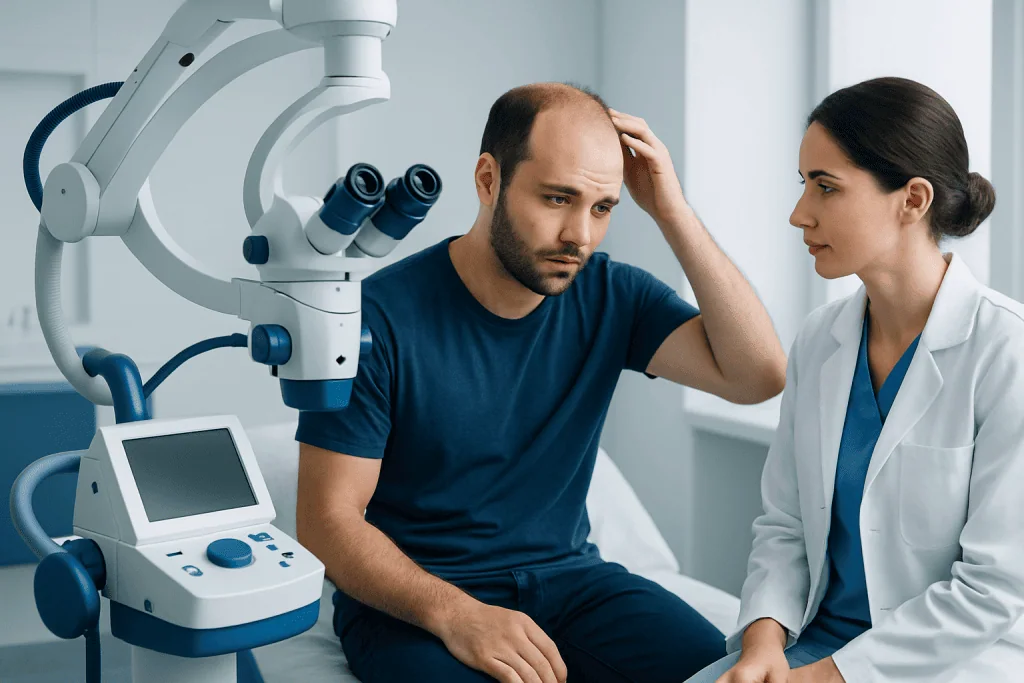
Before surgery, the consultation helps determine whether a person is a good candidate. Hair transplantation tends to work best for stable pattern hair loss, especially androgenetic alopecia, when there is enough donor hair available. It may be less suitable if hair loss is rapidly progressing, diffuse, or caused by an untreated scalp disease.
The doctor usually reviews medical history, medications, family history of hair loss, and any prior scalp procedures. The scalp is examined for inflammation, scarring, infection, or skin conditions that could affect healing or graft survival. Conditions such as seborrheic dermatitis or alopecia areata may need diagnosis and treatment before surgery is considered.
Patients are also guided on practical preparation. This may include avoiding smoking if possible, discussing blood-thinning medicines or supplements with the doctor, and following instructions about washing the hair before the procedure. Some people choose options such as hair transplant without shaving when appropriate for their hairstyle or personal preference.
Just as important, the surgeon and patient should agree on realistic goals. A transplant can improve fullness and frame the face, but it does not usually recreate the hair density someone had as a teenager. The quality of the before and after result depends on matching expectations to what the donor area can safely provide.
The after timeline: from the first days to final growth

In the first few days after a hair transplant, the scalp may feel tender, tight, or mildly swollen. Tiny scabs form around the grafts, and the transplanted area may look more densely covered than it will later. This stage is temporary and reflects healing rather than permanent growth.
During the first two to eight weeks, many transplanted hairs shed. This is often called shock shedding, and it is a normal part of the cycle. The follicles remain in the scalp, but the hair shafts fall out before new hairs begin to grow. This stage can worry patients, but it usually does not mean the transplant has failed.
New growth commonly starts around the third or fourth month, though timing varies. At first, the hairs may be fine, uneven, or lighter in texture. By months six to nine, coverage usually becomes more noticeable, and by nine to twelve months the result is often much clearer. Crown areas may take even longer to mature fully.
Because progress is gradual, before and after photos are most meaningful when taken under similar lighting and at consistent intervals. Comparing week-to-week changes can be frustrating, while month-to-month comparison gives a more accurate picture of improvement.
What affects hair transplant results
Several factors shape the final appearance of a transplant. One of the most important is donor hair quality. Thick, healthy donor hair with favorable texture or curl can create the impression of better coverage. In contrast, limited donor supply may restrict how much density can be achieved safely.
The pattern and cause of hair loss also matter. People with classic male or female pattern hair loss may be good candidates, while those with scarring alopecia or uncontrolled inflammatory scalp conditions need careful evaluation. If there is underlying scalp irritation or skin disease, treatment should come first to protect the result.
Technical planning has a major influence as well. The angle, direction, placement, and distribution of grafts all affect whether the result looks natural. Hairline design is especially important because an overly low or unnatural line may not age well. In some cases, further procedures such as hair transplant repair may be considered if a previous transplant produced an unsatisfactory appearance.
General health and habits can play a role in healing. Smoking, poorly controlled medical conditions, and not following aftercare instructions may reduce the quality of recovery. Some people may also benefit from supportive treatments such as non-surgical hair restoration or laser hair therapy when recommended by a doctor.
Recovery, aftercare, and self-care tips
Aftercare is a key part of achieving the best possible before and after result. The transplanted grafts are delicate in the early period, so patients are usually advised to avoid rubbing, scratching, or placing pressure on the scalp. Sleeping with the head elevated for a short time may help reduce swelling, depending on the doctor’s instructions.
Hair washing usually resumes in a specific way recommended by the surgical team. Gentle cleansing helps remove crusts without disturbing grafts. Patients are often told to avoid strenuous exercise, heavy sweating, swimming, saunas, and direct sun exposure for a period after the procedure, because these may irritate the scalp during healing.
It is also important to use only the products and medicines advised by the doctor. Some clinics recommend moisturizers, saline sprays, shampoos, or medications to support recovery and existing hair. If non-transplanted hair is thinning, ongoing treatment may be discussed to help maintain the overall look around the transplanted area.
Self-care after a transplant is not only physical. Emotional expectations matter too. Visible change takes time, and the in-between stages may feel disappointing if a person expects immediate fullness. Clear guidance and regular follow-up can make the process easier and more predictable.
Who is a good candidate and who may need caution
A good candidate for hair transplantation usually has a stable pattern of hair loss, realistic goals, and enough healthy donor hair to redistribute. The procedure may be suitable for men and women, although surgical planning differs between individuals and between patterns of hair thinning. Some women may benefit from specialized assessment and options such as hair transplant for women.
Caution is needed when hair loss is due to active autoimmune disease, infection, scarring disorders, or untreated scalp inflammation. People with conditions that affect wound healing, those prone to abnormal scar formation such as keloid, or those with very limited donor hair may not be ideal candidates. In these situations, a dermatologist or hair restoration specialist can help explore alternatives.
Age is another consideration. Younger patients may still be developing their long-term hair loss pattern, which can make aggressive hairline design less suitable. A conservative, future-oriented plan often gives a more natural appearance over time. Older adults may still be candidates if their health, scalp condition, and donor area are appropriate.
Sometimes the best plan is to delay surgery and first treat the underlying cause of shedding or thinning. A proper diagnosis protects both the health of the scalp and the quality of the final cosmetic result.
When to contact a doctor and where to seek care
Most healing changes after a hair transplant are expected, but some symptoms deserve medical review. A patient should contact the treating team if there is increasing pain, marked swelling, spreading redness, pus, fever, or bleeding that does not settle. These signs may suggest infection or another complication that needs prompt attention.
Medical advice is also important if shedding seems severe outside the expected pattern, if the scalp develops persistent itching or inflammation, or if growth appears absent long after the expected timeline. Sometimes the issue is simply slower-than-average progress, but in other cases the doctor may look for scalp disease, poor graft survival, or progression of underlying hair loss.
Choosing an experienced team helps at every stage, from diagnosis to hairline design and follow-up. A center with dermatology, plastic surgery, and hair restoration expertise can evaluate both cosmetic goals and medical causes of thinning. Acibadem International’s multidisciplinary specialists and JCI-accredited hospitals diagnose and treat hair loss and provide hair transplant care for international patients.
Whether a person is considering a first procedure or reviewing an older result, an informed medical consultation is the best way to understand what before and after changes are realistic. Safe planning, appropriate technique, and patience usually make the biggest difference in satisfaction.
Frequently asked questions
How long does it take to see hair transplant results?
Most people do not see final results immediately. New growth often begins around 3 to 4 months, becomes more noticeable by 6 to 9 months, and is commonly assessed more fully around 9 to 12 months. In some areas, especially the crown, maturation may take longer.
Is it normal for transplanted hair to fall out after surgery?
Yes, temporary shedding is common in the first several weeks. This usually affects the hair shaft, while the transplanted follicle remains in place and later begins a new growth cycle. It is a normal part of recovery for many patients.
Will a hair transplant look natural?
A well-planned transplant can look very natural, especially when grafts are placed to match the natural angle, direction, and density of hair. Natural results also depend on the quality of the donor hair and realistic hairline design. Choosing an experienced medical team is important.
Are hair transplant results permanent?
Transplanted follicles are generally selected from areas that are more resistant to pattern hair loss, so they often continue to grow for the long term. However, a transplant does not stop future thinning in the non-transplanted hair. Some people need ongoing medical treatment or a later procedure to maintain overall balance.
Can everyone with hair loss have a hair transplant?
No. Hair transplantation is not suitable for every cause of hair loss. People with active scalp disease, certain autoimmune conditions, scarring alopecia, or very limited donor hair may need other treatments or further evaluation first.
Does a hair transplant work for women too?
It can, but candidacy depends on the type and pattern of hair loss. Women with stable thinning and a suitable donor area may benefit, while diffuse shedding or untreated medical causes should be assessed first. A personalized consultation helps determine the best option.
References
- American Academy of Dermatology
- International Society of Hair Restoration Surgery
- National Health Service
- Mayo Clinic
- MedlinePlus
This article is for general information only and is not a substitute for professional medical advice. Please consult a qualified doctor about your individual situation.
Hair transplant in Turkey — costs, graft counts & a free assessment
JCI-accredited · board-certified surgeons · reply within 24h
Add us as a Preferred Source to see more of our trusted health content across Google Search, AI Overviews and Discover.

Related Treatments
Related Conditions
More from the Health Library



Related Specialists

Prof. Dr. Sedef Şahin
Dermatology
Prof. Dr. Özlem Dicle
Dermatology
Prof. Dr. Emel Öztürk Durmaz
Dermatology
Assoc. Prof. Dr. Yasemin Koyuncu
Dermatology