Lymphoma Fungoides: Symptoms, Causes, and Treatment Options

Mycosis fungoides is a slow-growing skin lymphoma that begins in T-cells and often looks like eczema or psoriasis. It is usually confirmed by skin biopsy, and early-stage disease is often controlled with skin-directed or light-based treatments. See a doctor if a rash persists or keeps returning despite usual treatment.
Key Takeaways
- Lymphoma fungoides is a rare cancer of T-cells that primarily involves the skin.
- Early symptoms often look like common inflammatory skin conditions, which can delay diagnosis.
- Treatment is guided by the stage, extent of skin involvement, symptoms, and overall health.
- Many people with early-stage disease are treated with skin-directed therapies rather than systemic treatment.
- Regular follow-up is important because the condition can change over time.
You’ve been treating the same itchy, scaly patch for months. Creams help a little, then it comes back. Your doctor called it eczema, maybe psoriasis. But it keeps returning.
Sometimes, a rash that behaves this way turns out to be something else. Lymphoma fungoides is the most common type of cutaneous T-cell lymphoma, a cancer that starts in certain white blood cells and mainly affects the skin. It often develops slowly, with rash-like patches or plaques that can resemble eczema or psoriasis, so diagnosis usually relies on a skin biopsy and specialist review.
Overview
Lymphoma fungoides is a rare form of non-Hodgkin lymphoma that begins in T-lymphocytes, a type of white blood cell involved in immune defense. It is the most common subtype of cutaneous T-cell lymphoma, meaning the abnormal cells mainly collect in the skin. In many people, it follows a slow course over years, although the pattern can vary from person to person.
The condition often starts with flat, scaly, discolored patches or thicker raised plaques. Because these skin changes may closely resemble eczema, dermatitis, or psoriasis, lymphoma fungoides can be difficult to recognize early. A careful skin examination, review of symptoms over time, and one or more biopsies are often needed to confirm the diagnosis.
Lymphoma is a cancer, yes — but lymphoma fungoides does not behave like the more aggressive blood cancers. Early-stage disease may remain limited to the skin for a long time, and many patients are managed successfully with treatments applied directly to the skin or with light-based therapy. More advanced disease may involve lymph nodes, blood, or internal organs and usually needs broader treatment planning.
Symptoms and how it may appear on the skin
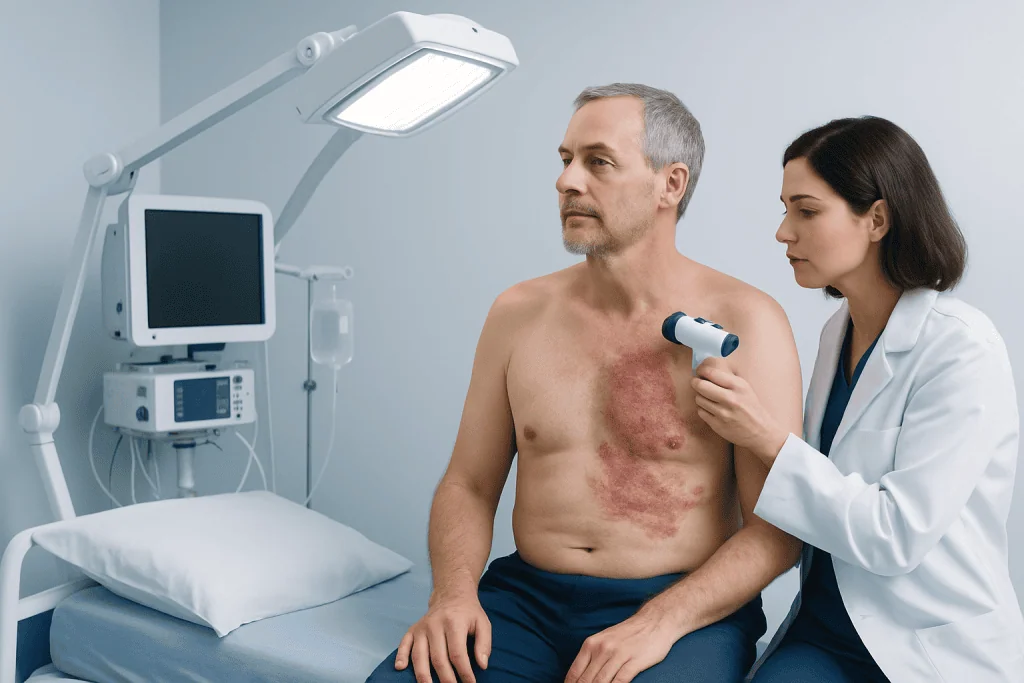
The symptoms of lymphoma fungoides depend on the stage and depth of skin involvement. In the earliest phase, there may be dry, itchy, slightly scaly patches that are lighter or darker than the surrounding skin. These areas often appear on skin that is usually covered by clothing, such as the buttocks, thighs, breasts, or trunk.
Over time, some patches become thicker and form plaques. In later stages, nodules or tumors can develop, and the skin may crack, ooze, or become painful. Itching can be mild or severe and may affect sleep and quality of life. In some people, widespread redness and scaling of the skin can occur, which needs prompt medical evaluation.
Possible features include:
- Persistent rash that does not fully improve with usual skin treatments
- Flat patches that are pink, red, brown, or lighter than nearby skin
- Raised plaques with scaling or dryness
- Itching, burning, or skin tenderness
- Thickened skin on the palms or soles in some cases
- Enlarged lymph nodes in more advanced disease
None of this automatically means cancer. Ordinary skin conditions are far more common. Still, a rash that is long-lasting, unusual in pattern, or repeatedly returns after treatment should be assessed by a dermatologist or hematology-oncology specialist familiar with lymphoma.
Causes and risk factors

The exact cause of lymphoma fungoides is not fully understood. It develops when certain T-cells become abnormal and collect in the skin, but why this happens in one person and not another is usually unclear. It is not considered contagious, and there is no evidence that ordinary contact can spread it from one person to another.
Researchers believe the disease is likely linked to a combination of genetic changes within the affected cells and immune-related factors. These changes usually arise during a person’s lifetime rather than being inherited in a simple way. Most people diagnosed with lymphoma fungoides do not have a strong family history of the condition.
It shows up more often in older adults, and more often in men than in women. However, it can occur in adults of different ages and backgrounds. Having a rash alone does not mean someone is at high risk; the key issue is persistence, progression, and the way the skin findings behave over time.
How lymphoma fungoides is diagnosed and staged
Diagnosis usually begins with a detailed history and skin examination. A doctor will ask how long the rash has been present, whether it comes and goes, what treatments have been tried, and whether there are symptoms such as itching, fever, night sweats, or weight loss. Because the appearance can mimic benign skin disorders, lymphoma fungoides is often diagnosed only after repeated review over time.
The most important test is a skin biopsy. A small sample of skin is examined under the microscope to look for patterns typical of cutaneous T-cell lymphoma. Special laboratory techniques, including immunophenotyping and molecular studies, may be used to identify the type of cells involved. In some cases, more than one biopsy is needed, especially if the earliest samples are not definitive.
If lymphoma fungoides is confirmed or strongly suspected, staging helps guide treatment. This may include blood tests, examination of lymph nodes, and selected imaging studies when there are signs of deeper disease. Some patients may be evaluated with PET-CT imaging or other scans to assess lymph nodes or organs, and occasionally a lymph node biopsy is needed. Staging does not only describe where the disease is located; it also helps estimate how closely follow-up is needed and which therapies are most appropriate.
Treatment options
Treatment for lymphoma fungoides is individualized. Doctors consider the stage, how much of the skin is affected, symptom severity, the speed of progression, and overall health. Early-stage disease is often managed with skin-directed treatment, while more advanced disease may require systemic therapy that treats the whole body.
Skin-directed options may include topical corticosteroids, other prescription creams or gels, localized radiation, or phototherapy using carefully controlled ultraviolet light. These approaches aim to reduce visible lesions, relieve itching, and limit progression while preserving skin comfort. Depending on the pattern of disease, some people also benefit from radiation oncology techniques for limited or thicker lesions.
When the disease is widespread, resistant, or involves lymph nodes, blood, or internal organs, systemic treatment may be recommended. This can include oral medicines, targeted treatments, biologic or immune-based therapy, and in selected cases chemotherapy. Because lymphoma fungoides belongs to the broader group of non-Hodgkin lymphoma, care may involve dermatology, pathology, hematology, and oncology working together to balance disease control with quality of life.
People respond differently. Some people have long periods of stability, while others need therapy changes over time. Follow-up appointments are important to monitor the skin, evaluate for side effects, and detect any shift in stage or symptoms as early as possible.
Living with the condition: self-care and follow-up
What you do for your skin every day supports the medical treatment. Gentle cleansers, regular moisturizing, and avoiding irritants may help reduce dryness, discomfort, and scratching. If itching is troublesome, a doctor may suggest additional strategies to protect sleep and quality of life.
People living with lymphoma fungoides often benefit from keeping a symptom diary or taking photos of skin changes between appointments. This can help specialists see whether patches are stable, spreading, or changing in thickness. It is also useful to note how the skin responds to prescribed treatment and whether there are new symptoms such as enlarged nodes or increasing fatigue.
Don’t overlook the emotional side of this. A long period of uncertainty before diagnosis, repeated biopsies, and the chronic nature of the disease can be stressful. Clear communication with the care team can help patients understand goals of therapy, expected timelines, and when additional tests are needed.
If you are travelling for care, Acibadem International brings together specialists in dermatology, hematology, pathology, and oncology across JCI-accredited hospitals, so your diagnosis and treatment for lymphoma-related conditions are planned as one coordinated plan.
When to seek medical care
See a doctor about any rash that drags on for weeks to months, keeps coming back, or does not respond as expected to standard eczema or psoriasis treatment. A specialist review is especially important if the affected areas are spreading, thickening, or becoming increasingly itchy or painful.
Prompt evaluation is also important if there are signs that the condition may be more extensive, such as swollen lymph nodes, widespread redness of the skin, skin breakdown, recurrent infections, unexplained weight loss, fevers, or night sweats. These symptoms do not always mean advanced disease, but they should not be ignored.
Anyone already diagnosed with lymphoma fungoides should contact their doctor if a treatment suddenly stops helping, if new nodules or tumors appear, or if side effects become difficult to manage. Early reassessment can help the care team adjust therapy safely and maintain the best possible symptom control.
Frequently asked questions
Is lymphoma fungoides a skin cancer or a blood cancer?
Lymphoma fungoides is a type of lymphoma, which is a cancer of white blood cells called lymphocytes. It mainly affects the skin, so it is classified as a cutaneous T-cell lymphoma rather than a typical skin cancer that starts in skin cells.
Can lymphoma fungoides be mistaken for eczema or psoriasis?
Yes. Early lymphoma fungoides often looks very similar to eczema, dermatitis, or psoriasis, which is one reason diagnosis can take time. If a persistent rash does not behave as expected or returns repeatedly, a skin biopsy may be needed.
Does lymphoma fungoides spread quickly?
In many people, lymphoma fungoides grows slowly and may stay limited to the skin for a long time. However, the course is not identical for everyone, so regular follow-up is important to watch for changes.
What is the first test used to diagnose lymphoma fungoides?
The key test is usually a skin biopsy, in which a small sample of affected skin is examined under the microscope. Additional blood tests, imaging, or repeat biopsies may be used if the diagnosis is uncertain or staging is needed.
Is lymphoma fungoides curable?
Treatment can often control the disease very effectively, especially in early stages, but the outlook depends on the stage and how the condition behaves over time. Some people live for many years with stable disease managed through ongoing care.
What treatments are commonly used for lymphoma fungoides?
Common treatments include medicated creams, phototherapy, localized radiation, and systemic medicines for more advanced disease. The best option depends on how much skin is involved, symptom severity, and whether other parts of the body are affected.
This article is for general information only and is not a substitute for professional medical advice. Please consult a qualified doctor about your individual situation.
Lymphoma in Turkey — costs, top hospitals & a free quote
7 JCI-accredited hospitals · board-certified surgeons · reply within 24h
Add us as a Preferred Source to see more of our trusted health content across Google Search, AI Overviews and Discover.

Medically reviewed by the Acıbadem International Medical Board — August 24, 2026
See our medical review board →
Update history
- PublishedAugust 2, 2026
- Medical review approvedAugust 24, 2026
- Last content updateAugust 24, 2026
References2
- Mycosis Fungoides (Including Sézary Syndrome) Treatment (PDQ) – NCI — cancer.gov
- Mycosis fungoides – MedlinePlus Genetics — medlineplus.gov
Medical Oncology Department
Chemotherapy, immunotherapy and targeted therapy planned by a multidisciplinary tumor board — coordinated cancer care across Acibadem's JCI-accredited hospitals.
61 specialists in this unitDermatology Specialists at Acibadem




Related Treatments
Related Conditions
More from the Health Library

Kirkland Minoxidil for Pattern Hair Loss and Regrowth

Lip Eczema Often Traces Back to Irritants or Allergens

Keratosis Treatment Options, From Freezing to Field Creams

Skin Atrophy Means Thinning From Aging, Steroids, or Disease
Boils Often Heal With Warm Compresses, but Some Need Drainage